Wine Rack Organization Systems: Organize Your Collection with a Spreadsheet

*Pictures are renderings. Actual wine racks may look different
What if the hardest part of finding a bottle isn't remembering what you own, but remembering where you put it? Notes, receipts, and memory each capture only part of a collection. A spreadsheet without rack locations can still leave you searching. Well-planned wine rack organization systems connect each bottle's details to its physical place, making your collection easier to browse and manage.
A useful inventory doesn't need to be complicated. Record the details that matter to you, assign clear storage locations, and update the system as bottles come and go. This guide covers useful spreadsheet columns, location formats that match your racks, and ways to keep the inventory manageable as your collection grows. It also explains how storage choices, from wall racks to modular layouts, can work with your tracking method so your records point to bottles you can actually find.
Key Takeaways
- Give each rack area a clear location code so your records can guide you to the bottle, not just describe it.
- Start your spreadsheet with practical fields such as producer, vintage, quantity, and location, then add details that suit your collection.
- Choose between a spreadsheet, paper list, or inventory app based on how you prefer to search and keep records current.
- Build wine rack organization systems around your collection's size, bottle mix, access needs, and display preferences.
- Plan the rack layout and inventory method together, and begin with a manageable portion of your collection before expanding.
Why Wine Rack Organization Systems Need Both an Inventory and a Location Plan
A collection is easier to enjoy when you can answer two questions: what do I own, and where is it? Wine rack organization systems connect inventory details, such as a wine's producer and vintage, with clear physical locations. A list that identifies every bottle but not its place may help you review the collection, but it can still leave you scanning shelves when you want to open one.
A reliable system also helps you spot gaps. If a bottle has been moved, opened, or given away but its record remains unchanged, comparing the inventory with the rack reveals that it needs updating. Retrieval and display are related but distinct goals. A visually striking arrangement might group bottles by color or label, while a retrieval-focused layout uses a location structure you can search and follow.
To see how different rack designs can support various ways of arranging and accessing a collection, consider how physical layout directly influences your daily retrieval routine:
Set the purpose before entering bottle details
Decide whether your first priority is finding a particular bottle, reviewing what you own, planning what to drink, or combining these tasks. Separate the fields needed for those jobs from optional notes. Producer, vintage, and location may be enough for retrieval. Add tasting impressions, purchase details, or occasion notes only if you'll use them. A consistent, manageable level of detail is more useful than an elaborate record you stop maintaining.
Every inventory record needs a physical location, or it can describe a bottle without helping you find it.
Decide how the physical collection should be navigated
Choose a location structure that reflects the room and rack layout. You might identify a rack, then a section and row, or use individual positions when bottles are tightly grouped. The right level of detail depends on how easily you can distinguish one space from another. Make the system clear to anyone who may retrieve a bottle, not just the person who created the spreadsheet.
Use one naming rule throughout. For example, label each rack with a letter and each section with a short, consistent identifier. Avoid switching between descriptive names and improvised abbreviations. Each code should point to one place, not several possible shelves. A simple room sketch can connect the records to the physical arrangement, especially if the cellar has multiple rack areas.
Plan for access as well as storage conditions. A bottle should be easy to locate and kept in an appropriate environment. For an overview of relevant conditions, consult these principles of wine storage as you plan the room and its racks.
How to Structure a Wine Collection Spreadsheet for Easy Searching
A useful spreadsheet starts with a small set of clear fields, not an attempt to document every detail about every bottle. Set up columns around the questions you're likely to ask: What is the wine? Who made it? Which vintage is it? How many bottles remain, and where are they stored? You can add more information later if you find you need it.
The minimum useful wine record identifies the bottle and gives its physical location. Without both, a search may tell you what you own but not help you retrieve it. Keep each type of information in its own column so you can filter by one detail instead of sorting through a block of notes.
Choose the core columns for each bottle
Start with a practical foundation. Adapt these fields to your collection rather than treating every column as mandatory:
- Wine name: Use the label name or a concise identifier that distinguishes similar bottles.
- Producer: Record the winery or maker consistently, including spelling and spacing.
- Vintage: Include it when it helps distinguish bottles or inform your collection decisions.
- Quantity: Enter the number of bottles represented by the record, and adjust it when bottles are opened or added.
- Location: Use the rack identifier that matches your physical layout, so the spreadsheet points to a real storage position.
Decide whether each row will represent one bottle or a group of matching bottles. Individual rows are useful when bottles of the same wine are stored in different places or have different notes. One row with a quantity may be simpler when identical bottles share a location. Whichever approach you choose, apply it consistently so totals and searches remain easy to interpret.
Add optional fields without overwhelming the inventory
Extra columns are useful when they support a decision you actually make. Purchase details can help you review where or when you acquired a bottle. A drinking reminder can bring a bottle to your attention, while a brief tasting note can preserve an impression worth revisiting. Keep notes concise and use separate fields for distinct information, so a search for a producer doesn't have to scan long comments.
Consistency matters as much as the fields themselves. Choose one spelling for each producer, one date format, and one way to enter missing information. Avoid mixing abbreviations with full names or entering quantities as free-text phrases. These habits make sorting and filtering more dependable as the sheet grows. Before adding a column, ask whether it will help you find, review, or manage the collection. If not, leave it out.
If you're planning a new cellar or revising its layout, coordinating the physical design with your inventory approach can make location fields more intuitive. A wine cellar design plan can help bring those storage and organization decisions together.
Spreadsheet, Labels, or Inventory App: Choose a System You Will Maintain
The best record-keeping method is the one that fits how you handle your collection. A spreadsheet lets you sort and filter bottle details, a paper list keeps records simple and close at hand, and an inventory app offers a dedicated digital tool for browsing and updating. Every option still depends on accurate information and a rack layout you can navigate.
| Method | Setup effort | Searching | Update habit |
|---|---|---|---|
| Spreadsheet | Set up fields to suit your collection | Sort or filter by recorded details | Edit as bottles enter, move, or leave |
| Paper list | Start with a simple written format | Scan entries manually | Write changes directly on the list |
| Inventory app | Enter records in the app's format | Search using available inventory tools | Update records in the app |
There isn't one right choice for every collector. Consider how you prefer to add a bottle, look up a detail, and record a change. Choose a tool that supports those routines rather than creating another chore.
When a spreadsheet is a practical fit
A spreadsheet suits collectors who value editable fields and a familiar grid. You can arrange information in columns, then sort or filter entries to review a particular producer, vintage, or rack location. Start with fields you expect to use and keep their meaning consistent. If you prefer to update records on a computer you already use, a spreadsheet may feel straightforward. If you rarely open it, the flexibility won't help much. Choose a structure you can maintain as bottles change.
How physical labels complement digital records
Rack and section labels provide a visible link between the record and the bottle. If your spreadsheet location reads "Rack B, Section 2," use that exact identifier on the corresponding area. Consistent wording lets you move from a search result to a place in the room without translating between naming systems. Labels are navigation aids, not inventory records: they can't identify every bottle or show whether its quantity has changed.
Whatever tool you choose, keep the physical arrangement practical to navigate. A well-planned rack layout gives each location a clear role, while your records direct you to the right area. That connection is central to effective wine rack organization systems, whether you track bottles digitally or on paper. If you're coordinating a cellar layout with a location scheme, a wine cellar design plan can help bring the physical arrangement into focus.
How to Build and Maintain Your Wine Rack Inventory Step by Step
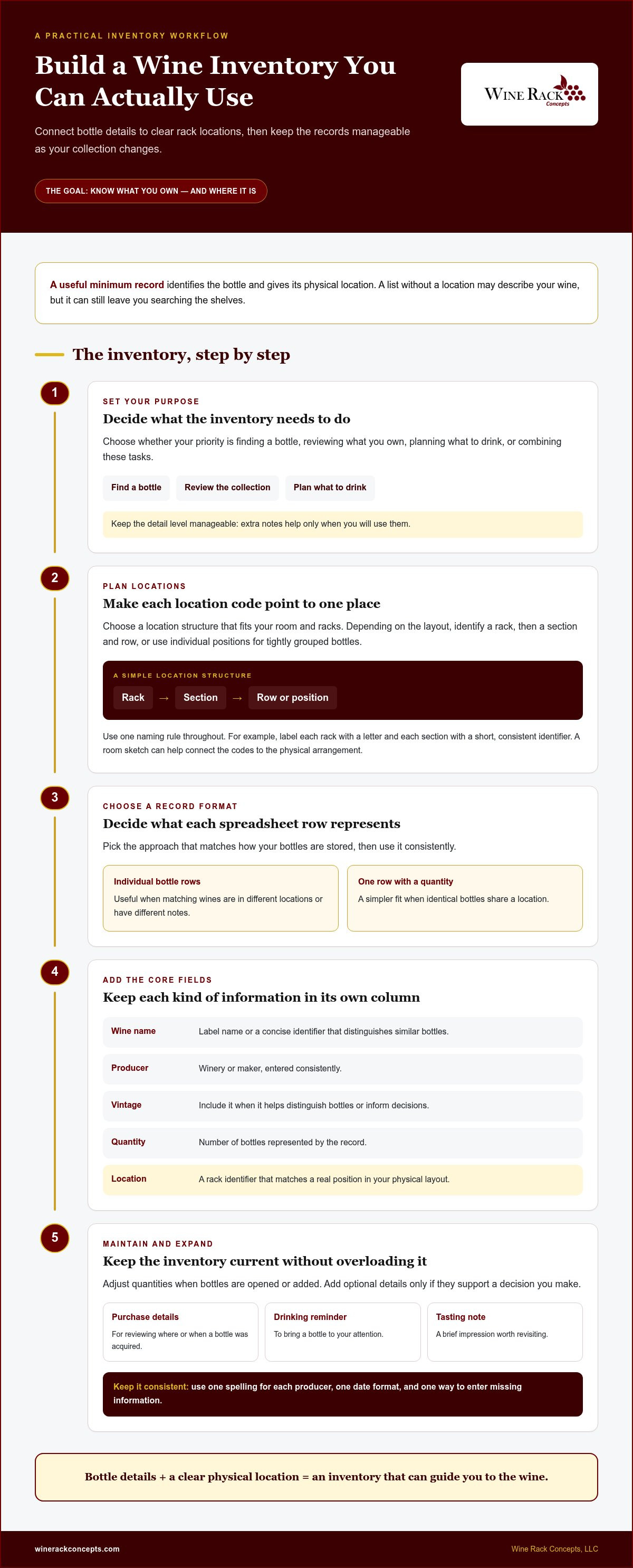
Build a dependable inventory in stages. Instead of documenting every bottle at once, work through one manageable part of the collection, check that the records match the rack, and then expand. This gives you a chance to refine the process before it becomes a larger task.
Create the first accurate version of the inventory
Start with the physical map. Assign readable names to each rack or section, then use those names consistently in the inventory. If an area is labeled "Rack B, Section 2," enter that exact location rather than a shortened version that could mean something else. Clear location codes make the inventory easier to use and help anyone else who needs to find a bottle.
- Define the locations. Choose a simple structure that matches how you move through the storage area, from a whole rack down to a section or individual position as needed.
- Create the columns. Include the identifying details you'll use to distinguish bottles and a location field that connects each record to the rack.
- Enter a manageable group. Begin with one rack, section, or category. Record enough detail to tell similar wines apart, but don't slow the process with notes you may not use.
- Test the records. Search for a few entries, then find those bottles in the storage area. If a result points to an unclear or incorrect spot, refine the naming rule before entering more of the collection.
This trial run checks the system against real bottles. A spreadsheet may look orderly on screen while using vague locations or inconsistent names. Testing it in the storage area helps catch those problems early.
Keep records aligned with changes in the collection
Update the inventory as bottles enter, move, or leave storage. Add new arrivals before putting them away, change the location when you relocate a bottle, and reduce the quantity or remove the record when bottles are opened or gifted. Waiting can make small changes difficult to reconstruct.
Set a review rhythm that suits your habits. You might check the records after putting away new bottles or set aside a regular moment to compare entries with the rack. The useful routine is one you'll follow. During each review, look for incomplete fields, duplicate records, and location names that don't match the labels or layout. Fixing these discrepancies keeps wine rack organization systems reliable as the collection changes.
A rack layout designed around how you store and retrieve bottles can make this workflow easier to maintain. If you're planning a coordinated cellar and storage arrangement, start with free wine cellar design.
Match Your Wine Rack Organization System to the Collection and the Room
The rack layout should reflect both the wine you keep and how you use the room. A compact selection of bottles opened regularly may call for a different arrangement than a varied collection with wines set aside for longer-term aging. Access, visibility, available wall and floor space, and the character of the room all shape how storage zones work together. Aim for a layout that feels considered and remains practical to browse.
Start with the collection you have now. Do you store bottles in a range of shapes and sizes? Do you want frequently chosen wines within easy reach, or prefer a display that makes labels part of the room's design? These preferences can influence the rack and how you group areas, without requiring every bottle to follow the same organizing principle.
Choose a rack approach that supports the way you store wine
Traditional wooden or metal rack layouts can provide clearly defined storage positions that are straightforward to map and navigate. Wall racks can use vertical space and bring bottles into view, while cable and glass systems offer other ways to shape the room's visual presentation. These are different design approaches, not universal solutions. The right fit depends on the collection, the space, and the balance of access and display you want.
Consider how the rack arrangement will work in everyday use. A bottle that's difficult to reach or identify can undermine an otherwise elegant display. If a room combines open presentation with more discreet storage, distinct zones can give each approach a clear purpose. Explore metal wine rack options as one example of how rack style can inform the overall plan.
Plan for a collection that may change over time
Leave room for the layout to adapt. A collection may gain new regions, producers, or bottle formats, and clear, flexible zones can make those changes easier to accommodate. Rather than assigning every space a narrow purpose, consider where additions could fit without disrupting the rest of the arrangement. A coherent physical plan also makes inventory updates easier to understand because location names continue to correspond to recognizable areas.
Think about the room, too. Consider how people enter and move through it, which bottles should be most accessible, and how the rack design will relate to surrounding finishes and features. A custom wine cellar design can bring storage, display, and the wider room into one coordinated plan.
Well-planned wine rack organization systems unite the collection's practical needs with the character of its setting. To develop a coordinated rack and cellar layout, explore free wine cellar design.
Make Your Collection Easier to Enjoy as It Grows
Your inventory can become more than a record of what you own. With a layout that suits the room and how you use it, it can make each bottle easier to find and the collection simpler to enjoy as it changes. The most effective wine rack organization systems leave room for new discoveries without making the collection harder to navigate.
For a residence or commercial space, Wine Rack Concepts, LLC designs custom wine racks and cellars around the room and your collection. The Classic, Carpenter, and Vintner series, along with wall, cable, and glass systems, offer different ways to approach storage and display. The next step is to shape those choices into a layout for your space.
Start planning your wine storage with Wine Rack Concepts, LLC's free design assistance.
Frequently Asked Questions
What should I include in a wine collection spreadsheet?
Include enough detail to distinguish bottles that could otherwise be confused, then add fields that help you make collection decisions. For example, if you own several bottlings from one producer, record the cuvée or another label distinction. You might also add a status field for bottles you plan to serve soon. Keep the sheet focused: a detail is useful if you'll search it, review it, or act on it.
How do I assign locations to bottles in my wine rack?
Choose a location pattern that follows how someone approaches and scans the storage area. For a room with several rack runs, identify each run on a simple floor plan, then name its sections in a consistent direction. Avoid codes that rely on personal memory, such as "the one near the corner." Anyone retrieving a bottle should be able to interpret its location without needing you to translate it.
Can I organize my wine collection with a basic spreadsheet?
Yes. A basic spreadsheet can manage a collection if you can add records, find them, and keep them current. Start with a small sample, then check that the sheet is readable on the device you're likely to use near the cellar. You can print a copy as a paper reference, but treat it as a snapshot and update it when details change.
How often should I update my wine inventory?
Update it whenever you can reliably capture a change, and choose a review rhythm that fits how often you use the collection. If you add several bottles at once, keep the purchase details together until you can enter them rather than relying on memory later. During a review, compare a shelf with the inventory and note any mismatch to resolve. The right cadence depends on your routine.
Is a spreadsheet better than a wine inventory app?
Neither is automatically better. Choose according to how you like to record and consult information. A spreadsheet can be adapted to your own categories, while an app may appeal if you prefer a purpose-built interface or its wine-focused features. Try entering a few representative bottles and searching for them before committing. The best option is the one you'll continue using alongside a clear physical layout.
How can I track bottles that I have opened or removed from storage?
Give bottles a clear status, such as "in cellar," "opened," or "removed," so an old entry isn't mistaken for current stock. If you track matching bottles as a group, reduce the quantity when one is opened and leave the record active while others remain. If you want a history, keep a separate short log of the date and action rather than adding long notes to the main inventory.
Should I organize wine by region, variety, or drinking plans?
Choose the arrangement that best serves how you browse. Region or variety can make sense if you often compare wines by origin or grape. Drinking plans may suit a collection you select from for upcoming meals or occasions. You can use one principle for the physical arrangement and another to search your records. Pick a primary method that feels intuitive, then keep secondary interests searchable in your inventory.
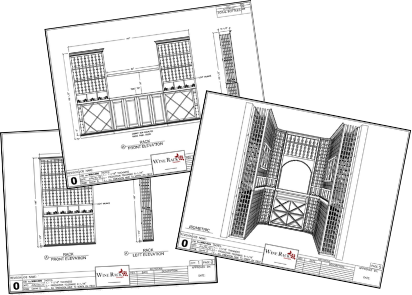
Have an expert help today!
Free 2D wine cellar design