Wine Cellar Ventilation Guide for Basement Conversions

Could a single pocket of stagnant air in your basement be the quiet end of your vintage Bordeaux? While many enthusiasts focus on the aesthetic of the display, the structural integrity of your collection depends entirely on what you can't see. You likely understand that a basement conversion is more than just adding racks; it's about managing the heat and moisture that naturally accumulate in subterranean spaces. Meeting specific wine cellar ventilation requirements is the only way to prevent the mold growth and cooling system strain that can ruin a lifetime of curation.
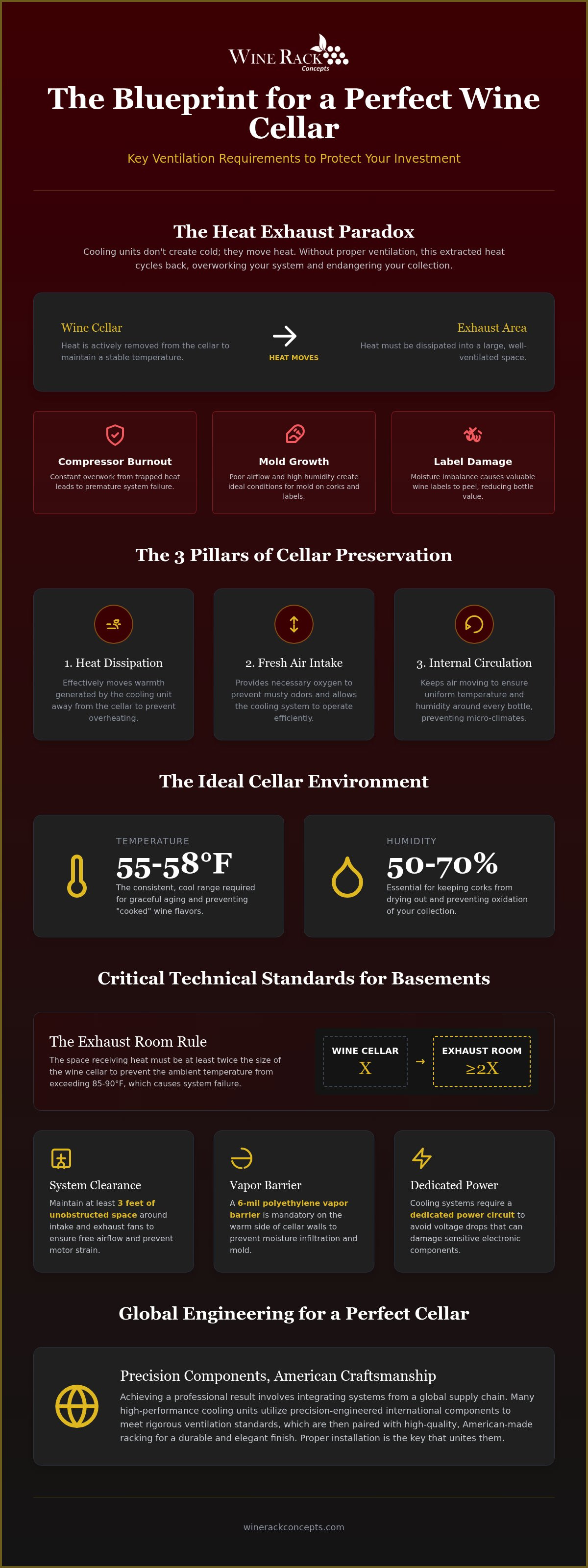
We'll help you master the technical standards needed to protect your investment and ensure your refrigeration operates at peak efficiency. This guide provides a clear blueprint for cellar airflow, from calculating CFM needs to choosing between self-contained units and split systems sourced from global manufacturers. You'll gain the confidence to select the right hardware and install the 6-mil polyethylene vapor barriers required for a stable, mold-free environment. We'll explore how to exhaust heat effectively and maintain the ideal 55 to 58 degree temperature range your wine deserves, all while aligning with the latest 2025 ventilation standards. Whether your components are American-made or imported from specialized international facilities, proper installation is the key to a professional result.
Key Takeaways
- Calculate your basement's specific BTU load to ensure your cooling system can handle the unique thermal challenges of glass walls and subterranean insulation.
- Master the "Exhaust Room Rule" and other wine cellar ventilation requirements to ensure the space receiving heat is large enough to prevent equipment overheating.
- Evaluate the practical trade-offs between through-the-wall units and ducted systems based on your basement's proximity to suitable exhaust zones.
- Navigate the global supply chain with confidence by integrating precision-engineered international cooling components with high-quality, American-made racking.
- Identify the most efficient heat exhaust paths to maintain a stable environment and protect your refrigeration unit from premature failure.
Understanding the Role of Ventilation in Wine Cellar Preservation
Successful wine storage relies on more than just a thermostat setting. True cellar ventilation is the managed exchange of air designed to dissipate heat and maintain air quality within a confined space. If you are converting a basement, you must account for the "Heat Exhaust Paradox." This thermodynamic principle dictates that cooling units don't actually create cold air; instead, they remove heat from the cellar and must deposit it elsewhere. Without meeting specific wine cellar ventilation requirements, that heat simply cycles back into the system, forcing the machinery to work harder until it fails prematurely.
A functional system rests on three essential pillars. First, heat dissipation ensures that the warmth pulled from your collection is moved to a well-ventilated exhaust area. Second, fresh air intake provides the oxygen levels necessary to prevent musty odors from settling into the room. Third, internal circulation keeps air moving around every bottle to ensure uniform cooling. By Understanding Wine Cellars and their active cooling needs, you can avoid the common pitfalls of poor design. Neglecting these pillars leads to severe consequences, including compressor burnout, the growth of mold on corks, and the gradual peeling of valuable labels due to moisture imbalance.
Why Basements Present Unique Ventilation Challenges
Subterranean spaces are inherently shielded from natural airflow, which creates a unique set of obstacles for collectors. Because basements are surrounded by earth, they often lack the pressure differentials that drive air movement in above-ground rooms. Stagnant air is the primary enemy here. It leads to the formation of micro-climates where localized "hot spots" develop behind your racks, even if the center of the room feels cool. Additionally, basement humidity can fluctuate significantly. If your ventilation system isn't sized to handle the moisture load typical of below-grade construction, the cooling unit will struggle to maintain the 50 to 70 percent humidity range required for long-term aging.
The Interplay Between Ventilation and Temperature Stability
Proper airflow is the only way to prevent "stratification," a phenomenon where warm air gathers at the ceiling while cold air sinks to the floor. This temperature variance can be as much as five degrees in a poorly ventilated room. To achieve a consistent 55°F environment, you must calculate the Cubic Feet per Minute (CFM) required for your specific square footage. This calculation is heavily influenced by the thermal mass of your collection, which is the total volume of liquid and glass that retains temperature and resists rapid changes in the air. While some components like our Vintner or Carpenter series racks are crafted in the United States, many high-performance cooling systems utilize precision parts engineered in international facilities. This global sourcing ensures that the internal fans and compressors meet the rigorous wine cellar ventilation requirements needed to protect your investment over several decades.
Technical Ventilation Requirements: Exhaust, Intake, and Airflow
Basements present a unique challenge because heat cannot simply vanish into the earth. If you choose a self-contained refrigeration unit for your project, you must follow the "Exhaust Room Rule." This technical standard requires the space receiving the heat exhaust to be at least twice the size of the wine cellar itself. If the exhaust room is too small, it will quickly exceed the maximum temperature limit of 85°F to 90°F. When this happens, the cooling unit loses its ability to shed heat, leading to a cycle of inefficiency and eventual hardware failure. Proper planning ensures your wine cellar ventilation requirements are met before the first bottle is placed.
Clearance is another critical factor for system longevity. You should maintain at least three feet of unobstructed space around both the intake and exhaust fans. This ensures that air can move freely without creating backpressure that strains the motor. Additionally, these systems require a dedicated power circuit. Sharing a circuit with other basement appliances can lead to voltage drops that damage sensitive electronic controllers. For those in the early planning stages, consulting with an expert on custom wine cellar integration can prevent these technical oversights and ensure your hardware operates as intended.
Calculating Airflow Needs (CFM) for Your Cellar
To determine your required airflow, you must consider more than just square footage. A basic formula involves multiplying the cubic footage of your cellar by the desired air exchange rate, but bottle density changes the equation. High-capacity racking, such as our Vintner series, increases the number of bottles in a small area and creates more resistance to airflow. This necessitates a higher CFM (Cubic Feet per Minute) rating to ensure cold air reaches the back of every rack. Factors like uninsulated basement walls or large glass doors also increase the load on your fans. Effective basement moisture control is equally vital, as high humidity can force the ventilation system to work harder to prevent condensation on cooling coils.
Fresh Air Intake vs. Recirculation
While introducing fresh outside air can improve air quality, it often brings unwanted humidity into a subterranean space. Most modern designs rely on recirculation combined with high-quality carbon filters. These filters are essential for long-term aging because they trap odors that could eventually permeate the cork and affect the wine's profile. To ensure air doesn't stagnate in deep corners, internal fans are often used to push air through dense racking configurations. It is important to recognize that while our wood racking is produced in the United States, the high-performance fans and filtration components are often the result of international engineering. This global approach allows for the most reliable climate control technology to be paired with traditional craftsmanship, fulfilling all wine cellar ventilation requirements for a professional-grade storage environment.
Comparing Ventilation Strategies for Basement Wine Room Conversions
Selecting a cooling strategy requires balancing your basement's physical layout with your long-term storage goals. While we take pride in our American-made racking, it's a reality of the modern industry that high-performance cooling components are global products. Not all essential parts are made in America; many of the most reliable compressors and electronic controllers are imported from international engineering hubs. These specialized parts are designed to meet the rigorous wine cellar ventilation requirements of a luxury home. For enthusiasts embarking on a budget-conscious basement conversion, the through-the-wall (TTW) method is frequently the entry point, though it's vital to evaluate if your space can support the heat output.
Passive vs. Active Ventilation in Basements
Subterranean spaces often have a reputation for being naturally cool, but this environmental trait is rarely sufficient for a serious collection. Passive ventilation relies on natural air convection, which fails in high-density basement cellars where bottle counts are high. Active ventilation uses mechanical air movement to ensure temperature stability. Relying on the basement's ambient temperature without mechanical support invites fluctuations that can age wine prematurely. Active systems are essential for maintaining the specific 55°F environment required for proper maturation, especially when you consider the humidity challenges inherent in below-grade construction.
Self-Contained Units vs. Ducted Split Systems
Self Contained Refrigeration Units, often called through-the-wall units, are ideal for closet-to-cellar conversions. These systems house the compressor and evaporator in one housing, making them easier to install if an adjacent exhaust room is available. If your basement layout places the cellar far from a suitable exhaust zone, a ducted system becomes necessary. These units allow you to hide the mechanical hardware and duct the heat to a remote area or the exterior. For a premium experience, a split system separates the evaporator and condenser, which significantly reduces noise and provides maximum design flexibility. Choosing between these options depends on your structural constraints and whether you prioritize ease of installation or aesthetic integration. Regardless of the hardware's origin, ensuring the system can handle your cellar's BTU load is the only way to fulfill the wine cellar ventilation requirements for a professional-grade storage environment.
Step-by-Step Guide to Planning Your Cellar Ventilation System
A successful installation requires a methodical approach. Start with the math. Calculating the total BTU load is the most critical first step, as you must account for the specific R-value of your basement walls and the thermal loss from any glass features. Without an accurate load calculation, your cooling hardware will either short-cycle or run continuously, both of which shorten the lifespan of the equipment. Identifying the primary heat exhaust path is the next priority. You must determine if the heat will be directed into an adjacent mechanical room or ducted directly to the home's exterior to satisfy the wine cellar ventilation requirements of your project.
Once the load and path are established, select a cooling unit that matches these parameters. It is important to recognize that while our racking is crafted in the United States, high-performance cooling units are often the result of international collaboration. Precision-engineered compressors and fans are frequently imported to ensure the highest reliability, reflecting the global nature of modern manufacturing. After selecting your unit, design the racking layout using our Wall Wine Rack Series or similar configurations. Maintaining a one to two inch air gap behind the bottles is essential for preventing stagnant air pockets. Finally, install a 6-mil polyethylene vapor barrier and high-R-value insulation. This prevents the "sweating" that occurs when warm basement air meets the cooled cellar walls.
Integrating Racking with Airflow Design
The style of racking you choose significantly impacts how air moves through the room. Floating systems, such as our Cable and Glass Wine Racks, offer the least resistance to airflow and allow for maximum visibility. These open designs ensure that the cooled air reaches the center of the collection without being blocked by heavy wooden supports. If your design includes a grand entrance, Metal Wine Cellar Doors with professional-grade weather stripping are necessary to maintain the seal. When arranging your layout, ensure that the racking does not obstruct the supply or return vents of the cooling unit. Proper placement ensures the system doesn't have to work harder to overcome physical barriers within the room.
Testing and Calibrating Your Ventilation
Your work isn't finished once the power is turned on. You must monitor the environment using high-quality hygrometers to track both temperature and humidity levels. A simple smoke or ribbon test can help you identify "dead air" zones where circulation might be lacking. If the ribbon doesn't flutter in a corner, you may need to adjust the angle of your supply vents. Adhering to technical wine cellar ventilation requirements ensures that the environment stabilizes within a 24 to 48 hour window. Avoid the temptation to stock the cellar immediately. Wait until the system proves it can maintain a steady 55°F to 58°F range before introducing your most valuable bottles.
Selecting Components and Cooling Systems for a Balanced Environment
Building a professional grade cellar requires a realistic understanding of the global supply chain. While our Vintner and Carpenter series racks are manufactured in the United States using durable hardwoods, the high performance cooling units that protect them often rely on international engineering. Many of the most advanced compressors and electronic controllers are sourced from specialized global facilities. This combination of American craftsmanship and globally sourced refrigeration tech allows you to meet strict wine cellar ventilation requirements while maintaining a luxury aesthetic. It is a practical approach that ensures you get the most reliable components for your investment.
For many basement projects, Self Contained Refrigeration Units offer the most straightforward path to climate control. These units are designed for easy integration into a wall, housing the evaporator and condenser in a single chassis. They are particularly effective for collectors who want a simplified installation process without extensive ductwork. To complete the thermal envelope, Metal Wine Cellar Doors provide a superior seal compared to standard residential doors. These precision fit doors prevent air leaks that would otherwise force your cooling system to run longer than necessary, ensuring your ventilation strategy remains efficient and your temperatures stay stable.
Material Choices and Their Impact on Humidity
The choice between wood racking series often comes down to the environmental conditions of your basement. The Vintner Series is designed for high density storage and performs exceptionally well in climate controlled environments. If you are dealing with a basement where humidity levels are naturally higher, stainless steel or powder coated metal racking, such as our Fusion Wine Walls or Wine Peg Series, provides excellent moisture resistance. These materials won't warp or degrade when exposed to the 50 to 70 percent humidity required for long term wine aging. It's also vital to use non off gassing finishes on any wood components. In a closed ventilation loop, chemicals from cheap stains can permeate the air and eventually affect the flavor profile of the wine through the cork.
The Final Step: Consulting with a Cellar Design Specialist
Achieving the perfect balance of airflow and temperature requires more than just buying the right parts. Every basement has unique structural constraints that impact wine cellar ventilation requirements. Seeking a professional CAD design ensures that your cooling unit is correctly sized for the BTU load of your specific space. This level of planning avoids the "over cooling" trap, where a unit that is too powerful cycles too frequently and dries out the air. A specialist can help you navigate these technical nuances to create a stable, museum quality environment for your collection. They act as a bridge between your vision and a technically sound reality.
Securing the Future of Your Vintage Collection
Protecting a valuable wine collection requires a precise balance of thermal engineering and quality craftsmanship. By adhering to the "Exhaust Room Rule" and maintaining proper CFM levels, you ensure your basement conversion remains a stable environment for long-term aging. It's a practical reality that while our racking series are made in America, the specialized cooling hardware often relies on precision components from the international marketplace. Fulfilling all wine cellar ventilation requirements is what separates a simple storage room from a professional-grade cellar that preserves your investment for decades.
Professional CAD design and expert climate control integration prevent the common pitfalls of stagnant air and moisture imbalance. Combining our American-made custom racking series with globally sourced refrigeration technology provides a comprehensive design-to-build solution for even the most challenging subterranean spaces. You've curated your collection with care; your storage environment deserves that same level of attention to detail.
We look forward to helping you transform your basement into a world-class showcase for your favorite labels.
Frequently Asked Questions
Does a wine cellar really need outside ventilation?
A wine cellar doesn't strictly require ventilation to the outdoors, but it must exhaust heat to a space significantly larger than the cellar itself. This exhaust area needs enough volume to absorb the heat without rising above 85°F to 90°F. If you can't vent to a large indoor area, ducting to the exterior is the most reliable way to meet technical wine cellar ventilation requirements and protect your collection.
Can I exhaust my wine cellar cooling unit into the same basement room?
You cannot exhaust a cooling unit into the same basement room because it creates a closed heat loop. The unit removes heat from the cellar and dumps it into the basement; if that basement air is then used for intake, the system will overheat and fail. To avoid this, the exhaust space should be at least twice the size of the cellar to allow the heat to dissipate effectively without straining the compressor.
How much space do I need around my cooling unit for proper airflow?
You should maintain at least three feet of unobstructed clearance around both the intake and exhaust fans. This space allows for the high volume air movement necessary to prevent backpressure. If you place racking or storage boxes too close to the unit, the motor will strain to pull in air, leading to higher energy costs and premature failure of the cooling hardware.
What happens if my wine cellar ventilation is blocked?
Blocked ventilation leads to immediate temperature spikes and eventual compressor burnout. When air can't move, moisture builds up on the cooling coils, which can lead to mold growth and severe damage to your wine labels. It's a costly mistake that can be avoided by ensuring your wine cellar ventilation requirements are verified during the initial design and racking installation phase.
Do I need a separate fan if I already have a cooling unit?
A separate internal fan is often beneficial for deep racking systems like our Vintner series to prevent "dead air" zones. While the cooling unit handles the primary air exchange, auxiliary fans help push cold air into the dense corners of the room. This ensures that every bottle in a high density collection remains at a consistent temperature, regardless of its position in the rack.
How do I prevent mold in a basement wine cellar with no windows?
Preventing mold in a windowless basement requires a 6-mil polyethylene vapor barrier and active humidity management. You must seal the warm side of the insulation to keep moisture from migrating into the cooled space. Combining this barrier with a high performance cooling unit ensures that humidity stays within the safe 50 to 70 percent range even without natural airflow.
Is it better to exhaust heat into a crawl space or a mechanical room?
A large mechanical room is generally a better choice than a crawl space for heat exhaust. Crawl spaces are often too confined and humid, which can cause the cooling unit to struggle with moisture load. A mechanical room usually has enough volume and existing airflow to keep exhaust temperatures below the critical 90°F threshold required for equipment longevity and efficiency.
What is the ideal CFM for a 500-bottle basement wine room?
The ideal CFM for a 500-bottle room depends on the cubic footage and the insulation quality rather than just the bottle count. A typical small residential cellar might require between 100 and 300 CFM depending on the total BTU load. You should consult with a specialist to calculate the exact airflow needed to overcome the thermal mass of your specific collection and basement environment.
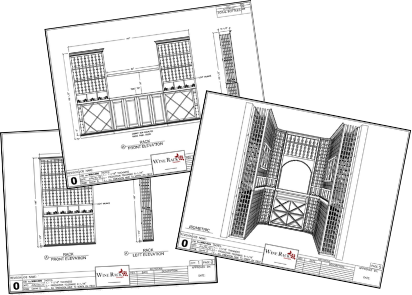
Have an expert help today!
Free 2D wine cellar design