WhisperKOOL Buying Guide: Best Units for Cellars

*Pictures are renderings. Actual wine racks may look different
The most powerful refrigeration unit cannot protect your wine collection if its airflow conflicts with your room's architecture. Preserving fine vintage bottles requires more than just cooling capacity; it demands a deliberate balance between thermal engineering and structural preparation. If you find yourself asking which WhisperKOOL system matches your room volume, ventilation constraints, and noise tolerance, you are addressing the single most critical decision in cellar design.
You have invested thought, time, and care into curating your bottles, and the last thing you want is dry corks, temperature spikes, or intrusive motor rumble leaking into adjoining living spaces. You need consistent, reliable preservation that operates seamlessly behind the scenes.
In this guide, you will discover how to select, size, and integrate the ideal WhisperKOOL cooling system for optimal cellar climate control. We will explore self-contained, split, and ducted configurations, unpack proper vapor barriers and insulation values, and show you how to maintain an effortless 55°F environment that honors both your wine and your aesthetic.
Key Takeaways
- Standard air conditioning strips essential moisture, while dedicated cellar systems maintain a continuous 55°F and balanced humidity to protect cork integrity.
- Selecting the ideal WhisperKOOL configuration requires balancing acoustic preferences and layout constraints across self-contained, split, and ducted systems.
- Accurate system sizing relies on a detailed thermal heat load calculation accounting for glass and insulation, rather than basic cubic footage alone.
- Proper room preparation, including a continuous vapor barrier and high R-value insulation, is vital to prevent condensation and premature cooling failure.
- Aligning your wine racking layout with cooling airflow ensures uniform circulation and eliminates localized warm pockets across your displays.
Why WhisperKOOL Wine Cellar Cooling Systems Protect Fine Collections
Standard air conditioning units are designed to cool living spaces rapidly while extracting moisture for human comfort. In a cellar environment, that process proves catastrophic. When ambient air dries out, natural corks shrink and degrade, allowing oxygen to seep into the bottle and spoil prized vintages. Dedicated wine preservation demands specialized refrigeration that balances sensible heat, or air temperature, with latent heat, or airborne moisture. Maintaining an active wine cellar requires mechanical equipment engineered specifically to preserve both the wine and its closure. WhisperKOOL systems are calibrated to provide stable 55°F cooling while maintaining the atmospheric humidity essential for long-term collection security.
Integrating dedicated refrigeration is an indispensable phase when planning custom wine cellars, ensuring your architectural woodwork and wine investments stay protected. To see how dedicated cooling equipment functions in real-world installations, watch this helpful video:
Stable Climate Control: Preserving Aging Conditions at 55°F
Liquid temperature stability is the cornerstone of proper wine maturation. When ambient room air swings rapidly, the liquid inside the bottle expands and contracts. This physical movement creates internal pressure that can push wine past the cork seal or draw oxygen into the neck. WhisperKOOL systems utilize gradual cooling cycles that protect delicate phenolic flavor compounds from thermal shock. Sustaining a steady 55°F baseline ensures wine matures at a measured, graceful pace, preserving aging potential across decades of cellaring.
Precision Relative Humidity Management for Cork Preservation
Ambient moisture is just as essential as temperature for preserving fine wine. The industry standard calls for relative humidity levels between 50% and 70%. Standard refrigeration coils freeze out air moisture, but specialized wine units employ oversized evaporator coils that operate at higher surface temperatures. This allows the system to chill the air gently without stripping away vital humidity. Keeping corks supple and expanded ensures an airtight seal, safeguarding valuable bottles against cork failure and oxidation.
Evaluating WhisperKOOL System Types for Modern Cellar Architecture
Every cellar project presents a unique combination of volume, wall depth, and acoustic expectations. Selecting the right cooling architecture prevents intrusive motor hum from leaking into adjacent living areas while protecting delicate vintage bottles from mechanical vibration. A high-performance cooling layout must align directly with the room's physical envelope and ventilation access. Proper planning of your cellar infrastructure ensures that your chosen equipment functions efficiently without overtaxing structural components.
Self-Contained Through-the-Wall Systems for Compact Enclosures
Self-contained units house both the compressor and the evaporator coils within a single, self-contained chassis. These systems mount directly through a cutout between standard wall studs, making them an efficient choice for retrofits, reach-in closets, and smaller enclosures. However, they discharge heat and mechanical sound directly out the rear of the unit. This requires an adjacent interior room with adequate cubic volume and ventilation, such as an unfinished basement or mechanical utility room, to absorb the exhaust safely.
Ducted and Split Cooling Systems for Whisper-Quiet Living Areas
When a wine cellar sits adjacent to a dining room, living space, or entertaining area, acoustic isolation is essential. WhisperKOOL split systems decouple the system by locating the condensing unit in an exterior location or remote utility space, connected to the cellar via hidden refrigerant lines. This eliminates motor vibration against the wall studs and removes mechanical noise from living quarters.
Fully ducted systems take concealment one step further. By utilizing insulated ducting to supply cold air and collect return air, all equipment remains hidden outside the cellar perimeter. You only see subtle supply and return grilles blended into the ceiling or millwork. If you are balancing room dimensions with mechanical noise considerations, requesting a complimentary custom cellar layout can help pinpoint the exact line runs and duct placement before framing begins.
Ductless Ceiling Mount Solutions for Restricted Wall Space
For glass-enclosed displays and rooms where every square foot of wall space is dedicated to bottle storage, ceiling-mounted split evaporators provide an elegant solution. These flush-mount panels install cleanly between ceiling joists, keeping vertical surfaces completely unobstructed for racking arrays. By introducing chilled air from above, the system harnesses natural convection; dense cold air descends smoothly through the bottles, creating consistent thermal distribution across every shelf.
How to Accurately Size a WhisperKOOL Cooling Unit for Your Space
Sizing wine cellar refrigeration goes far beyond matching room volume to an equipment label. Calculating dimensions is merely the initial baseline; the true thermal demand rests on environmental heat transmission. Sizing must account for wall construction materials, lighting loads, and the thermal properties of adjacent spaces. To ensure your WhisperKOOL unit operates at a healthy 50% to 70% daily duty cycle, you must calculate total thermal heat gain rather than relying solely on cubic footage.
Calculating Cubic Feet and Thermal Heat Loads
Determining base room volume requires multiplying interior length, width, and ceiling height. While residential cellars commonly fall between 500 and 3,000 cubic feet, this number alone fails to reflect actual performance needs. Thermal assessments examine every surface touching the room perimeter, evaluating insulation density, exterior wall exposure, and concrete subfloors. An accurate calculation establishes the true British Thermal Unit (BTU) requirements needed to overcome steady heat transfer and pull-down loads during seasonal warmth.
Accounting for Glass Enclosures, Ambient Temperatures, and Lighting
Contemporary cellar design frequently incorporates full-height glass panels, which introduce substantial thermal conductance compared to framed, insulated walls. Factoring in architectural elements requires adjusting your cooling requirements across three primary thermal drivers:
- Glass surface area: Even double-paned, argon-filled glass carries an R-value far lower than standard insulated stud walls, transferring ambient room warmth directly into the refrigerated zone.
- Ambient exhaust differential: High-performance cooling lines are rated for a 55°F temperature differential, meaning exterior or exhaust zone conditions directly influence condenser workload.
- Radiant display illumination: Integrated LED lighting strips and accent downlights introduce radiant heat that must be offset during routine operation.
Avoiding Common Undersizing Mistakes and Compressor Fatigue
Choosing an undersized unit forces the mechanical compressor to run without interruption. Continuous operation leads to premature mechanical breakdown, coil icing, and catastrophic temperature spikes during summer heat waves. Conversely, an oversized unit drops room air temperature too rapidly, causing short-cycling; the system shuts off before running long enough to balance atmospheric humidity.
Selecting balanced wine cellar cooling requires evaluating real-world conditions rather than idealized lab ratings. Inadequate wall insulation alone can increase required cooling capacity by 15% to 40%, placing unnecessary strain on mechanical components. Calculating precise thermal heat loads beforehand ensures your equipment maintains a consistent climate effortlessly.

Preparing Cellar Infrastructure: Vapor Barriers, Insulation, and Exhaust
No cooling unit, regardless of horsepower, can overcome flawed room construction. Wine rooms operate at temperature and humidity levels starkly different from the rest of a home. Because nature seeks thermal equilibrium, warm, moist air constantly attempts to push through wall cavities toward your cooled 55°F environment. Without a properly constructed building envelope, this migration leads to severe structural decay. Success begins during the rough carpentry phase, establishing airtight thermal barriers before mechanical cooling ever powers on.
Proper Vapor Barrier Installation to Prevent Condensation
Moisture control demands precision. When humid outside air meets cold interior drywall, it condenses into liquid water inside the wall studs. This concealed moisture fosters toxic mold blooms, rots structural wood, buckles fine cabinetry, and turns prized bottle labels into peeling pulp.
Two proven construction pathways eliminate this risk:
- Continuous 6-mil polyethylene sheeting: Wrapped continuously around the warm exterior side of studs and ceiling joists, with all seams, corners, and electrical cutouts sealed with specialized vapor tape. Framing with 2x6 studs is recommended to achieve the target R-19 wall and R-30 ceiling insulation values.
- Closed-cell spray foam: Applied directly between framing bays, closed-cell foam acts simultaneously as high-density thermal insulation and an impermeable moisture barrier, preventing any air movement through wall cavities.
Managing Heat Exhaust and Adequate Ventilation Pathways
Every BTU of heat extracted from your cellar must be discharged somewhere else. For through-the-wall units and split condensers, ensuring adequate airflow is vital. If your WhisperKOOL condenser exhausts into a confined space where temperatures exceed 85°F, the unit loses heat-exchange capability. This triggers emergency thermal cutoffs, forcing compressor shutdowns and sudden cellar warming.
Planning these airflow paths early prevents costly architectural revisions. Integrating dedicated exhaust ducting to an exterior wall or remote, ventilated mechanical room protects living areas from excess heat. Engaging an experienced design partner for your custom wine cellar design ensures these vital duct paths and structural envelopes are engineered correctly from day one.
Integrating WhisperKOOL Refrigeration with Custom Wine Racking Systems
A wine cellar operates as an integrated thermal ecosystem. Even high-capacity cooling equipment cannot perform properly if surrounding cabinetry chokes its intake or discharge pathways. Effective climate control demands unimpeded airflow circulation through your bottle displays, creating steady convective circulation rather than turbulent dead zones. Aligning mechanical equipment with your custom woodwork and metal displays ensures every shelf maintains the exact conditions your vintages require.
Harmonizing Airflow Patterns with Wood and Metal Wine Racks
Air movement requires open pathways to distribute chilled air evenly across the entire space. When positioning cabinetry, you must leave unobstructed clearance zones around cooling unit supply grilles and return vents. If bottles or solid vertical millwork sit directly in front of the supply discharge, air bounces back into the evaporator coil. This short-circuits the system, falsely signaling that the room reached 55°F while distant corners remain dangerously warm.
Blasting high-velocity cold air directly against solid hardwood racking can dry out timber joints and create finish stress over time. Planning your layout ensures chilled air circulates gently through designated open channels. Modern storage arrays combining clean lines and wine cellar cooling paired with low-profile metal pegs naturally encourage air movement, allowing cold air to sink smoothly through horizontal bottle tiers.
Expert Consultation and Professional Wine Cellar Planning
Architectural cohesion requires planning your mechanical footprint alongside your wine storage capacity before framing starts. WhisperKOOL cooling units demand dedicated condensate drain lines, dedicated electrical circuits, and strategic placement relative to structural framing and display lighting. Attempting to shoehorn cooling equipment into a finished racking layout often results in compromised bottle counts or awkward duct routing.
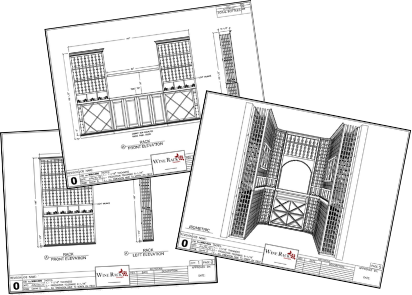
Collaborating with experienced cellar specialists eliminates guesswork during the planning phase. Taking advantage of a free cellar design consultation provides detailed 3D layouts that map out every element in advance. This coordinated approach balances mechanical load with storage aesthetics, ensuring your refrigeration works seamlessly alongside your racking to protect your investment for decades.
Bring Architectural Precision to Your Wine Preservation
A curated collection deserves an environment built with architectural intention. Long-term wine preservation hinges on the harmony between an airtight vapor envelope, unimpeded airflow circulation, and an accurately sized WhisperKOOL cooling system. When master craftsmanship in custom wooden and architectural metal wine racks is supported by precision thermal load calculations, your cellar safeguards both bottle maturation and structural beauty.
Planning your climate-controlled space doesn't have to be daunting. Our team simplifies the technical details, offering complimentary 3D design consultations for residential and commercial wine rooms. With proper engineering, your completed cellar will maintain steady preservation conditions while delivering an elegant showcase you'll take pride in curating for decades to come.
Frequently Asked Questions
How cold does a WhisperKOOL wine cellar cooling unit get?
WhisperKOOL cooling systems are engineered to achieve and maintain an ideal storage range between 50°F and 65°F, with 55°F being the established standard for long-term wine aging. These units shouldn't be treated like residential refrigerators. Forcing them to lower temperatures can strip atmospheric moisture, cause the evaporator coils to ice over, and compromise the natural humidity balance required to keep bottle corks supple.
Can a cooling system be vented into an attic or garage?
Venting directly into an attic or garage is generally discouraged unless that environment stays below 85°F year-round. Attics and unconditioned garages easily trap extreme heat during warmer seasons. Exhausting hot air into an already hot room causes compressor strain, spikes head pressure, and trips thermal safety switches. Exhaust should ideally route into a well-ventilated utility area, a basement, or directly to the exterior using insulated ductwork.
What is the difference between self-contained and split systems?
Self-contained units house the compressor, evaporator coils, and fans inside a single chassis that mounts through a framed wall cutout. In contrast, split systems divide the equipment into two separate assemblies. The quiet evaporator panel mounts inside the cellar, while the noisy compressor sits in an exterior location or remote mechanical space, connected by hidden copper refrigerant lines. Split systems virtually eliminate motor noise and vibration within living areas.
Why is a vapor barrier necessary before installing a wine cooling unit?
A continuous vapor barrier stops warm, humid air from migrating into your chilled cellar environment. Because cold air holds less moisture, water vapor traveling through unsealed wall cavities condenses into liquid water against cool drywall and studs. Over time, this trapped moisture leads to toxic mold growth, structural framing rot, buckled wooden wine racks, and damaged bottle labels. A proper 6-mil plastic barrier or closed-cell foam ensures the room stays completely airtight.
How loud is a WhisperKOOL wine cooling unit during operation?
Sound levels depend heavily on your chosen system architecture. Self-contained through-the-wall models produce an operational hum comparable to a quiet room air conditioner, since the compressor is mounted in the wall. WhisperKOOL split systems and fully ducted configurations, however, are exceptionally quiet within the cellar. By relocating the mechanical compressor to a garage or outdoor pad, living spaces and tasting rooms enjoy tranquil, undisturbed wine storage.
How often does a wine cellar cooling system require regular maintenance?
Dedicated wine cellar cooling systems should undergo routine inspection every three to six months. Standard maintenance involves inspecting and cleaning the air filters, brushing away dust or lint from the condenser coils, and clearing condensate drain lines to prevent clogs. Keeping the coils unobstructed ensures proper heat transfer, maintains optimal energy efficiency, and prevents the compressor from overworking, protecting your refrigeration equipment across years of continuous operation.
Can I install a through-the-wall cooling unit myself?
Competent DIY homeowners with basic carpentry and electrical skills can often install self-contained through-the-wall units. These systems fit between standard wall studs and plug into dedicated wall outlets. However, split and ducted systems require professional installation by a licensed HVAC-R technician to properly braze copper line sets, pull a vacuum, and charge refrigerant. Proper support framing and level mounting remain critical for every installation type.
Have an expert help today!
Free 2D wine cellar design