Under Stair Wine Cellar Design Ideas: Transforming Dead Space into Luxury Storage

*Pictures are renderings. Actual wine racks may look different
What if the most neglected corner of your home could become its most sophisticated architectural feature? Most homeowners look at the awkward, sloped cavity beneath their staircase and see nothing but wasted potential. You might worry about your collection of fine vintages spoiling due to improper temperatures, or perhaps you're simply unsure how to fit standard racks into such a challenging footprint. Creating an under stair wine cellar is the definitive way to reclaim this space while adding significant value and elegance to your property.
You'll soon discover exactly how to turn this unused area into a professional-grade, climate-controlled display that rivals any traditional basement vault. We'll guide you through the technical essentials of insulation and cooling, along with creative design ideas that range from modern metal pegs to timeless wood modules. Whether you envision a sleek glass enclosure or a cozy alcove, you'll find the inspiration and practical steps needed to build a cellar that protects your investment and serves as a stunning centerpiece. From navigating sloped ceilings to selecting specialized racking series, this guide provides the clarity you need to move from vision to installation.
Key Takeaways
- Learn how to transform underutilized dead space into a sophisticated architectural focal point that increases your property's overall market value.
- Understand why professional-grade climate control and vapor barriers are essential to protect your wine collection from damaging temperature fluctuations.
- Explore how modular systems like the Vintner Series and Fusion Wine Walls adapt perfectly to the unique sloped ceilings of an under stair wine cellar.
- Discover the critical first steps of planning, from identifying electrical access points to utilizing professional design services for a precision fit.
Maximizing Potential: Why an Under Stair Wine Cellar is the Ultimate Home Upgrade
Many homes contain a neglected triangular void beneath the staircase that serves as little more than a dusty storage closet for vacuum cleaners or seasonal boxes. Transforming this area into a dedicated under stair wine cellar represents a deliberate shift from simple utility to high-end luxury. It's an opportunity to reclaim "dead space" and turn it into a functional architectural focal point that commands attention. When you move your collection from a hidden basement or a kitchen cupboard into a curated display, the entire atmosphere of your home changes.
Centralizing your wine storage in a main living area adds a layer of convenience that standard cellars often lack. You no longer need to trek to a remote part of the house to select a bottle for dinner. Instead, your collection is exactly where you entertain. This makes the act of choosing and opening a bottle part of the social experience. It fundamentally changes how you interact with your home, moving from a mindset of storage to one of presentation.
The Architectural Impact of Under-Stair Storage
A custom cellar adds incredible visual depth to hallways or foyers. If you opt for glass-enclosed walls and professional lighting, the space becomes a living piece of art. You can use varied materials to match your home's personality. For instance, rich wood finishes offer a sense of timeless tradition. Metal racking provides a sleek, contemporary edge. These elements work together to create a sense of permanence and quality. Consider these design benefits:
- Visual Depth: Glass walls open up narrow corridors, making the home feel more spacious and bright.
- Custom Finishes: Use wood or metal to harmonize with existing flooring, cabinetry, and millwork.
- Lighting: Integrated LEDs turn your bottles into a glowing gallery that highlights your best vintages.
Investment Value and Home Resale Appeal
Luxury wine storage is a top-tier feature for modern homebuyers who value specialized amenities. It signals a level of craftsmanship that sets a property apart in a competitive market. From a financial standpoint, utilizing existing square footage is far more cost-efficient than building a separate room addition. Integrating a custom wine cellar design ensures that the space is technically sound, which is vital for long-term ROI. A professional installation protects your wine and your home's structural integrity, making it a wise and beautiful investment.
Under Stair Wine Cellar Design Styles and Examples
Every home possesses a distinct architectural character, and your wine storage should feel like a seamless extension of that aesthetic. Selecting the right style for an under stair wine cellar involves balancing visual impact with the physical constraints of the sloped ceiling. While some homeowners prefer the warmth of a traditional cellar, others opt for the sharp, clean lines of a modern gallery. If you're unsure which direction to take, exploring how different materials interact with the unique geometry of the staircase can provide the necessary clarity.
Transitional designs have become increasingly popular because they bridge the gap between old-world charm and contemporary precision. These layouts often blend rich wood textures with sleek metal accents to create a layered, sophisticated look. Minimalist peg systems are another excellent choice for tight spaces. Using metal wine racks allows for a floating appearance, where the bottles themselves become the primary design element. This approach is particularly effective in narrow hallways where bulky furniture would feel restrictive.
The Contemporary Glass Wine Room
Frameless glass remains the premier choice for modern, open-concept residences. By removing bulky frames, you maintain clear sightlines across your foyer or dining area, making the home feel larger and more interconnected. Pairing glass walls with the Fusion Wine Wall series creates a high-contrast display that looks like a custom-built installation. Lighting is the final, critical component of this style. We recommend integrated LED systems that highlight bottle labels without emitting harmful UV rays, ensuring your collection stays protected while looking its best. If you want a truly high-tech aesthetic, the Cable and Glass wine rack system offers a "suspended in air" look that is sure to spark conversation.
Classic Wood Racking for Sloped Spaces
For those who value the timeless atmosphere of a classic vineyard, wooden wine racks in mahogany or redwood offer unmatched warmth. The Vintner Series is specifically engineered to handle the challenges of a sloped ceiling. Because it's a modular system, the racks can "step down" in height to follow the exact angle of your staircase. This ensures that no vertical space is wasted and the installation looks perfectly tailored to the room. If your footprint allows for it, you can incorporate a small tasting niche or a decanting tabletop. This turns a simple storage area into a functional destination for enjoying a glass of wine. If you're ready to see how these styles fit your specific dimensions, you can request a custom layout to visualize the final result before the project begins.
Technical Realities: Climate Control and Insulation
An under stair wine cellar is more than just a collection of racks tucked into a corner. While simple shelving might suffice for bottles intended for immediate consumption, a true cellar requires a controlled environment to facilitate long-term aging. This involves maintaining a consistent temperature of 55 to 58 degrees Fahrenheit and humidity levels around 60 percent. Without these technical safeguards, your investment is at the mercy of household temperature fluctuations. Building a wine cellar in a small, sloped area requires more than just aesthetic vision; it demands technical precision.
Small volume spaces present unique challenges for wine cellar cooling. You must account for how the unit will exhaust heat and where the condensation will drain. In a central home location, these logistics must be handled discreetly to maintain the elegance of the space. It isn't just about cooling the air; it's about protecting the structural integrity of your home from moisture and heat buildup.
Refrigeration and Cooling Unit Selection
Self-contained units are often the go-to choice for under-stair applications because they are compact and relatively straightforward to install. However, they require a well-ventilated adjacent room to exhaust heat. If your staircase is in a central living room or foyer, noise becomes a primary factor. You don't want a loud compressor interrupting a dinner conversation. In these scenarios, a ductless split system is often the superior choice. This allows the noisy mechanical components to be located outdoors or in a garage. Adhering to commercial wine cellar refrigeration standards ensures that the unit is sized correctly for the specific thermal load of your sloped walls.
Insulation and Vapor Barrier Standards
Vapor barriers are non-negotiable. When you cool a small space to 55 degrees while the rest of the home is at 72 degrees, condensation will form on the warm side of the wall. Without a proper vapor barrier, this moisture leads to mold and rot within your home's framing. Closed-cell spray foam is the gold standard for an under stair wine cellar. It provides a high R-value even in thin wall cavities and acts as its own vapor barrier. Additionally, your door must be exterior-grade with a tight weather-strip seal. A standard interior door will leak cool air, forcing your cooling unit to work harder and potentially shortening its lifespan.
Choosing the Best Racking System for Sloped Ceilings
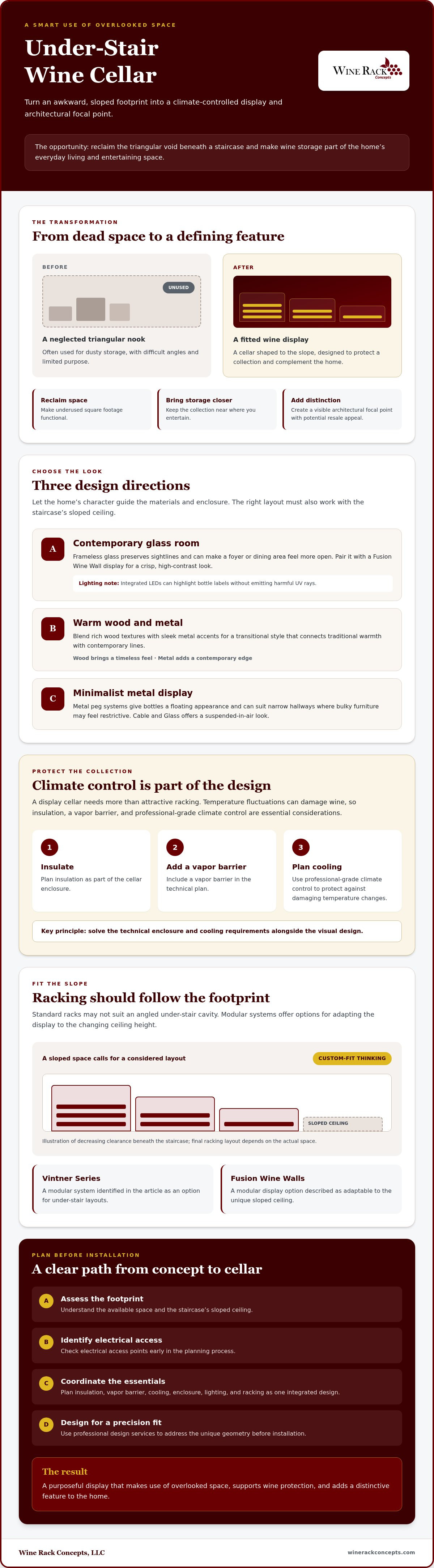
Designing an under stair wine cellar requires a departure from standard storage logic. Because the ceiling height changes with every step, you need a system that adapts to the slope without looking disjointed. Standard kits often leave awkward gaps, but specialized series are designed to step down with precision. This ensures that every cubic inch of the "dead space" is utilized for your collection. The right choice depends on whether you want the cellar to stand out as a modern gallery or blend in with your home's existing furniture.
The Vintner Series is particularly effective for these challenging footprints. It offers modular flexibility that allows you to align the rack heights with the staircase's angle. This creates a tailored look that mimics a fully custom build. For a more modern aesthetic, the Fusion Wine Wall combines metal and wood to provide a sleek, textured backdrop for your bottles. If you prefer a more traditional, integrated look, the Carpenter Series offers a built-in furniture feel that matches high-end home millwork. In the deepest sections of the staircase, you can maximize capacity by using double-deep racking. This allows you to store two bottles in the space of one, which is essential for serious collectors.
Modular vs. Fully Custom Racking
Modular custom wine racks bridge the gap between affordability and bespoke design. They allow for high-capacity storage even in a limited footprint. You can easily mix and match heights to follow the ceiling slope while customizing the wood species and stains to match your existing decor. This approach provides the polished look of a custom project without the extended lead times of a fully bespoke build. It's a practical way to achieve a professional-grade under stair wine cellar that looks like it was planned alongside the house's original construction.
Metal and Cable Systems for Narrow Spaces
When your under-stair area is shallow, the Wine Peg Series is often the best solution. These metal pegs allow for label-forward storage, which is visually striking and highly space-efficient. If you want a truly avant-garde look, consider Cable and Glass Wine Racks. These systems use tensioned cables to make bottles appear as though they're floating in mid-air. The low-profile nature of metal racking is perfect for keeping narrow hallways feeling open and airy while still providing professional-grade protection for your wine.
Planning Your Under Stair Cellar: From Concept to Completion
The journey to a completed under stair wine cellar begins with meticulous preparation. Unlike a standard rectangular room, a sloped area requires three-dimensional accuracy to ensure every rack fits the descending ceiling line perfectly. You'll need to measure the maximum height, the run of the stairs, and the available depth. It's also the time to locate your electrical source and identify where a drainage line can be run for your cooling equipment. These early logistical decisions prevent costly adjustments later in the build. Taking the time to map out these utilities ensures that the finished space functions as a high-performance storage vault rather than just a decorative closet.
Selecting a door is a critical crossroads where aesthetics meets engineering. While a standard glass door looks beautiful, it must be thermal-pane and weather-stripped to maintain the cellar's environment. Metal wine cellar doors offer a high-performance alternative that provides a secure, airtight seal while complementing modern or transitional designs. This choice is vital for protecting your collection from the temperature fluctuations common in central living areas.
The Design and Consultation Phase
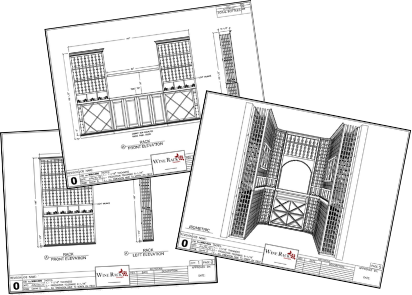
Preparing for your free wine cellar design consultation is the most productive step you can take. We recommend having your rough dimensions and a few photos of the existing space ready. During this phase, you'll balance your desire for maximum bottle capacity with aesthetic features like high-reveal display rows or a small tasting area. Our specialists use these details to create detailed 3D renderings. These visual tools are essential for confirming that the racking steps down at the correct intervals to mirror your staircase's unique slope. It allows you to see the finished project before a single board is cut.
Installation and Final Touches
Once the design is finalized, timeline expectations vary based on whether you've chosen modular components or fully bespoke elements. Modular systems typically offer a faster turnaround, while custom-fit pieces require more time for precision manufacturing. During the physical installation, integrating LED lighting is a priority. These cool-burning lights provide a dramatic glow without adding heat that could stress your cooling unit. The final step is the most rewarding: stocking and organizing your new custom wine cellar. It's helpful to group your collection by region or aging potential, ensuring that every bottle is stored in the optimal position for long-term preservation.
Bringing Your Vision to Life
Transforming that unused space under your stairs is more than a simple home improvement project; it's a deliberate investment in your lifestyle and your property's long-term value. By combining technical precision with high-quality materials, you turn an overlooked corner into a sophisticated architectural gallery. We've explored how specialized racking series like Vintner and Fusion solve the complex puzzle of sloped ceilings while maintaining a polished, professional look. We also established that comprehensive climate control and proper insulation are the essential foundations that protect your vintages for years to come.
Building a high-performance under stair wine cellar allows you to showcase your curation right in the heart of your living space. You're now equipped with the technical knowledge to bridge the gap between an initial concept and a finished, professional result. Whether you prefer a traditional wood finish or a modern glass-enclosed display, the right planning ensures your collection remains protected and beautifully presented.
We look forward to helping you navigate the design process and creating a space that you'll be proud to share with friends and family for many years.
Frequently Asked Questions
Is it worth building a wine cellar under the stairs?
Yes, building an under stair wine cellar is a highly effective way to increase your home's market appeal. It transforms a neglected area into a functional, luxury amenity that serves as a conversation piece. Beyond the aesthetic value, it provides a centralized location for your collection, making it easier to manage and enjoy. This conversion is often more cost-effective than building a separate room addition, as you're working within your home's existing square footage.
How much space do I need for an under stair wine cellar?
You can create a functional under stair wine cellar in a space as small as 25 to 30 square feet. The minimum depth required for standard horizontal bottle storage is approximately 14 inches. If you have more depth, you can utilize double-deep racking to increase capacity. The most important factor is the height at the tallest point of the slope, which should ideally be at least 6 feet to allow for easy access and cooling unit installation.
Do I need a cooling system for a wine cellar under the stairs?
A cooling system is essential if you intend to age wine for more than a few months. While a decorative rack doesn't require climate control, a true cellar must maintain a stable temperature between 55 and 58 degrees. Without a dedicated unit, your wine is exposed to household heat and light, which can lead to premature aging or spoilage. Professional-grade refrigeration ensures your investment remains protected regardless of the season or the home's ambient temperature.
Can I use glass doors for my under stair wine cellar?
Glass doors are a popular choice for creating a modern, gallery-style display. To maintain the cellar's climate, you must use dual-pane, thermal-glass doors that are specifically designed for refrigerated environments. These units prevent condensation and keep the cool air trapped inside. Pairing these doors with high-quality weather stripping ensures that your cooling system doesn't have to work overtime, maintaining the desired temperature while providing a clear view of your collection.
How do I deal with the sloped ceiling when installing wine racks?
The most efficient way to handle a sloped ceiling is to use modular racking systems that can be stepped down in height. Systems like the Vintner Series are designed with varied module heights that follow the angle of the stairs perfectly. This eliminates wasted space and creates a custom, built-in appearance. If the slope is particularly steep or irregular, a professional design service can help you map out the exact placement of each rack to maximize every inch.
What is the best way to insulate a wine cellar under the stairs?
Closed-cell spray foam is the superior insulation method for these compact spaces. It provides a high R-value per inch, which is vital when you're working with thin wall cavities. This material also acts as a built-in vapor barrier, preventing moisture from seeping through the walls and causing mold or structural damage. Proper insulation is the single most important factor in ensuring your cooling unit operates efficiently and your wine remains at a constant temperature.
How many bottles can fit in a typical under stair wine cellar?
A typical conversion can accommodate between 100 and 500 bottles depending on the depth of the staircase. For example, a standard 3-foot wide space with single-deep racking often holds around 200 bottles. If the space is deep enough for double-deep racks, you can effectively double that capacity without changing the footprint. Utilizing every vertical inch under the slope is key to reaching higher bottle counts while maintaining an organized and accessible display.
What kind of lighting is safe for an under stair wine display?
LED lighting is the only safe option for a climate-controlled wine display. Unlike traditional bulbs, LEDs don't emit heat or harmful UV rays that can degrade the quality of your wine over time. You can use integrated LED strips along the racks or recessed puck lights in the ceiling to create a dramatic effect. These systems allow you to illuminate your labels and create a stunning visual focal point without compromising the cellar's internal temperature.
Have an expert help today!
Free 2D wine cellar design