The Professional Guide to Large Wine Collection Storage and High-Capacity Design

*Pictures are renderings. Actual wine racks may look different
*Pictures are renderings. Actual wine racks may look different
A collection that spans thousands of bottles is no longer just a hobby; it's a managed asset that requires the structural engineering of a commercial warehouse and the aesthetic soul of a private gallery. You've likely realized that standard retail racks and consumer-grade cooling units cannot keep pace once your inventory hits this significant scale. It's a common frustration to feel your space shrinking while your passion grows, or to worry if the air at the top of tall racks is as cool as the air at the floor.
Managing large wine collection storage requires a shift in perspective from simple furniture to integrated infrastructure. We understand the unique pressure of protecting a high-value investment while maintaining a space that's a joy to navigate. This guide promises to help you balance high-density racking with the precise climate control needed for large cubic footage. We'll examine the structural integrity of materials like the Vintner or Carpenter series, compare the benefits of metal versus wood for high-capacity loads, and provide a roadmap for a scalable storage plan. By the end, you'll have a clear vision for a cellar that's as secure as it is stunning.
Key Takeaways
- Define the specific design requirements that arise once a collection exceeds 500 bottles and requires dedicated room planning.
- Understand how specialized wood series like Vintner and Carpenter provide the necessary structural integrity for high-capacity, multi-tier loads.
- Learn the technical nuances of cooling large-volume spaces to ensure every vintage stays protected by precise climate stability.
- Discover how to optimize large wine collection storage by integrating metal systems that improve airflow without sacrificing bottle density.
- Follow a professional planning roadmap to transition your vision into a scalable, custom-built cellar that protects your long-term investment.
The Fundamentals of Managing a Large Wine Collection
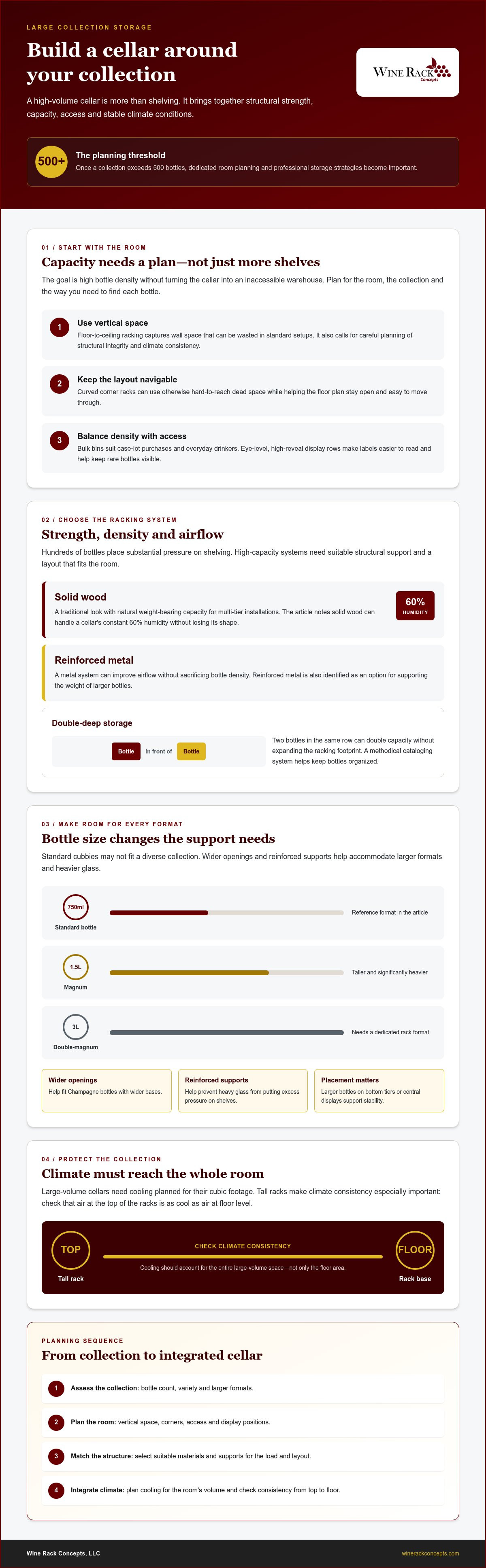
Managing a collection that exceeds 500 bottles requires a shift in mindset. At this scale, you're no longer just looking for a place to put wine; you're engineering a dedicated environment. This volume marks the transition where simple shelving gives way to professional large wine collection storage strategies. The primary goal is to achieve maximum bottle density without turning your cellar into an inaccessible warehouse. You need a system that allows you to see what you have while utilizing every available square inch of the room.
Floor-to-ceiling racking is a non-negotiable element for space optimization in high-volume rooms. By extending the racks to the top of the wall, you capture vertical space that often goes to waste in standard setups. This approach requires careful planning for structural integrity and climate consistency. Because large collections represent a significant investment, most enthusiasts begin with a consultative approach to find custom wine storage solutions that adapt to their specific room dimensions and bottle diversity.
Space Optimization vs. Accessibility
The biggest challenge in a massive cellar is finding the specific vintage you want without moving dozens of other bottles. We solve this by balancing bulk storage with individual racking. Bulk bins are excellent for case-lot purchases or everyday drinkers, but they can hide your rarest gems. To fix this, we integrate high-reveal display rows at eye level. These tilted shelves allow you to read labels clearly while keeping the corks moist.
Corner areas often become "dead space" where bottles are hard to reach. Utilizing curved corner racks ensures a seamless transition between walls, allowing the collection to flow naturally around the room. This layout maintains a high bottle count while keeping the floor plan open and navigable.
Accommodating Large Format Bottles
A diverse collection often includes more than just the standard 750ml bottle. If you collect Champagne, Magnums, or even 3L double-magnums, standard cubbies simply won't work. These larger formats require specialty racking with wider openings and reinforced supports. Champagne bottles have a wider base that can jam in tight racks, while Magnums are both taller and significantly heavier.
- Weight Distribution: Heavy glass puts immense pressure on shelving. We use solid wood or reinforced metal to prevent bowing over time.
- Format Variety: Dedicated 1.5L and 3L racks ensure these bottles are stored horizontally and safely.
- Visual Balance: Placing larger bottles on bottom tiers or in central feature displays provides better structural stability for the entire racking system.
Properly planning for these variations from the start prevents the frustration of "homeless" bottles that don't fit your primary racking system. It's about creating a home for every bottle in your large wine collection storage plan, ensuring that your investment is protected and your display is perfectly organized.
High-Density Racking Systems for Maximum Capacity
To achieve the best large wine collection storage, you need more than just a few shelves. You need engineered systems designed to withstand the immense pressure of hundreds of bottles. When you transition to a collection of significant scale, the structural integrity of your shelving becomes a safety priority. Standard kits often lack the bracing required for thousands of pounds of glass and liquid. For those seeking traditional aesthetics, wooden wine racks offer the necessary durability. Solid wood doesn't just look timeless; it provides the natural weight-bearing capacity needed for multi-tier installations. Unlike composite materials, solid wood handles the constant 60% humidity of a cellar without losing its shape. If you're working with a narrow room but need to maximize bottle count, double-deep racking is an effective strategy. It allows you to store two bottles in the same row, one behind the other. This effectively doubles your capacity without expanding the footprint of the racking itself, though it requires a methodical cataloging system to stay organized.
The Vintner and Carpenter Series
The Vintner series is designed for modularity, allowing you to stack components to reach high ceilings. It's an ideal choice for large wine collection storage because it adapts to varying wall heights and includes specialized components like display rows and corner units. If you prefer a more furniture-grade finish, the Carpenter series offers handcrafted aesthetics that feel bespoke. Both series rely on high-quality materials such as Redwood, Mahogany, and Pine. Redwood and Mahogany are particularly prized for their natural resistance to the cool environment of a cellar. These materials ensure your racks don't warp or degrade over decades of use, providing a stable home for your investment. Choosing between them often comes down to your desired color palette and the specific climate conditions of your room.
Wall-Mounted and Vertical Storage
Verticality is your best friend when floor space is limited. The Wall Wine Rack series allows you to utilize every inch of vertical surface area. These systems are particularly useful for modern designs where you want bottles to appear as if they're floating against the wall. Security is paramount in high-capacity wall installations. Each rack must be anchored to the wall studs to support the cumulative weight of the bottles. A single wall-mounted rack might hold twelve bottles, but a full wall can easily hold hundreds, creating a massive load on the wall's structure. Combining these wall-mounted options with floor-based bins creates a tiered look that is both functional and visually interesting. This hybrid approach allows you to keep bulk cases at the bottom while displaying prized vintages at eye level. If you're unsure which series best fits your room's dimensions, you can start by requesting a professional cellar layout to see how these systems integrate into your space.
Climate Control and Infrastructure for High-Volume Cellars
While the racking provides the physical structure, the cooling system acts as the lifeblood of large wine collection storage. Standard air conditioning is designed to remove humidity and cool air quickly for human comfort, but wine requires a much more delicate touch. A dedicated system maintains a constant 55°F while preserving a 60% humidity level to keep corks from drying out and shrinking. Without this technical precision, the thousands of bottles you've carefully curated are at risk of premature aging or spoilage. To achieve this environment, you must treat the room as a sealed envelope. This involves utilizing high-R-value insulation and a proper vapor barrier on the warm side of the wall to prevent condensation and mold growth from infiltrating your investment.
Integrating self-contained refrigeration units offers a streamlined path for many high-capacity projects. These systems house the evaporator and condenser in a single unit, simplifying the installation process compared to complex split systems. However, the sheer volume of air in a large cellar means the physics of cooling changes. You aren't just cooling air; you're managing the thermal mass of the liquid. Once a room is filled with bottles, it gains thermal stability, but the initial pull-down to the correct temperature requires a system specifically sized for that specific cubic footage.
Sizing Cooling Units for Large Cubic Footage
Calculating the heat load for a high-volume cellar is more complex than measuring square footage alone. You must account for several variables that standard calculators often overlook. If your design includes extensive LED lighting or glass display walls, the heat load increases significantly. For commercial-scale residential cellars, we often recommend redundancy. Installing two smaller wine cellar cooling systems instead of one large unit ensures that if one requires maintenance, the other keeps the temperature stable. Sensor placement is equally critical. We position sensors in high-density corners to avoid "hot spots" where air circulation might be restricted by tightly packed racking.
Metal Cellar Doors and Airtight Seals
The most common point of thermal failure in a large cellar isn't the cooling unit; it's the entrance. Standard interior doors allow far too much heat leakage and humidity transfer. Choosing metal wine cellar doors provides the structural rigidity and airtight seal necessary for long-term climate stability. Our American-made metal frames are engineered with thermal break technology. This prevents the external room temperature from conducting through the metal frame into the cool cellar interior. This allows you to maintain the aesthetic of large, beautiful glass panels while ensuring the thermal integrity of your large wine collection storage remains uncompromised. When paired with an automatic bottom seal, these doors create a vault-like environment that protects your vintages perfectly.
Modern Aesthetics for Large-Scale Displays
High-capacity storage is no longer confined to dark, hidden basements. Many collectors are transitioning from the traditional "hidden cellar" concept toward visible wine walls that serve as the architectural centerpiece of a home. This shift requires a design that balances visual lightness with the density needed for large wine collection storage. While wood provides a classic foundation, incorporating metal wine racks offers a significant advantage in large rooms: improved airflow. In high-density setups, metal systems allow air to circulate more freely around each bottle, which helps the cooling system maintain a uniform temperature across the entire collection. For a truly sophisticated look, cable and glass systems create a "floating" effect, making thousands of bottles appear weightless while maintaining a high-capacity footprint.
The Fusion Wine Wall series represents the pinnacle of hybrid design, blending the organic warmth of wood with the industrial precision of metal. This system allows you to create a textured display that avoids the monolithic look sometimes associated with massive wooden installations. By mixing materials, you can define different zones within your collection, such as separating everyday drinkers from investment-grade vintages through contrasting finishes.
Fusion Wine Walls and Contemporary Design
Design flexibility is the primary benefit of the Fusion series. If you want to break up the visual repetition of a large wall, you can mix horizontal and vertical bottle orientations. This variety doesn't just look better; it helps you organize your inventory by sight. Using these systems to create a focal point in a large room requires careful consideration of the mounting surface. Because a full-scale display can hold hundreds of pounds of wine, these metal components require heavy-duty mounting into wall studs or reinforced backer boards. This ensures the display remains secure while providing the clean, minimalist lines expected in contemporary luxury design.
Wine Pegs and Minimalist High-Density Racking
The Wine Peg series is an excellent solution for collectors who prefer a label-forward display. These pegs allow you to showcase the artwork of your favorite labels rather than just the foil tops. Even with a minimalist footprint, you can achieve a surprisingly high bottle count by using double or triple-deep peg configurations. This approach is particularly effective in narrow corridors or as a backdrop for a tasting area. You can also customize the peg spacing to accommodate diverse bottle shapes, from slender Rieslings to wider Pinot Noir bottles, ensuring every piece of your large wine collection storage fits perfectly within the grid.
Planning Your Custom High-Capacity Storage Project
Planning a project of this magnitude requires a methodical approach that begins long before the first rack is installed. Managing large wine collection storage is a journey that moves from a simple bottle count to a fully engineered environment. It's easy to underestimate the complexity of supporting thousands of pounds of inventory while maintaining strict climate zones. A professional custom wine cellar design serves as the essential roadmap for this transition. It ensures that every structural and environmental requirement is addressed before construction begins. Budgeting for these projects involves balancing the costs of high-density racking, specialized cooling units, and the foundational construction of the room itself. If you're planning for a hospitality space or a massive private estate, consulting with experts on commercial wine cellars provides insights into high-traffic durability and inventory management systems that standard residential plans might overlook.
The Design and Blueprint Phase
CAD drawings are the most powerful tool in the planning phase. They allow you to visualize bottle density and traffic flow in three dimensions. You can see how a ladder system might interact with the racking or where a tasting table fits best. It's vital to account for future collection growth during this stage. If you build exactly for the 1,000 bottles you own today, you'll run out of space the moment you acquire a new case. We typically recommend planning for at least 20% more capacity than your current inventory. This phase is also the time to coordinate with contractors. Your electrician and HVAC technician need precise blueprints to place outlets and ductwork where they won't interfere with the racking layout.
Expert Consultation and Professional Support
Large-scale projects benefit significantly from working with a single-source manufacturer. This eliminates the communication gaps that happen when racking, doors, and cooling units come from different vendors. Leveraging a free design consultation is the best way to avoid costly errors like undersized cooling units or racking that doesn't clear ceiling obstructions. A specialist acts as a master craftsman and a helpful guide, ensuring that your initial vision translates into a professional result. Beyond the installation, professional support ensures you have a clear plan for long-term cooling maintenance. Protecting a significant investment requires a partner who understands the nuances of large wine collection storage and is available to help your cellar evolve as your collection matures.
Securing Your Liquid Legacy
Building a cellar that accommodates thousands of bottles is a significant undertaking that rewards careful planning and technical precision. As your inventory grows, the shift from simple shelving to engineered infrastructure becomes essential for both safety and accessibility. By prioritizing high-density racking like the Vintner series and ensuring your cooling system is perfectly sized for your room's cubic footage, you create a stable environment where your vintages can reach their full potential. Successful large wine collection storage isn't just about finding space; it's about creating a harmonious balance between structural integrity, environmental control, and your personal design aesthetic.
Our team acts as your partner throughout this process, providing a master craftsman's eye for detail and a helpful guide's technical expertise. From professional CAD design services to the selection of thermal-break metal doors, we ensure every component works together to protect your investment. You don't have to navigate these complex decisions alone. A well-designed cellar is more than a storage room; it's a testament to your passion for curation and a beautiful addition to your home or business.
Your collection deserves a space that's as enduring as the vintages it holds. We look forward to helping you transform your vision into a professional reality that brings you pride for years to come.
Frequently Asked Questions
What is the racking for a collection of over 1,000 bottles?
High-density wooden wine racks like the Vintner or Carpenter series are ideal for collections of this scale. These series are engineered to handle the immense weight of a four-figure bottle count while maximizing vertical space. You can stack modular components to reach high ceilings, which is a key strategy for large wine collection storage. Choosing solid wood like Redwood or Mahogany ensures the racks don't warp under the constant pressure of thousands of pounds of wine.
How do I choose between wood and metal for a large wine cellar?
Your choice depends on whether you prioritize traditional structural mass or modern airflow and visibility. Solid wood racking offers a timeless aesthetic and the natural strength required for heavy, multi-tier installations. Conversely, metal wine racks provide a minimalist look and allow for superior air circulation in high-density rooms. Many collectors choose a hybrid approach, using wood for bulk storage and metal for feature walls to create a balanced, functional environment.
Does a large wine collection require a special cooling unit?
Yes, large collections require dedicated wine cellar cooling systems that are specifically sized for the room's cubic footage. Standard residential air conditioners cannot maintain the constant 55°F temperature and 60% humidity necessary for long-term aging. For high-volume spaces, you might even consider redundant units. This setup ensures that if one unit requires maintenance, your entire investment remains protected by the second system, preventing dangerous temperature fluctuations in your cellar.
Can I mix different racking series in one large cellar?
You can certainly mix different racking series to create a more functional and visually interesting space. Combining the modular Vintner series with a contemporary Fusion Wine Wall allows you to balance bulk storage with high-end display areas. This hybrid strategy helps define different zones within your cellar, such as separating your everyday bottles from your investment-grade vintages. It's an effective way to customize your large wine collection storage while maintaining a cohesive professional look.
What are the structural requirements for a high-density wine room?
High-density rooms require reinforced floors, high-R-value insulation, and a complete vapor barrier. A collection of 1,000 bottles can weigh over 3,000 pounds, so your floor must be capable of supporting that concentrated load without settling. Additionally, the walls must be properly sealed to prevent moisture from infiltrating the space. Using a professional custom wine cellar design ensures these foundational elements are addressed before you begin installing your racking or cooling equipment.
How do I store Magnums and large-format bottles in a standard rack?
Standard 750ml racking cubbies aren't wide enough for Magnums, so you must integrate specialty large-format racks into your design. These units feature wider openings and reinforced supports to handle the increased width and weight of 1.5L and 3L bottles. If you try to force these into standard slots, you risk damaging the labels or the rack itself. Placing these heavier bottles on the lower tiers of your racking system provides better overall structural stability.
Is it better to use double-deep racking to save space?
Double-deep racking is an excellent choice if you need to maximize bottle capacity within a narrow room footprint. This configuration allows you to store two bottles in each slot, one behind the other, effectively doubling your inventory count without expanding the rack's width. While it saves significant space, it does make inventory management more complex. We recommend using a digital cataloging system so you always know which bottle is tucked behind the front row.
How much does a custom large-scale wine cellar typically cost?
The cost of a large-scale cellar varies based on the materials, the cooling system's complexity, and the room's existing infrastructure. High-capacity projects involve significant investments in structural wood or metal racking, specialized refrigeration units, and airtight metal doors. Because every space is unique, we provide a free design consultation to help you understand the requirements of your specific project. This process allows you to balance your aesthetic goals with the technical needs of your collection.
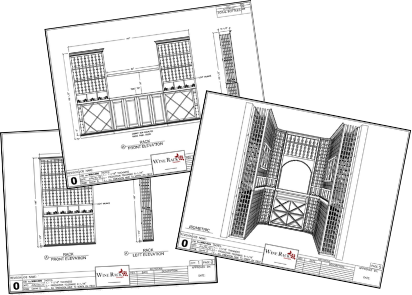
Have an expert help today!
Free 2D wine cellar design