The Architect’s Guide to Wine Peg Racking Systems: Design, Engineering, and Style

*Pictures are renderings. Actual wine racks may look different
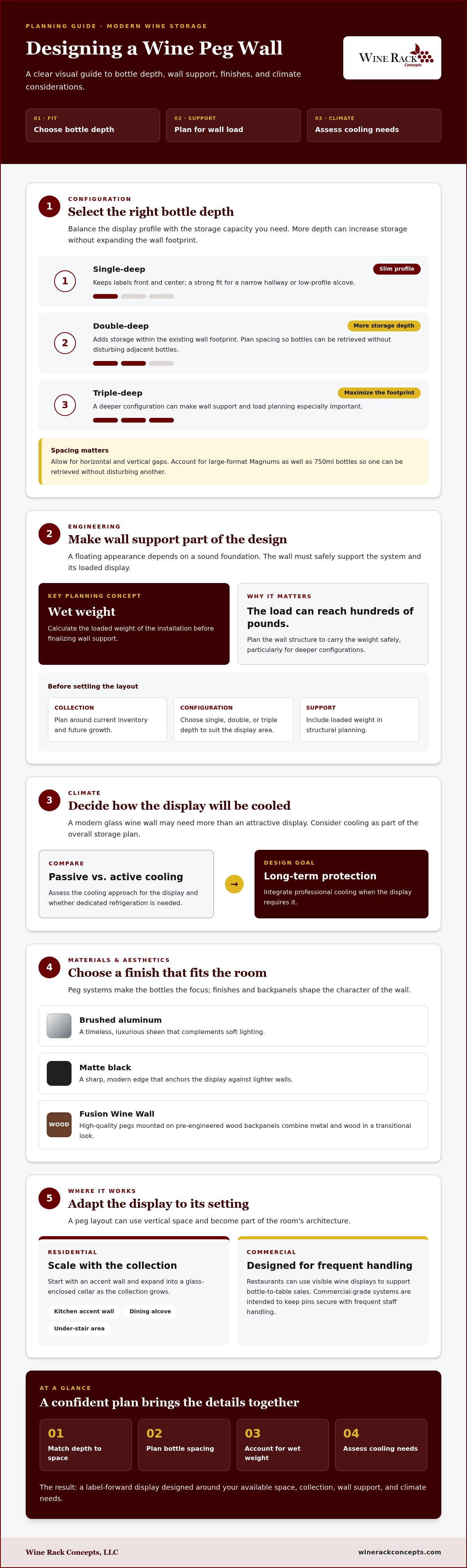
A minimalist wine wall is often the centerpiece of a modern home, yet its beauty relies entirely on the invisible engineering behind the glass. Choosing a wine peg racking system is about more than just aesthetics; it's a calculated decision involving structural load, material durability, and precise spatial planning. You likely envision a sleek, label-forward display that feels like it's floating, but you're also rightfully concerned about the weight of triple-deep configurations or how to maintain a consistent temperature without a traditional cellar.
We understand that a high-end collection requires more than just a place to sit. It needs a foundation that guarantees security and a climate that ensures longevity. This guide provides the technical expertise you need to master both the engineering and the style of modern peg systems. We'll explore how to choose between one, two, or three-deep bottle depths, the essential requirements for wall support, and how to integrate professional cooling into a modern display. By the end, you'll have the confidence to design a storage solution that is as structurally sound as it is visually stunning.
Key Takeaways
- Learn how to select the ideal configuration for your collection, whether you require single, double, or triple-deep bottle storage to maximize your available display area.
- Understand the critical structural requirements of a wine peg racking system, including how to calculate "wet weight" to ensure your wall safely supports hundreds of pounds.
- Discover the essential differences between passive and active cooling to determine if your modern glass wine wall requires dedicated refrigeration for long-term protection.
- Explore the aesthetic impact of premium finishes, comparing the timeless luxury of brushed aluminum with the bold, contemporary edge of matte black.
- Follow a methodical planning process that integrates your current inventory with future growth to create a storage solution that scales with your needs.
The Architecture of Minimalism: Understanding Wine Peg Racking Systems
Modern wine storage has evolved from the dark, subterranean corners of the home into the heart of the living space. A wine peg racking system is the cornerstone of this transformation, utilizing individual, precision-engineered pins to secure bottles in a label-forward position. This orientation is more than a stylistic choice; it's a functional upgrade that allows collectors to browse their inventory with a single glance, eliminating the need to disturb bottles to read their vintage. By focusing on the bottle itself rather than the structure holding it, the system creates a sense of weightless elegance.
We've seen a decisive shift from the traditional "hidden" cellar toward high-visibility wine walls that act as architectural focal points. While a classic cellar focuses on mass density, a peg system prioritizes the visual narrative of the collection. You can choose between a minimalist peg-only installation, where pins are mounted directly into a substrate, or an integrated system like our Fusion Wine Walls. These integrated options utilize backpanels to create a transitional look between metal and wood, providing a sophisticated backdrop that anchors the display within the room's design.
To better understand how these components come together during installation, watch this helpful video:
The Aesthetic Advantage of Peg Racking
A well-planned peg layout creates a distinct visual rhythm. By adjusting the spacing and alignment of the pins, you can transform a blank wall into a dynamic piece of art. This flexibility is particularly useful in challenging spaces. If you're working with a narrow hallway, a dining room alcove, or the awkward area under a staircase, these systems maximize vertical real estate without the bulk of traditional cabinetry. The result is a clean, hardware-free "floating" effect that complements contemporary design and makes the collection feel like an intentional part of the home's architecture.
Commercial vs. Residential Applications
In commercial environments, the stakes are different. Restaurants use these displays to drive "bottle-to-table" sales by making the wine list physically present and enticing to guests. A commercial-grade wine peg racking system ensures high-traffic durability, keeping pins secure even with frequent handling by staff. For residential projects, the system is infinitely scalable. You might start with a small accent wall in a kitchen and eventually expand into a full-scale glass-enclosed cellar as your curation grows. If you're ready to plan a custom display, you can contact us for a design consultation.
Anatomy of a Peg System: Materials, Depths, and Configurations
Constructing a sophisticated display requires a deep understanding of the individual components that make up a wine peg racking system. Our Wine Peg Series centers on precision-engineered pins that balance technical durability with a high-end aesthetic. These pins aren't just supports; they're the building blocks of a personalized gallery. Choosing the right material finish is often the first design hurdle. Brushed aluminum offers a timeless, luxurious sheen that complements soft lighting, while matte black finishes provide a sharp, modern edge that anchors the display against lighter wall surfaces.
Single, Double, and Triple Deep Configurations
Capacity and footprint are often at odds in modern design. If your goal is pure visual impact in a narrow hallway or low-profile alcove, single-deep pegs keep the profile slim and the labels front and center. When you need to maximize storage without expanding your wall's footprint, double and triple-deep configurations allow you to stack bottles securely. Proper spacing is essential here; you must account for specific horizontal and vertical gaps to ensure that even large-format Magnums can be retrieved without disturbing adjacent 750ml bottles.
The Fusion Series: Modernizing Traditional Wood
While metal pegs offer a minimalist look, some spaces benefit from the warmth and texture of organic materials. The Fusion Wine Wall addresses the gap between industrial metal and traditional woodwork by mounting high-quality pegs onto pre-engineered wood backpanels. This synergy creates a transitional look that feels cohesive in homes with existing cabinetry or wood flooring. Beyond aesthetics, these panels offer a significant structural advantage. Since the pegs are pre-installed into a reinforced board, you don't have to worry about individual mounting points or the complexities of wall substrate reinforcement. It's a streamlined solution for a professional result.
Whether you're curating a small residential collection or a massive commercial inventory, the flexibility of these components ensures your display can grow alongside your passion. If you're unsure which configuration fits your specific wall dimensions, you can speak with our design team to explore custom layout options. We accommodate everything from standard Bordeaux bottles to heavy Magnums, ensuring every piece of your collection is showcased with absolute confidence.
Engineering the Wall: Structural Requirements and Weight Management
A visually stunning wine wall is only as secure as the substrate behind it. While the focus often remains on the sleek finish of the pins, the true success of an installation lies in its structural integrity. You must account for the "wet weight" of the collection, which is the combined weight of the bottles, the liquid, and the racking itself. A standard 750ml bottle weighs approximately three pounds. If you're utilizing a triple-deep wine peg racking system, each pair of pegs supports nine pounds. A modest collection of 100 bottles translates to 300 pounds of constant, static tension pulling against your wall.
Relying on standard drywall anchors for this load is a high-risk strategy that often leads to structural failure. For professional-grade displays, the industry standard is the installation of 3/4" plywood backing. This provides a dense, reliable material for the fasteners to bite into, ensuring the pins don't sag or pull away over time. If you prefer to skip the complexities of on-site wall reinforcement, our Fusion Wine Wall series uses pre-engineered panels that help distribute weight, though the underlying wall still requires a solid connection to the studs. During the framing or renovation phase, adding structural blocking between the studs is the most effective way to prepare for a high-capacity display.
Substrate Preparation for High-Capacity Walls
Choosing between plywood backing and direct-to-stud mounting depends on your desired layout. Direct-to-stud mounting is incredibly strong, but it limits your design to the 16-inch or 24-inch intervals of your home's framing. Plywood offers total creative freedom, allowing you to place pegs exactly where the design dictates. If you're installing on unique surfaces like stone, tile, or masonry, the process requires specialized diamond-tipped drill bits and precise depth management to avoid cracking the finish. Regardless of the surface, ensuring every span is perfectly level is non-negotiable for maintaining a seamless visual flow.
Hardware and Fastener Integrity
Selecting the right fasteners must match the specific wall type. Wood studs require high-torque wood screws, while metal studs need specialized self-tapping fasteners to ensure a secure grip. Depth is critical, especially for triple-deep pins, as the lever effect increases the stress on the fastener's head. You must apply enough torque to seat the hardware firmly without stripping the substrate. If you're unsure about the requirements for your specific project, you should consult our design team for structural guidance to ensure your installation remains safe and beautiful for years.
Climate Synergy: Integrating Peg Racking with Professional Cooling
A beautiful display loses its value if the wine inside is compromised by fluctuating temperatures. Integrating a wine peg racking system into a climate-controlled environment requires a shift from purely aesthetic design to precise thermal engineering. You must first decide between passive and active cooling. Passive storage relies on the ambient temperature of the room. This is suitable for bottles meant for immediate enjoyment. If you're protecting a long-term investment, an active system is non-negotiable to maintain consistent conditions. It's a balance of art and science that prevents your curation from becoming a costly mistake.
Modern designs often feature glass enclosures. These present a unique challenge because glass has a high rate of heat transfer and offers minimal protection against UV exposure. To counteract this, you'll need a robust vapor barrier and high-grade insulation behind the wall where the pegs are mounted. A vapor barrier is a non-negotiable component of any refrigerated wine wall. Without a proper seal on the warm side of the insulation, moisture-laden air will migrate toward the cold cellar wall. This leads to hidden condensation that can rot studs; using closed-cell spray foam or high-density rigid insulation ensures your display remains a dry, stable environment.
Sizing Cooling Units for Modern Displays
Calculating heat load is essential for glass-heavy designs. Because glass doesn't insulate like a standard wall, your cooling unit must work harder to offset the heat gain. Self-contained refrigeration units are often the ideal solution for small to medium wine walls. These units are typically "plug-and-play" and are designed to keep the environment in that critical 55 to 58 degree "sweet spot" for long-term preservation. You must also consider the location of the unit. Proper airflow is vital to ensure the evaporator can circulate cooled air evenly across every bottle in the display, maintaining the humidity levels necessary to keep corks from drying out.
The Role of Metal Wine Cellar Doors
To maintain this environment, every exit point must be sealed. Metal wine cellar doors are superior to wood in these modern glass rooms. They provide a tighter thermal seal and won't warp under temperature differentials. Our metal doors are made in America and offer the durability required for both residential and commercial spaces. You can match the finish of the door frame to your wine peg racking system, creating a seamless visual transition from the entryway to the display. When you explore our metal wine cellar doors, you'll see how they anchor the entire climate-control strategy.
Explore our metal wine cellar doors
Designing Your Custom Wine Peg Display with Wine Rack Concepts, LLC
Planning a wine peg racking system is a methodical journey that transitions from a creative vision to a precision-engineered reality. At Wine Rack Concepts, LLC, we view this as a collaborative process where your personal curation meets our technical expertise. By following a structured roadmap, we eliminate the guesswork often associated with custom installations. This ensures that every bottle is stored safely and displayed with the sophistication your collection deserves.
The design process involves four critical phases:
- Step 1: Inventory Assessment. We begin by analyzing your current bottle count while accounting for future growth. If you have 50 bottles now, planning for 100 provides the necessary room for your collection to evolve. We also account for bottle shapes, ensuring your layout has dedicated space for both standard Bordeaux and wider Champagne or Magnum bottles.
- Step 2: Material Selection. You'll choose between the minimalist Wine Peg Series or the texture-rich Fusion Wine Wall. This decision defines whether your bottles appear to float against the wall or are anchored by sophisticated wood backpanels.
- Step 3: Environmental Check. We evaluate the structural readiness and lighting of your space. This step confirms that your wall can handle the static tension of the wine peg racking system and that your cooling infrastructure is appropriately sized for the heat load.
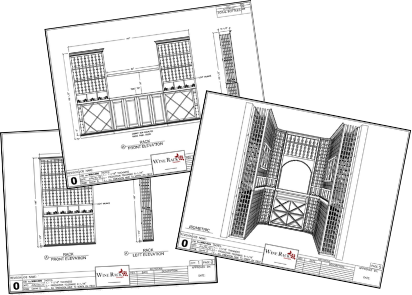
- Step 4: Professional Design. We utilize CAD and 3D modeling to create a digital twin of your room. This allows you to visualize the visual rhythm of the display before any hardware is ordered.
The Manufacturer Advantage
Working with a specialist manufacturer like Wine Rack Concepts, LLC, provides a level of precision that general retailers can't match. Because we manufacture our own series, we understand the exact tolerances and weight limits of every pin. If your project requires a mix of storage styles, we can customize our Vintner or Carpenter series to provide bulk storage that complements your modern peg wall. This holistic approach ensures every component works in harmony. To understand the broader scope of these projects, you can read our guide on custom wine cellar design.
Next Steps: From Inspiration to Installation
Moving from a concept to a finished project requires clear coordination. Once your 3D design is finalized, we provide a tailored quote based on your specific material and capacity needs. We also supply the technical specs your contractor needs for wall preparation and substrate reinforcement. If you're ready to build a professional-grade gallery, you can start your custom wine wall project today by connecting with our design team.
Elevating Your Collection with Professional Precision
A sophisticated wine peg racking system offers an unparalleled blend of minimalist beauty and functional customization, but its success depends on the synthesis of design and engineering. Throughout this guide, we've explored how the visual rhythm of floating bottles relies on a foundation of sound structural planning and thermal management. By addressing the requirements for wall reinforcement and environmental control early, you ensure that your display remains a secure and stable showcase for your most valued vintages.
With over a decade of expertise in precision-engineered storage, Wine Rack Concepts, LLC acts as a knowledgeable partner in bringing these high-end visions to life. We specialize in the development of the Wine Peg Series and Fusion Wine Walls, offering bespoke solutions that meet both residential and commercial requirements. Our team focuses on the nuances of high-performance cooling and structural design, providing the technical reliability required for modern, glass-enclosed cellars.
Request a Custom Wine Peg Design Consultation When you prioritize professional craftsmanship and technical accuracy, your storage solution becomes a timeless architectural feature. It's a transformation that celebrates your pride of ownership and provides the perfect environment for your collection to age gracefully. We look forward to helping you navigate the planning process and delivering a finished result that exceeds your expectations.
Frequently Asked Questions
Do wine peg systems require a special type of wall?
Yes, a wine peg racking system requires a wall with sufficient structural backing to support the weight of a full collection. Standard drywall anchors aren't strong enough for professional-grade displays. You should install 3/4" plywood behind the finish material or use structural blocking between the studs during the framing phase. This ensures the pins won't sag or pull away from the wall over time, even with triple-deep configurations.
How much weight can a single wine peg hold?
A single pair of pegs is designed to support the weight of one, two, or three bottles depending on the chosen configuration. Since a standard 750ml bottle weighs approximately three pounds, a triple-deep setup holds nine pounds of static tension. Precision engineering ensures these pins remain level under load. It's vital to follow manufacturer spacing guidelines to ensure the weight is distributed evenly across the reinforced substrate for maximum security.
Does a glass-enclosed wine wall need to be refrigerated?
Refrigeration is necessary if you intend to age your wine for more than a few months. While a passive display looks beautiful, it won't protect your investment from temperature fluctuations. A glass enclosure requires a dedicated refrigeration unit to maintain the ideal 55 to 58 degree environment. Without active cooling, the glass acts as a heat conductor, which can cause the wine to age prematurely or the corks to dry out.
What is the difference between the Wine Peg Series and Fusion Wine Walls?
The primary difference lies in the mounting method and the final aesthetic. Our Wine Peg Series consists of individual pins that mount directly into your reinforced wall for a minimalist "floating" look. In contrast, Fusion Wine Walls feature these same pegs pre-installed into high-quality wood backpanels. These panels simplify the installation process and provide a transitional texture that helps the display blend with your home's existing cabinetry and wood finishes.
Can I install a wine peg system myself (DIY)?
You can certainly install smaller displays yourself if you have basic construction skills and the correct tools. However, professional installation is highly recommended for larger projects or those involving climate control. Complex tasks like calculating heat load, installing vapor barriers, and ensuring a perfectly level substrate require specialized expertise. A professional ensures the system is structurally sound and that the cooling unit is sized correctly for your specific glass-enclosed space.
How do I protect my wine from light in a modern wall display?
Protecting your collection involves a combination of glass selection and lighting choices. You should use UV-rated glass for your enclosure to block harmful rays that can degrade the wine's organic compounds. Additionally, we recommend using LED lighting for the display. LEDs produce virtually no heat and zero UV radiation, allowing you to showcase your labels without risking the integrity of the wine. Position the display away from direct sunlight for optimal protection.
What bottle sizes fit on a standard wine peg racking system?
Standard pegs are designed to hold traditional 750ml Bordeaux and Burgundy bottles securely. However, the modular nature of a wine peg racking system allows for significant flexibility in your layout. By adjusting the horizontal and vertical spacing during installation, you can accommodate larger formats like Magnums or even oversized Champagne bottles. We recommend doing a full inventory assessment before installation to ensure your grid pattern provides enough clearance for your specific bottle shapes.
Do I need a vapor barrier for a wall-mounted wine display?
You only need a vapor barrier if your wine wall is actively refrigerated. In a climate-controlled environment, a vapor barrier is essential to prevent warm, moist air from hitting the cold cellar wall and turning into condensation. This prevents mold growth and structural rot within the wall cavity. For passive displays in temperature-stable rooms, a vapor barrier isn't required, though high-quality insulation is still a benefit for maintaining a consistent environment.
Have an expert help today!
Free 2D wine cellar design