Standard Wine Rack Dimensions: A Practical Guide to Fit and Capacity

*Pictures are renderings. Actual wine racks may look different
What if a wine rack fits your wall but not the bottles you want to store? Planning around standard wine rack dimensions can seem straightforward, yet published measurements may describe the rack's overall size, its openings, or the depth of its bottle supports. Each affects fit in a different way.
A standard 750 ml bottle is about 12 inches tall and 3 to 3.2 inches in diameter, but Burgundy and Champagne bottles can be wider. That variation can make a rack's stated capacity feel different in practice, especially when your collection includes a mix of shapes. A rack can also fit the available wall and still interfere with a door, walkway, or neighboring storage.
This guide explains how bottle dimensions relate to rack openings and layout, what to measure in your space, and which clearances to consider before choosing a rack. You'll also learn when a tailored design can better accommodate an unusual bottle mix, a challenging wall, or a specific capacity goal. With the right measurements in view, you can plan storage that fits your collection and works naturally in the room.
Key Takeaways
- Read standard wine rack dimensions carefully: opening size, support depth, and overall rack size each describe a different fit consideration.
- Account for bottle-shape variety when estimating capacity, especially if your collection includes broader Burgundy- or Champagne-style bottles.
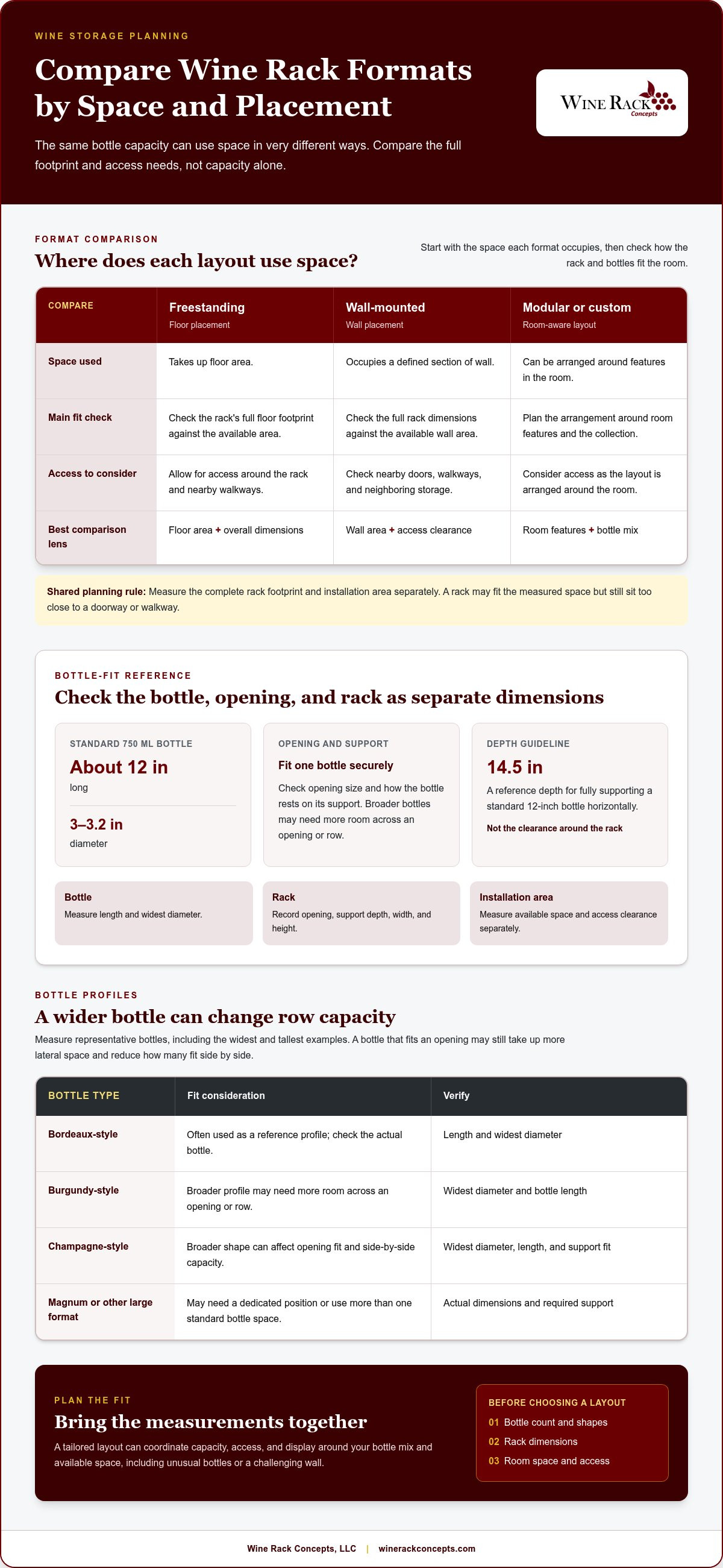
- Compare freestanding, wall-mounted, and modular layouts based on how they use available floor or wall space.
- Measure the installation area and note trim, baseboards, door swings, and walkways before settling on a rack layout.
- Bring bottle count, bottle shapes, room measurements, and display preferences together to plan storage that suits your collection.
Standard Wine Rack Dimensions Start with the Bottle
Standard wine rack dimensions describe more than a unit's outside measurements. They include the dimensions that let bottles sit securely, fit the rack's openings, and work within the installation area. Consider three separate questions: Will each bottle fit its space? Does the rack support it as intended? Will the complete unit fit the room without blocking access?
What size is a standard wine bottle?
Dimensions.com gives a useful reference for a standard 750 ml wine bottle: about 12 inches long and 3 to 3.2 inches in diameter. Treat those figures as a starting point, not a universal specification. Bottle profiles vary by shape and producer, so your collection may include bottles wider or taller than the sample used to plan a rack.
Measure representative bottles from your collection, including the widest and tallest examples. This helps you identify the opening size and support needed for a secure fit. Wine racks are commonly used to store bottles horizontally, so consider how each bottle rests in its support rather than comparing its length with the rack's outside dimensions alone.
Which wine rack measurements matter most?
Each measurement answers a different planning question:
- Bottle length and diameter: The bottle's end-to-end measurement and its widest point.
- Rack opening: The space that receives and supports one bottle. Its size affects fit and ease of placement.
- Rack depth: Check what the listed depth describes. It may refer to the bottle support or the unit's full front-to-back measurement. As a reference, Dimensions.com gives 14.5 inches as a depth guideline for fully supporting a standard 12-inch bottle horizontally. This is not the same as clearance around a rack.
- Overall width and height: The rack's full footprint, which helps determine how it fits the wall or floor area and how many bottles its layout can hold.
Record installation clearance separately from rack depth. A rack can fit within the measured wall space but still sit too close to a doorway or walkway.
Quick measurement diagram
Bottle: length + diameter → Opening: space for one bottle
Rack: overall width + height + depth
Installation: available width + height + depth, plus access clearance
These reference points make standard wine rack dimensions easier to compare, but final fit depends on your bottles and the rack design. Measure first, then plan capacity and placement together.
How Bottle Shape Changes Wine Rack Fit and Capacity
A rack planned around one familiar bottle profile may not hold a varied collection as neatly as its stated capacity suggests. Bordeaux-style bottles tend to have a narrower profile, while Burgundy- and Champagne-style bottles are broader. That difference affects more than whether a bottle passes through an opening: it can change spacing across a row, the support needed, and the number of bottles that fit in a section.
Dimensions.com offers a useful standard wine bottle dimensions reference, but no single sample represents every bottle. Producer and bottle shape can affect measurements. Before finalizing standard wine rack dimensions, measure the widest and most common bottles in your collection, including their length and widest diameter.
Can different wine bottle sizes share one rack?
Yes, mixed storage can work when each bottle fits its opening and rests securely on its support. A rack designed around a consistent set of narrower bottles may have less room for broader profiles. Even if a wider bottle fits, it may take up more lateral space and reduce how many bottles fit side by side. Measure both your most common bottles and the widest examples, then plan rows or sections around that mix rather than relying on a single sample.
| Bottle type | Fit consideration | Measurement to verify |
|---|---|---|
| Bordeaux-style | Often used as a reference profile; check the actual bottle before assuming it represents the collection. | Length and widest diameter |
| Burgundy-style | Broader profile may need more room across an opening or row. | Widest diameter and bottle length |
| Champagne-style | Broader shape can affect opening fit and the number stored side by side. | Widest diameter, length, and support fit |
| Magnum or other large format | May need a dedicated position or occupy more than one standard bottle space. | Actual dimensions and required support |
How do magnums and other large formats affect capacity?
Large-format bottles are a layout consideration, not an automatic fit for openings intended for standard bottles. Depending on their shape and the rack design, an oversized bottle may use more than one standard position. Identify these bottles before estimating capacity and note how many you want to store. This helps balance standard positions with special-format storage.
If your collection combines bottle shapes or includes large formats, a tailored plan can coordinate capacity, access, and display. Explore a wine storage design shaped around your bottle mix and available space.
Compare Wine Rack Dimensions by Format and Placement
The same bottle capacity can use space in very different ways. A freestanding rack takes up floor area, a wall-mounted rack occupies a defined section of wall, and modular or custom layouts can be arranged around a room's features. Compare the complete footprint and access needs, not just the bottle count. The standard dimensions for a 750 mL bottle offer a useful baseline, but the rack format still needs to suit your collection and placement.
| Format | Measurement to prioritize | Suitable planning scenario |
|---|---|---|
| Freestanding | Overall width, height, depth, and floor clearance | A room with a defined footprint available for a complete unit |
| Wall-mounted | Usable wall area and clearance around the rack | A clear wall where bottles remain accessible without obstructing nearby features |
| Modular | Dimensions of each section and the total assembled layout | A space where storage is planned in sections or needs to fit around room conditions |
| Custom | Room dimensions, bottle mix, access, and intended capacity | A cellar or room with specific placement, collection, or display requirements |
What dimensions should you check for a wall-mounted wine rack?
Measure the available wall area, then mark trim, switches, outlets, openings, and other obstructions. Consider the full installed rack, not only the bottle openings: bottles need to be reachable, and the rack should not intrude into nearby doors or walkways. Account for the mounting surface and the system's installation requirements before settling on placement.
How do freestanding and custom racks use space differently?
A freestanding unit occupies a defined floor footprint, including space to approach and use it. A custom layout can be planned for a particular wall or cellar, coordinating rack dimensions with room conditions and a varied bottle collection. Modular systems offer another approach, but assess the complete arrangement rather than treating each section as a standalone footprint.
For standard wine rack dimensions to work in practice, consider the rack, bottles, and surrounding furnishings as one layout. A unit may fit on paper yet make a cabinet difficult to open or narrow a route through the room. Measure the space around the rack as carefully as the space it occupies, then compare formats against how you use the room.
Measure Your Space Before Choosing Standard Wine Rack Dimensions
A room's listed width and height don't always reflect the area a rack can actually use. Baseboards, trim, uneven surfaces, door swings, nearby furnishings, and access routes can all reduce practical installation space. Use this sequence to connect your collection, the room, and the rack measurements before deciding on a layout.
- Inventory the bottles. Record your bottle count, the shapes you store most, and any wider or larger-format bottles that may need dedicated positions.
- Measure the intended area. Note the available width, height, and depth. If a wall, floor, or ceiling is uneven, measure at multiple points and use the limiting measurement when assessing fit.
- Mark obstacles. Include baseboards, trim, switches, outlets, nearby cabinets, and openings in your notes.
- Check access. Account for door swings, walkways, and the room needed to reach, load, and remove bottles.
- Confirm rack dimensions. Compare the usable installation area with the complete rack footprint, then check that openings and supports suit your bottles.
How do you measure a space for a wine rack?
Measure the spot where the rack will sit or mount, rather than relying on the room's overall dimensions. A wall may narrow near the floor because of baseboards, while trim or nearby openings can limit usable width higher up. Compare these measurements with the rack's full width, height, and depth, keeping installation clearance separate from the rack itself. Allow practical access for handling bottles, too.
Measurement worksheet
- Bottle count and shapes: ____________________
- Usable area: width ______ height ______ depth ______
- Measurements at multiple points, if needed: ____________________
- Baseboards, trim, switches, and other obstacles: ____________________
- Door swings, walkways, and bottle access: ____________________
- Rack footprint: width ______ height ______ depth ______
- Opening and support fit for the collection: ____________________
Quick sketch: Draw the wall or floor area, label its width and height, then mark the rack footprint, depth, obstacles, door swing, and nearby walkway.
What sizing mistakes should you avoid?
Don't estimate capacity from bottle count alone; bottle profiles can affect how many fit in a row. Keep internal support depth distinct from the unit's overall depth and from clearance around the installation. A catalog example is a reference, not a fit guarantee for a different room or collection. Set standard wine rack dimensions using measurements of your space and representative bottles, not a capacity label in isolation.
Plan a Wine Rack That Fits Your Collection and Room
A useful design brief brings the bottles and the room into the same conversation. Standard wine rack dimensions can guide early planning, especially when a collection mainly contains conventional bottle profiles. Treat them as estimates, though. Actual bottle shapes, room conditions, and rack construction all influence the final fit.
When are standard rack dimensions a useful starting point?
Use standard measurements to picture possible layouts and estimate how storage might fit your space. Then adjust the plan for your bottles and installation area. A collection with mixed formats, a restricted wall, or a specific capacity goal may benefit from tailored dimensions. This helps coordinate bottle support and access with the room, rather than forcing the collection into a standard footprint.
What should a wine rack design brief include?
Gather a few practical details before settling on a layout. Include:
- Collection: Current bottle count, the shapes and sizes you store most, representative measurements, and expected growth.
- Room: Usable width, height, and depth, measured around baseboards, trim, and other architectural features.
- Access: Door swings, nearby walkways, and the room needed to reach, load, and remove bottles.
- Display preferences: Whether you favor consistent rows, a feature area for selected bottles, or a storage layout that combines both.
This brief connects capacity to how the room functions and feels. A layout can make efficient use of a constrained wall, leave a clear route through a cellar, or give selected bottles a more prominent place. Custom dimensions bring these priorities together, helping the rack suit the collection and the visual character of the space. Explore the broader principles in this custom wine cellar design guide.
With your bottle mix and measurements in hand, you can move from reference dimensions to a considered storage plan.
Bring Your Wine Storage Plan Together
The right rack is measured against both the bottles it will hold and the room where it belongs. Use standard wine rack dimensions as a planning reference, then account for bottle shapes, openings, the full rack footprint, and clearances for everyday access. A capacity estimate is more useful when it reflects your actual collection rather than a single bottle profile.
Before choosing a layout, bring together your bottle count, representative bottle measurements, usable room dimensions, obstacles, and preferred display style. Wine Rack Concepts, LLC designs custom wine cellars and storage for residential and commercial applications, with Classic, Carpenter, and Vintner racks, wall racks, Fusion Wine Walls, and cable and glass systems for different spaces and collections.
With a clear picture of your collection and space, you can create storage that feels considered, functions comfortably, and gives your wines a fitting place in the room.
Frequently Asked Questions
What are standard wine rack dimensions?
Standard wine rack dimensions describe the measurements needed to fit bottles securely and place the complete rack in its intended space. They include individual openings, bottle supports, and overall rack width, height, and depth. These measurements aren't interchangeable: an opening determines whether a bottle fits, while the rack's outside dimensions determine its footprint. Use standard references for initial planning, then compare them with your collection and installation area.
How deep should a wine rack be for standard wine bottles?
For full horizontal support of a standard 12-inch bottle, Dimensions.com gives 14.5 inches as a rack-depth reference. Check what a product's depth measurement describes, since the bottle support, overall unit depth, and installation clearance are different measurements. The right depth depends on the rack's design and the bottles it will hold. Compare the complete rack dimensions with available space, and confirm that the support suits your bottles.
What is the average wine bottle size?
A useful reference for a standard 750 ml wine bottle is about 12 inches long and 3 to 3.2 inches in diameter, according to Dimensions.com. These measurements aren't universal. Bottle shape and producer can affect length and width, and broader profiles may need more room in a rack opening or row. For a reliable fit estimate, measure representative bottles from your collection, including its widest examples.
Can different bottle sizes fit in the same wine rack?
Different bottle sizes can share a rack if the openings and supports accommodate the bottles in each position. Wider bottles may take up more room across a row, reducing how many fit compared with narrower bottles. A capacity figure based on one bottle profile may not reflect a mixed collection. Measure the largest and most common shapes, then plan the rack layout around that mix and any special-format bottles.
How do I measure a space for a wine rack?
Measure the usable installation area by width, height, and depth, and check multiple points if floors, walls, or ceilings aren't even. Record baseboards, trim, switches, nearby furnishings, door swings, and walkways. Then compare the usable area with the complete rack footprint, not just its bottle openings. Allow practical access to load and remove bottles, and keep rack depth separate from clearance around the installed unit.
How much space should I leave around a wine rack?
There's no single clearance measurement that suits every rack and room. Leave enough room to approach the rack, place bottles in their openings, and remove them comfortably. Check that the installation won't obstruct a door swing, walkway, cabinet, or nearby storage. Consider the rack's full outside dimensions and how bottles project or are handled in use. Follow the layout and installation requirements for the specific rack design.
Do magnums fit in a standard wine rack?
Don't assume a magnum will fit an opening intended for standard bottles. Large-format bottles can require wider or differently arranged storage, and some may occupy more than one standard bottle position. Measure the specific bottle and consider its support needs before estimating capacity. If your collection includes magnums, identify how many you want to store during planning so the rack layout can account for them alongside your other bottle shapes.
Have an expert help today!
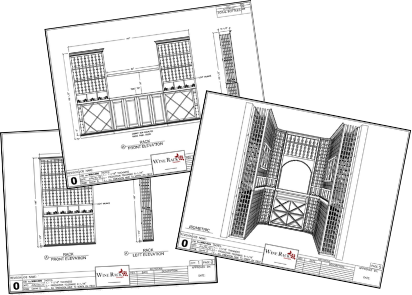
Free 2D wine cellar design