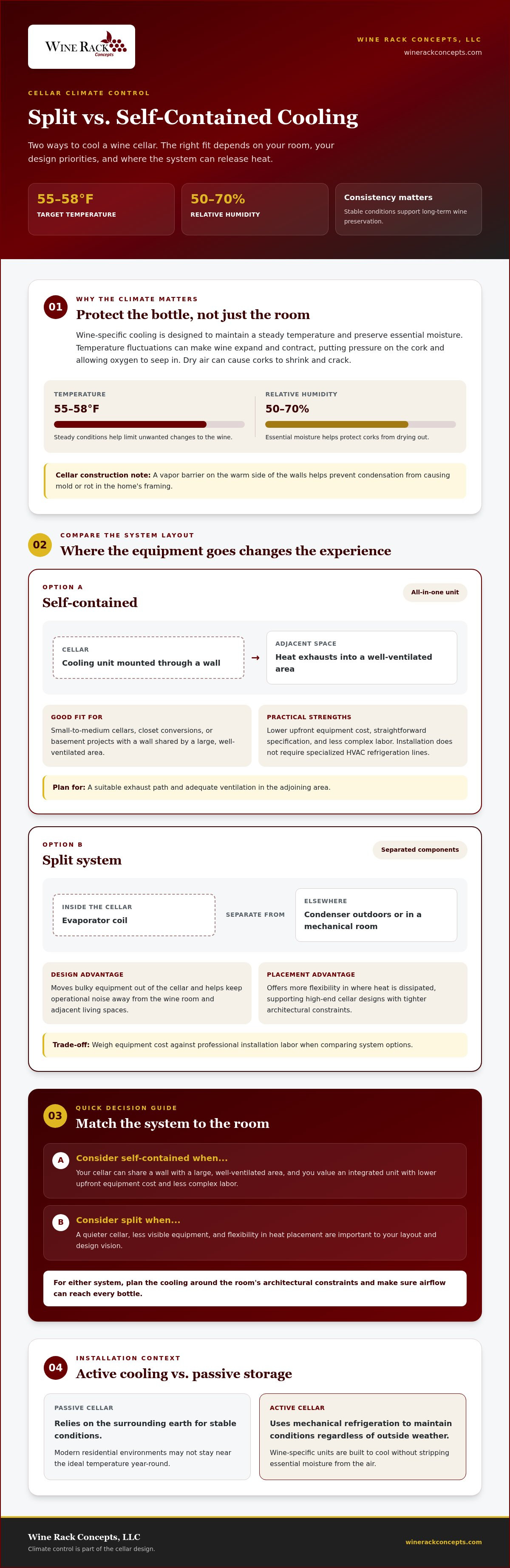
Split vs. Self-Contained Wine Cellar Cooling: Which System is Right for Your Collection?

*Pictures are renderings. Actual wine racks may look different
What if the most critical component of your luxury wine cellar was the one thing you never wanted to see or hear? You've spent months selecting the perfect racking and a custom metal door, so it’s natural to worry that a bulky, humming mechanical unit might disrupt that carefully curated aesthetic. You want a space that feels like a sanctuary for your collection, not a mechanical room.
We understand that choosing between split vs self contained wine cellar cooling is one of the most significant technical decisions you'll face during the design process. It's a choice that impacts everything from the decibel level in your adjacent living room to the long-term stability of your vintage's aging environment. This guide will help you discover the technical and aesthetic differences between these systems so you can select the perfect climate control for your architectural constraints.
We’ll compare the quiet, nearly invisible nature of split systems against the straightforward, integrated approach of self-contained units. By the end, you'll have a clear path toward a cooling solution that protects your investment without compromising your design vision.
Key Takeaways
- Understand why maintaining a precise temperature of 55-58°F and consistent humidity is the "heart" of your cellar's long-term preservation strategy.
- Compare the functional differences of split vs self contained wine cellar cooling to determine which mechanical footprint fits your room's architectural constraints.
- Learn how split systems eliminate bulky equipment and operational noise from your cellar, making them the professional standard for high-end living spaces.
- Discover how to integrate refrigeration seamlessly with racking series like Vintner and Classic to ensure optimal airflow reaches every bottle.
- Evaluate the trade-offs between upfront equipment costs and professional installation labor to find the most reliable solution for your specific collection.
Understanding the Core Differences in Wine Cellar Climate Control
Achieving the perfect environment for a wine collection is a delicate balancing act that goes far beyond simply keeping a room cool. While a standard air conditioner is designed to lower the temperature for human comfort, it lacks the precision required to preserve delicate tannins and organic corks. A dedicated wine cooling system is engineered to maintain a steady 55 to 58°F while keeping relative humidity between 50 and 70 percent. This specific range prevents the chemical reactions that lead to premature aging. When planning your space, the primary technical hurdle is deciding on split vs self contained wine cellar cooling, as this choice dictates your room's layout and mechanical requirements.
Self-contained units are all-in-one systems that typically mount through a wall, venting heat into an adjacent, well-ventilated room. They are straightforward and cost-effective but require a specific exhaust path. In contrast, split systems separate the evaporator coil inside the cellar from the condenser unit, which is placed elsewhere, such as outdoors or in a mechanical room. This separation allows for a much quieter environment and more flexibility in where the heat is dissipated. Neither system should be confused with standard household cooling; wine-specific units are built to run without stripping the air of essential moisture.
The Science of Wine Preservation
Consistency is the most important factor in long-term storage. If temperatures fluctuate, the liquid inside the bottle expands and contracts, which puts pressure on the cork and allows oxygen to seep in. This oxidation can quickly turn a vintage into vinegar. Humidity is equally vital because dry air causes corks to shrink and crack. To protect the room's infrastructure, a vapor barrier is a critical component of cellar construction. It's a specialized moisture-resistant layer installed on the warm side of the walls to prevent condensation from causing structural mold or rot within your home's framing.
Active vs. Passive Cellars
Historically, collectors relied on deep underground caverns to provide naturally stable conditions. While some modern basements offer a degree of stability, the distinction between active and passive wine cellars is stark. Passive cellars rely solely on the surrounding earth, which rarely stays at the ideal 55°F year-round in modern residential environments. Active cellars use mechanical refrigeration to guarantee these conditions regardless of the weather outside. For most homeowners, a professional Custom Wine Cellar Design must include active cooling to ensure the investment remains protected. Without this mechanical assistance, your collection is at the mercy of seasonal shifts and household heating systems.
Self-Contained Cooling Units: The Practical All-in-One Solution
Self-contained refrigeration units represent the most straightforward entry point for collectors establishing their first climate-controlled space. These systems house all the essential components, including the compressor, condenser, evaporator, and fans, within a single chassis. This "all-in-one" design is typically mounted through a wall, much like a high-end window air conditioner, but with the specific engineering required for proper climate control systems. When weighing the benefits of split vs self contained wine cellar cooling, the self-contained route is often chosen for its lower upfront equipment cost and the ability to install the unit without specialized HVAC refrigeration lines.
These systems are ideal for small-to-medium cellars, closet conversions, or basement projects where a wall shares space with a large, well-ventilated area. Because the unit is a single piece of hardware, it's easier to specify and requires less complex labor. It's a reliable choice for those who want a functional, effective system without the intensive construction required for remote mechanicals. If you're unsure if your space fits these requirements, a professional design consultation can help determine the best placement for your unit.
Ventilation and Exhaust Requirements
The most common oversight with self-contained units is the "exhaust room" problem. Every cooling unit works by removing heat from the cellar and dumping it elsewhere. If you vent this hot air into a small, enclosed space like a hallway or a small closet, that area will quickly overheat. This creates a feedback loop where the unit must work harder to dump heat into an already hot room, eventually leading to system failure. Ideally, the exhaust room should be at least twice the size of the cellar or have its own independent ventilation. You should also expect a moderate hum; these units typically operate between 45 and 55 decibels, which is similar to a standard kitchen dishwasher.
Installation Best Practices
Precision during installation ensures the longevity of your cooling system. You must provide a dedicated electrical circuit, usually 15 to 20 amps, to prevent the unit from competing for power with other household appliances. Placement is equally important. These units should be mounted high on the wall, typically within 18 inches of the ceiling, because heat rises and cold air sinks. This positioning encourages natural convection and ensures the coldest air reaches the top of your wine racks. Finally, sealing the unit is non-negotiable. Any air leaks around the chassis will allow moisture to enter the cellar, causing the unit to work overtime and potentially leading to frost buildup on the evaporator coils. Use high-grade gaskets or expanding foam to create an airtight seal between the unit and the wall cutout.
Split Cooling Systems: The Professional Standard for High-End Cellars
For collectors who view their wine room as a centerpiece of home design, split systems offer a level of sophistication that self-contained units cannot match. By separating the mechanical components, these systems allow the evaporator to stay inside the cellar while the noisy compressor resides elsewhere. This architectural flexibility is a primary driver when deciding on split vs self contained wine cellar cooling for luxury installations. It transforms the cellar from a room with a machine in it into a gallery where the focus remains entirely on the bottles. You don't have to worry about a bulky unit disrupting the clean lines of your racking or the visual flow of the room.
It's the ultimate noise solution. By moving the compressor to a garage, a mechanical room, or an exterior wall, you eliminate the mechanical hum that often accompanies through-the-wall systems. This is particularly vital if your cellar is located near a dining room, library, or bedroom. Split systems also excel in cooling large or oddly shaped rooms. Because the components are separate, a designer can place the evaporator in the most efficient location to ensure even air distribution, regardless of the room's footprint. If you're planning a high-capacity space, wine cellar cooling via a split system provides the industrial-grade power needed for long-term stability.
Ductless vs. Ducted Split Options
A ductless split, often called a mini-split, features an evaporator mounted directly on the cellar wall. While these units are visible, they are significantly sleeker than through-the-wall models and are remarkably efficient. However, for those seeking a completely invisible look, a ducted split system is the gold standard. In this configuration, the evaporator is hidden in a nearby ceiling or closet, and the cool air is piped into the cellar through discreet grilles. This is the preferred choice for modern glass wine cellars. It keeps the glass walls free of any mechanical obstructions, maintaining the "jewelry box" effect that glass enclosures are known for.
The Role of the Line Set
The connection between the indoor and outdoor components is handled by a line set. This consists of two copper pipes that carry refrigerant between the evaporator and the condenser. While this allows for great flexibility, there are distance limitations to consider. Most residential systems perform best when the line set is under 75 feet, though specialized pumps can extend this range if necessary. Because these lines carry pressurized refrigerant and require vacuum testing, professional HVAC installation is mandatory. This isn't a DIY project. A certified technician must braze the lines and charge the system to ensure it operates at peak efficiency without leaks.
Choosing Your System: A Comparative Framework for Performance and Cost
Deciding on split vs self contained wine cellar cooling often comes down to a balance between your immediate budget and the long-term ambiance of your home. Self-contained units offer the lowest entry price for both equipment and installation. However, when you factor in the labor of a licensed HVAC professional required for a split system, the total investment can increase significantly. The question isn't just about the price tag. It's about the value of your environment. You're choosing between a functional appliance and a professional-grade climate infrastructure.
Noise levels are a frequent pain point for collectors. Ideally, a cellar should maintain a sound level below 35 decibels to ensure it doesn't disrupt the rest of the house. While ductless systems typically run between 45 and 55 decibels, a remote split system moves the loudest mechanical parts away from your living area. This allows for a quiet dinner or a conversation in an adjacent room without the constant drone of a compressor. If your cellar is a focal point of your entertaining space, the silence of a split system is often worth the extra investment.
Maintenance remains a necessity for both configurations to ensure the "heart" of your cellar stays healthy. You'll need to clean the evaporator and condenser coils every six months to prevent dust buildup and airflow restriction. Split systems require an annual check of the refrigerant lines by a professional to ensure there are no leaks. While self-contained units are often easier to swap out if a major component fails, split systems are built for a longer service life with individual parts that can be serviced or replaced without removing the entire unit.
Cost vs. Long-Term Value
Investing in a custom wine cellar requires a long-term perspective on equipment durability. A well-installed split system can last 15 to 20 years, which is significantly longer than many through-the-wall units. High-end buyers view a professional-grade cooling system as a permanent feature of the home. This can positively influence resale value because it demonstrates a commitment to proper preservation that serious collectors respect. When the cooling system is integrated correctly, it protects the liquid assets and the structural integrity of the room.
The Aesthetic Impact
Aesthetics are non-negotiable in luxury design. You want a system that complements your Metal Wine Cellar Doors rather than distracting from them. In contemporary glass-enclosed rooms, a split system is almost always the preferred choice. It allows you to hide the mechanical components, leaving only the beauty of your collection on display. When you eliminate the bulky housing of a through-the-wall unit, you gain more space for premium racking and better visual flow.
Integrating Cooling with Your Wine Racking and Cellar Design
Designing a wine cellar is as much about the physics of air as it is about the beauty of the racking. When you evaluate split vs self contained wine cellar cooling, you're not just choosing a machine; you're deciding how much wall space remains for your collection. A self-contained unit requires a significant cutout in the wall, which often means sacrificing a section of premium storage. In contrast, a split system offers the flexibility to mount a smaller evaporator high on the wall or even hide it in the ceiling, allowing your racking to take center stage. The goal is to ensure that your cooling and racking work in a symbiotic relationship where the air moves freely and the aesthetics remain undisturbed.
High-capacity racking series like the Vintner or Classic series are designed to maximize bottle counts, but this density can create challenges for airflow. If the cooling unit is placed incorrectly, "dead zones" can form where air becomes stagnant and temperatures rise. This is particularly critical in modern Fusion Wine Walls, where the minimalist, open-concept design leaves no room for bulky mechanical equipment. These contemporary displays rely on discreet climate control to maintain the "jewelry box" effect while ensuring every bottle stays at a precise 55 degrees. A professional design helps you map out these airflow paths before the first rack is installed.
Airflow and Racking Density
The material of your racks plays a significant role in how air circulates throughout the room. Traditional wooden wine racks provide a timeless look and excellent stability, but their solid vertical uprights can block horizontal air movement if the room is overpacked. Metal racking often allows for better circulation because of its thinner profile and open-air design. Regardless of the material, the evaporator must be positioned so that cold air can drop from the ceiling and move through the racks rather than just bouncing off the front of the bottles. This ensures that the wine at the back of a double-deep rack is just as protected as the wine at the front.
Planning Your Project
One of the most common mistakes in cellar construction is treating cooling as an afterthought. It should be the first technical decision you make, as it dictates the framing, electrical requirements, and insulation needs of the entire room. Sizing the unit correctly is a complex calculation that involves the total cubic footage, the amount of glass in the room, and the local climate. Utilizing professional design services ensures that your cooling system is perfectly matched to your storage goals. You can Get a Free Wine Cellar Design to ensure your cooling and racking work in harmony from the very beginning of the project.
Securing the Future of Your Collection
Selecting the right climate control is an investment in the longevity of every bottle you own. While self-contained units provide a practical, all-in-one solution for many homeowners, split systems offer the nearly silent, invisible performance required for high-end displays. The decision on split vs self contained wine cellar cooling ultimately shapes the atmosphere of your home and the visual impact of your racking. It's the difference between a functional storage room and a sophisticated gallery for your collection.
We bring over 15 years of experience in expert cooling integration to every project we undertake. Whether you choose our specialized metal or wood racking collections, our comprehensive national design and manufacturing ensures your system fits your room's specific architectural constraints. We act as your knowledgeable partner to simplify these complex technical decisions, bridging the gap between your initial vision and a finished, professional result.
With the right technical foundation in place, your cellar will become a timeless sanctuary for curation and pride of ownership. We look forward to helping you build a space that protects your investment for decades to come.
Frequently Asked Questions
What is the main difference between a split and a self-contained wine cooling system?
The primary distinction lies in the physical arrangement of the mechanical components. A self-contained unit houses the compressor, condenser, and evaporator in one single chassis that typically mounts through a wall. In contrast, a split system separates the indoor evaporator from the outdoor or remote condenser. This separation allows for greater design flexibility and much lower noise levels inside the room. Understanding split vs self contained wine cellar cooling is essential for matching the system to your home's layout.
Do I need a professional HVAC technician to install my wine cellar cooling unit?
You must hire a licensed HVAC professional to install any split cooling system. These units require the connection of copper refrigerant lines, vacuum testing, and precise charging of the system. While some self-contained refrigeration units are designed for through-the-wall installation by a handy homeowner, professional assistance is still recommended. This ensures the unit is perfectly level and the wall cutout is sealed tightly to prevent air leaks that could compromise your collection's stability.
Can a self-contained unit exhaust heat into the same room as the cellar?
No, a self-contained unit cannot exhaust heat into the same room it is cooling. These systems work by removing heat from the cellar and must discharge that hot air into a separate, well-ventilated space. If you vent into the same room, the unit will fight against its own exhaust, leading to a rapid rise in temperature and eventual system failure. The exhaust room should ideally be twice the size of the cellar to ensure proper heat dissipation.
How much noise does a split wine cellar cooling system make compared to a through-the-wall unit?
Split systems are significantly quieter than through-the-wall units because the loudest component is located elsewhere. A typical self-contained unit produces about 45 to 55 decibels, which is comparable to a standard kitchen dishwasher. Because a split system moves the compressor to a garage or an exterior wall, the only sound inside the cellar is the gentle hum of the evaporator fans. This makes split systems the preferred choice for cellars located near quiet living areas.
What happens if my wine cellar cooling system is sized incorrectly for my space?
An incorrectly sized cooling unit will fail to protect your wine and may lead to premature mechanical failure. If the system is too small, it will run continuously without ever reaching the target temperature of 55 degrees. If it is too large, it will short cycle, turning on and off too frequently. This prevents the system from properly managing humidity and puts excessive wear on the compressor. Professional design services are vital to ensure your unit matches your cellar's specific BTU requirements.
Do I need a vapor barrier if I am using a high-end split cooling system?
Yes, a vapor barrier is a non-negotiable requirement regardless of the cooling system you choose. The cooling unit's job is to maintain the internal environment, while the vapor barrier prevents outside moisture from migrating through the walls. Without this barrier, condensation can form inside the wall cavities, leading to structural rot and mold growth. High-end split systems are powerful, but they cannot compensate for a lack of proper insulation and moisture protection in the cellar's construction.
How often should I perform maintenance on my wine cellar refrigeration unit?
You should perform basic maintenance on your refrigeration unit at least every six months. This process includes cleaning the evaporator and condenser coils to remove dust and debris that can restrict airflow. You should also check the drain lines for any clogs and replace air filters if your unit uses them. For split systems, an annual inspection by an HVAC technician is recommended. This ensures the refrigerant levels are correct and the mechanical components are operating at peak efficiency.
Can I use a split system for a small closet wine cellar conversion?
You can certainly use a split system for a closet conversion, and it is often the best choice for small spaces. Because closets are frequently located in central hallways or near bedrooms, the silence of a remote condenser is a major benefit. Additionally, a split system's evaporator takes up less wall space than a bulky self-contained unit. This allows you to maximize your storage using high-density racking series like our Vintner or Classic collections without sacrificing room for mechanical housing.
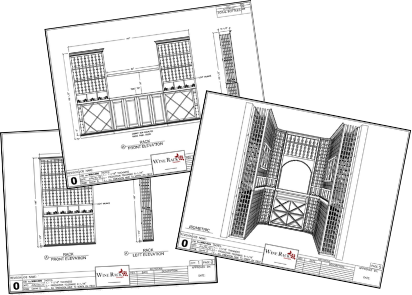
Have an expert help today!
Free 2D wine cellar design