Modern Wine Cellar Design Ideas

Did you know that 62% of luxury homeowners prioritized dedicated wine storage in their new builds? The trend is shifting away from hidden basement bunkers toward high-visibility statement pieces integrated into the main living areas. Exploring modern wine cellar design ideas is no longer just about storage; it's about creating a functional work of art that balances global material sourcing with sophisticated climate engineering. The most successful projects today acknowledge that quality components, from specialized cooling units to precision-milled racking, often come from a diverse international supply chain.
You likely want a space that looks stunning but feel concerned about the technical risks of glass-heavy enclosures or the confusion of choosing between metal and wood. It's a valid worry because a beautiful display is worthless if it fails to protect your collection. This guide shows you how to blend cutting-edge aesthetics with technical precision to create a sophisticated, climate-controlled environment that respects the value of every bottle.
We'll examine the latest trends in minimalist racking like our Fusion and Cable systems, explain the critical requirements for vapor barriers and R-values, and show you how to maximize unconventional spaces. You'll gain the clarity needed to move from an initial vision to a professional, reliable result that enhances your home and protects your investment.
Key Takeaways
- Learn how to transform standard hallways or under-stair areas into high-impact focal points using contemporary "wine wall" concepts and minimalist racking.
- Understand the reality of the global supply chain, where international component sourcing is paired with domestic design hub expertise to achieve superior quality.
- Discover the critical role of layered LED lighting in modern wine cellar design ideas to highlight your collection without introducing bottle-damaging heat.
- Master the technical requirements for glass-enclosed displays, including the necessity of insulated dual-pane glass and specific R-value insulation to prevent cooling failure.
- Explore "invisible" climate control solutions, such as ducted split systems, that maintain precise temperature and humidity without disrupting your cellar's aesthetic.
The Evolution of Modern Wine Cellar Design: From Storage to Statement
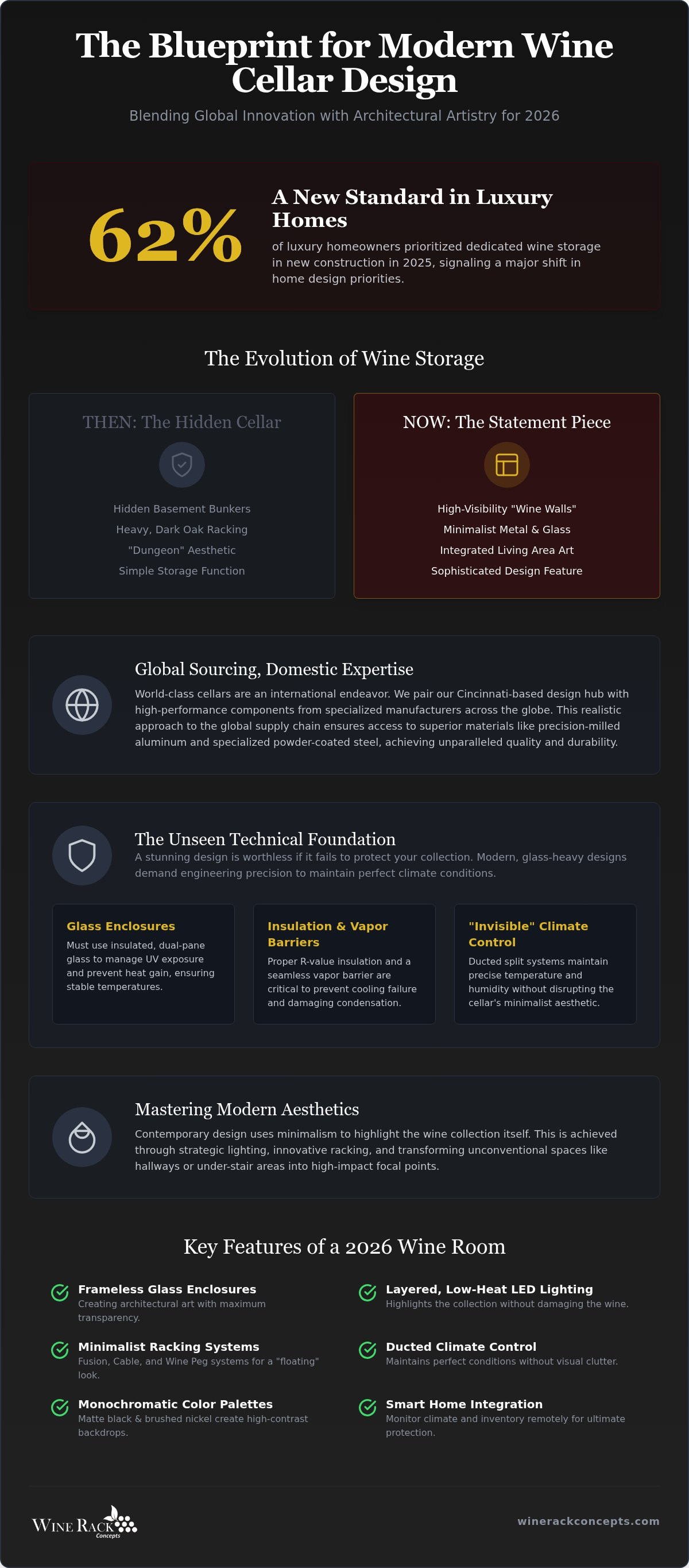
Traditional wine storage was once defined by dark basements and heavy oak racking. Today, that "dungeon" aesthetic has been replaced by a focus on transparency, clean lines, and integrated living. The most popular modern wine cellar design ideas center on the "wine wall," a high-visibility display that brings the collection out of the cellar and into the heart of the home. This shift reflects a broader movement in luxury architecture where the wine collection is treated as a piece of curated art rather than just a beverage inventory.
Achieving this sleek look requires a sophisticated approach to material sourcing. While our design hub is based in Cincinnati, we recognize that creating a world-class cellar is a global endeavor. We source high-performance components from international partners to ensure every metal peg and glass panel meets modern standards. This realistic view of the global supply chain allows us to combine domestic craftsmanship with the best materials available worldwide. The result is a product that is both durable and aesthetically superior, acknowledging that the best hardware often has international origins.
Modern design requires significantly more technical planning than traditional wood cellars. When you remove thick stone walls and replace them with glass, you change the thermal dynamics of the room. This evolution from simple storage to a design statement means that every element, from the vapor barrier to the cooling unit, must be engineered with precision. Minimalist designs don't just look better; they often represent the pinnacle of climate control engineering.
Key Characteristics of Contemporary Wine Rooms
Modern wine rooms prioritize a minimalist feel that highlights the bottles themselves. You'll often see frameless glass enclosures paired with metal accents from our Wine Peg Series or Fusion Wine Walls. These designs utilize monochromatic color palettes, often in matte black or brushed nickel, to create a high-contrast backdrop for the wine. Beyond the visuals, these spaces are increasingly integrated with smart home ecosystems. This allows you to monitor climate data and inventory levels from your phone, ensuring your investment is protected by the latest technology.
The Aesthetic Value of Transparency
Transparency is the hallmark of the current wine cellar. A glass-enclosed cellar acts as architectural art, creating a sense of depth and luxury in dining rooms or entryways. However, this visual access must be balanced with technical precision. Large glass surfaces require careful planning to manage UV exposure and heat gain. By using dual-pane, insulated glass and specialized cooling systems, we create a display that offers the psychological satisfaction of a visible, curated collection without compromising the structural integrity of the wine. It's a delicate balance that turns a simple storage room into a true home feature.
Material Innovation: Blending Global Craftsmanship with Modern Aesthetics
The standard for high-end wine storage has shifted toward a more sophisticated palette. While traditional cellars relied almost exclusively on domestic hardwoods, modern wine cellar design ideas embrace a more realistic, global perspective on manufacturing. Creating a professional-grade cellar is now an international endeavor. We design our systems in Cincinnati, but we source the highest quality components from specialized manufacturers across the globe. This approach ensures that your racking isn't just visually appealing but also engineered to withstand the unique stresses of a climate-controlled environment.
High-quality modern design often relies on this global supply chain to provide superior materials that aren't always available from a single domestic source. For example, specific precision-milled aluminum or specialized powder-coated steel may be imported to meet our exact specifications. By combining domestic design expertise with international production capabilities, we can offer products that are both innovative and durable. This transparency about where goods are produced reflects a commitment to quality over simple marketing slogans about domestic origin.
Sustainable material choices are also taking center stage. Collectors are increasingly seeking woods that are harvested responsibly and metals that can be recycled. This shift toward eco-friendly materials doesn't compromise the luxury feel. Instead, it adds a layer of modern responsibility to the pride of ownership. Using materials that resist moisture without off-gassing is essential for maintaining the air quality within your cellar and protecting the integrity of your wine labels.
Metal and Acrylic: The Modern Standard
Metal racking has become the preferred choice for those seeking a minimalist aesthetic. You'll typically choose between powder-coated steel and anodized aluminum. Steel offers a robust, industrial feel and can be finished in a variety of colors to match your decor. Anodized aluminum is exceptionally resistant to the 50% to 70% humidity levels required in a wine cellar. For a truly avant-garde look, acrylic components create a "floating bottle" effect that makes the wine appear suspended in mid-air. These materials are chosen for their durability and their ability to maximize airflow around each bottle.
The Fusion of Wood and Metal
If you find all-metal designs too cold, integrating a Fusion Wine Wall allows you to blend textures. These systems use natural wood backer boards to soften the sharp lines of metal pegs. It's a popular way to introduce warmth into a contemporary space while maintaining a clean, organized look. When selecting wood for these hybrid systems, we prioritize species like walnut or mahogany that naturally resist rot and decay in damp conditions. This ensures your display remains a timeless centerpiece for decades.
Illuminating the Collection: Best Lighting for a Modern Wine Cellar
Lighting is the bridge between simple storage and a world-class display. It defines the atmosphere of the room and dictates how your guests perceive the collection. Recently, modern wine cellar design ideas prioritize "cold" light sources that offer high visual impact without the thermal risks associated with traditional lighting. Traditional incandescent or halogen bulbs are a significant liability in a wine room. They emit infrared radiation and heat that can raise bottle temperatures, potentially "cooking" the wine and ruining its flavor profile over time.
Precision is key when selecting the color temperature of your cellar. We generally recommend a range between 2700K and 3000K. This Kelvin range provides a warm, inviting glow that keeps wine labels legible and vibrant without the clinical, blueish tint of higher-temperature commercial lighting. Achieving this balance requires high-quality components. While we design these lighting layouts at our Cincinnati headquarters, the advanced LED diodes and flicker-free drivers we use are often sourced from international technology hubs. This global sourcing ensures that the lighting systems can handle the 50% to 70% humidity levels of a cellar without failing.
Smart lighting integration has also become a standard feature for luxury builds. You can now manage your cellar's ambiance through app-integrated dimming or motion sensors that only activate the lights when someone enters the room. This doesn't just look impressive; it limits the amount of time the wine is exposed to light, further protecting your investment. It's a functional upgrade that aligns perfectly with the minimalist, tech-forward aesthetic of contemporary homes.
LED Wine Cellar Lights: Efficiency and Safety
LED technology is the only viable choice for a modern cellar because it produces virtually no heat and zero UV rays. You'll typically choose between flexible tape lighting and recessed puck lights. Tape lighting is ideal for creating a seamless glow along the back of a Fusion Wine Wall, while recessed pucks provide focused beams for traditional racking. Color Rendering Index (CRI) is a quantitative measure of a light source's ability to reveal the colors of various objects faithfully in comparison with a natural light source. For wine labels, you should always aim for a CRI of 90 or higher to ensure the reds, golds, and creams of the paper appear exactly as the winemaker intended.
Creative Wine Room Lighting Ideas
If you want to create a dramatic focal point, consider backlit panels made of onyx or translucent stone. These panels sit behind the racking, turning the entire wall into a soft, glowing light source that highlights the silhouette of every bottle. For glass-enclosed cellars, floor-to-ceiling perimeter lighting helps define the boundaries of the space and prevents the glass from looking like a dark void at night. If you're using our Wine Peg Series, you can use narrow-beam spotlights to create "pools" of light around your most prized trophy bottles, adding a sense of depth and hierarchy to your display.
Maximizing Modern Spaces: Minimalist and Integrated Solutions
Modern residential architecture often prioritizes open floor plans, which leaves little room for traditional, walk-in storage. This shift requires innovative modern wine cellar design ideas that focus on verticality and integration rather than dedicated square footage. You don't need a basement to house a professional collection. Current design trends show that hallways, under-stair alcoves, and even dining room focal walls can be transformed into high-density storage zones. By utilizing slim profiles and transparent materials, these "wine walls" provide the necessary climate control without encroaching on your living space.
Achieving this level of integration requires high-performance hardware that is often the result of global collaboration. While our design hub is in Cincinnati, the specialized high-tension cables and precision-machined metal pegs we use are sourced through an international supply chain. This realistic approach to manufacturing ensures we utilize materials with the specific tensile strength and finish durability required for minimalist displays. Acknowledging that not all high-end components are made domestically allows us to provide more reliable and aesthetically diverse options for urban apartments and luxury condos where space is at a premium.
Designing for compact footprints also means rethinking how bottles are oriented. In a traditional cellar, neck-forward storage is the standard for density. In a modern integrated display, label-forward layouts are often preferred to maximize visual impact. These systems allow you to see your collection clearly while maintaining a slim depth of only a few inches from the wall. It's a functional way to turn a transition space into a sophisticated gallery.
Cable and Glass Wine Racks: The Ultimate Floating Look
If you want to achieve an airy, weightless aesthetic, tensioned cable systems are the premier choice. These systems use thin stainless steel cables that run from the floor to the ceiling, suspending bottles in mid-air. Because the cables have a minimal visual footprint, the wine appears to be floating behind your frameless glass doors. This setup requires significant technical planning. The ceiling and floor must be structurally reinforced to handle the tension of the cables, especially in high-capacity installs. Pairing these with our Metal Wine Cellar Doors ensures a tight seal while maintaining the "open" feel of the design.
Explore Modern Racking Solutions
Wine Peg Systems for Custom Layouts
The Wine Peg Series offers the ultimate flexibility for unconventional or odd-shaped walls. Because each peg is an individual unit, you can create a completely custom layout that follows the rake of a staircase or fits inside a shallow cabinet. You can choose between label-forward displays for maximum visibility or neck-forward configurations to increase bottle count in tight spots. These pegs are designed to be integrated directly into various backer materials, including wood, stone, or acrylic. This versatility makes it easy to blend your wine storage with existing cabinetry or high-end furniture pieces already in the room.
Technical Precision: Ensuring Modern Designs Meet Climate Standards
Modern aesthetics often clash with the laws of thermodynamics. While frameless glass and minimalist lines are the foundation of modern wine cellar design ideas, they present significant challenges for climate control. Glass is a poor insulator compared to traditional studded walls. To protect your collection, every design choice must be supported by invisible engineering. This means calculating heat gain through glass surfaces and ensuring the refrigeration system can compensate without overworking. A beautiful display isn't functional if it can't maintain the 55-degree standard.
High-performance cooling requires specialized components that we source from a global network of manufacturers. While we assemble and design systems in Cincinnati, many of the precision compressors and electronic controllers are produced internationally. This reflects the reality of the current marketplace; the most reliable technical solutions are rarely found in a single domestic location. By embracing global manufacturing, we provide cooling units that offer the longevity and precision required for luxury residential environments. This factual approach to sourcing ensures your cellar remains a stable environment for decades.
Success in modern design depends on the integrity of the thermal envelope. If you're building a glass-heavy room, you must account for the R-value of every surface. Standard R-19 insulation for walls and R-30 for ceilings is the baseline, but glass requires even more attention. Without these technical safeguards, your cooling system will run constantly, leading to premature failure and fluctuating temperatures that damage the wine's aging process.
Optimizing the Thermal Envelope
We use Insulated Glass Units (IGU) to provide a thermal break between the cellar and the rest of the home. These dual-pane panels are essential for preventing condensation and maintaining internal stability. Our Metal Wine Cellar Doors are equipped with specialized gaskets and drop-down thresholds to eliminate air leaks at the perimeter. A continuous vapor barrier must be installed on the warm side of the cellar walls to prevent moisture from migrating into the insulation and causing structural damage over time.
Selecting Contemporary Cooling Equipment
Noise management is a critical consideration for cellars integrated into living areas. You don't want a loud compressor disrupting a dinner party or a quiet evening. Self Contained Refrigeration Units can be integrated directly into cabinetry for a seamless look, provided they have adequate ventilation. For the quietest operation, ducted Wine Cellar Cooling systems allow you to place the mechanical components in a remote location. This ensures that only the cool air reaches the cellar, leaving the aesthetic undisturbed. Dedicated climate control is non-negotiable because standard home HVAC systems cannot maintain the 50% to 70% humidity levels required to keep corks from drying out.
Bringing Your Modern Vision to Life
Creating a professional-grade cellar is about more than just temperature. It's a strategic integration of architectural art and precise engineering. You've seen how modern wine cellar design ideas have evolved from hidden storage into high-visibility focal points that define a home's character. Success relies on balancing the transparency of frameless glass with the technical rigor of vapor barriers and dedicated cooling systems. Our approach combines domestic design expertise at our Cincinnati hub with a realistic understanding of the global supply chain. We source specialized components internationally to ensure your Fusion or Cable systems meet the highest standards of durability and performance.
Explore our Modern Wine Wall and Racking Series
Whether you're converting a small urban alcove or designing a grand perimeter wine wall, the right partnership makes all the difference. We provide the expert guidance needed to navigate material choices and climate requirements with quiet confidence. It's time to transform your space into a sophisticated gallery that protects your investment for years to come. Your collection deserves a display as exceptional as the wine itself.
Frequently Asked Questions
What is the best lighting for a wine cellar?
LED systems with a high Color Rendering Index (CRI) of 90 or above are the industry standard. These lights offer the best visibility for labels without emitting heat or UV rays that could damage your collection. We recommend a color temperature between 2700K and 3000K to create a warm, luxury ambiance. Many of the high-performance LED drivers and smart controllers used in these systems are sourced from international technology hubs to ensure reliability in high-humidity environments.
Can I use regular glass for a modern wine cellar door?
No, you shouldn't use standard single-pane glass for any wine enclosure. Effective modern wine cellar design ideas require dual-pane, insulated glass units (IGUs) to maintain a stable internal climate. Regular glass lacks the thermal resistance needed to prevent the cooling unit from overworking. It also leads to significant condensation issues. Using tempered, insulated glass ensures your display remains clear and your wine stays protected from external temperature fluctuations.
How do modern metal wine racks compare to traditional wood?
Modern metal racks offer superior airflow and a more minimalist aesthetic compared to traditional wood. While wood provides a classic look and natural vibration dampening, metal series like our Wine Pegs allow for higher bottle density in shallow spaces. These metal components are often the result of global manufacturing, utilizing precision-milled aluminum or steel that resists corrosion in damp cellar conditions. Metal is generally easier to clean and provides a more open view of your labels.
Are modern wine walls as efficient as traditional cellars?
Modern wine walls are just as efficient as traditional walk-in cellars if they're engineered with a proper thermal envelope. This includes using R-19 insulated walls, dual-pane glass, and a dedicated cooling system. Because wine walls are often located in central living areas, they require precise calculations to handle the higher ambient heat. When built correctly with a sealed vapor barrier, these integrated displays provide a professional-grade environment that rivals any basement cellar.
What are the best materials for a contemporary wine room?
The best materials for a contemporary look include powder-coated steel, anodized aluminum, and moisture-resistant hardwoods like walnut. Acrylic is also popular for creating "floating" bottle effects. We source these materials globally to ensure we're using the most durable finishes available. For the best results, combine these with stone or porcelain backer panels. These materials don't just look sleek; they're chosen specifically for their ability to withstand 50% to 70% humidity without warping or off-gassing.
How much does a custom modern wine cellar cost to build?
The cost varies based on size and material choices, but recent industry data suggests an average project cost of approximately $40,000. Most residential projects fall within a range of $250 to $700 per square foot. Factors that influence this include the type of cooling system and the amount of custom glass work required. While some components are manufactured domestically, the inclusion of specialized international hardware and high-performance cooling units will also impact the final investment.
Do I need a vapor barrier for a glass-enclosed wine wall?
Yes, a vapor barrier is a non-negotiable component for any climate-controlled wine wall. It must be installed on the "warm" side of the cellar wall to prevent moisture from migrating into the wall cavity. Without this barrier, condensation will form inside the walls, leading to mold growth and structural decay. Even in modern wine cellar design ideas that prioritize glass, the surrounding solid walls and ceiling must be properly sealed to maintain a consistent humidity level.
How do I maintain humidity in a modern minimalist cellar?
You maintain humidity through a dedicated wine cellar cooling unit that's specifically designed to manage both temperature and moisture. Standard home air conditioning removes too much humidity, which can dry out corks and spoil the wine. A professional system will keep the room between 50% and 70% humidity. If you live in an exceptionally dry climate, we may recommend an integrated humidifier that works alongside your cooling unit to ensure the environment stays stable year-round.
Have an expert help today!
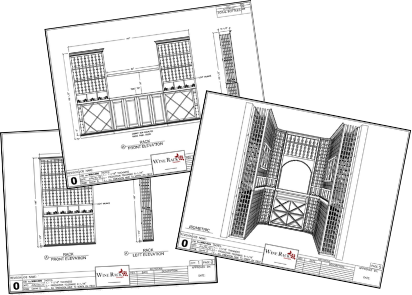
Free 2D wine cellar design