Mastering Basement Wine Cellar Moisture Control: A Comprehensive Guide

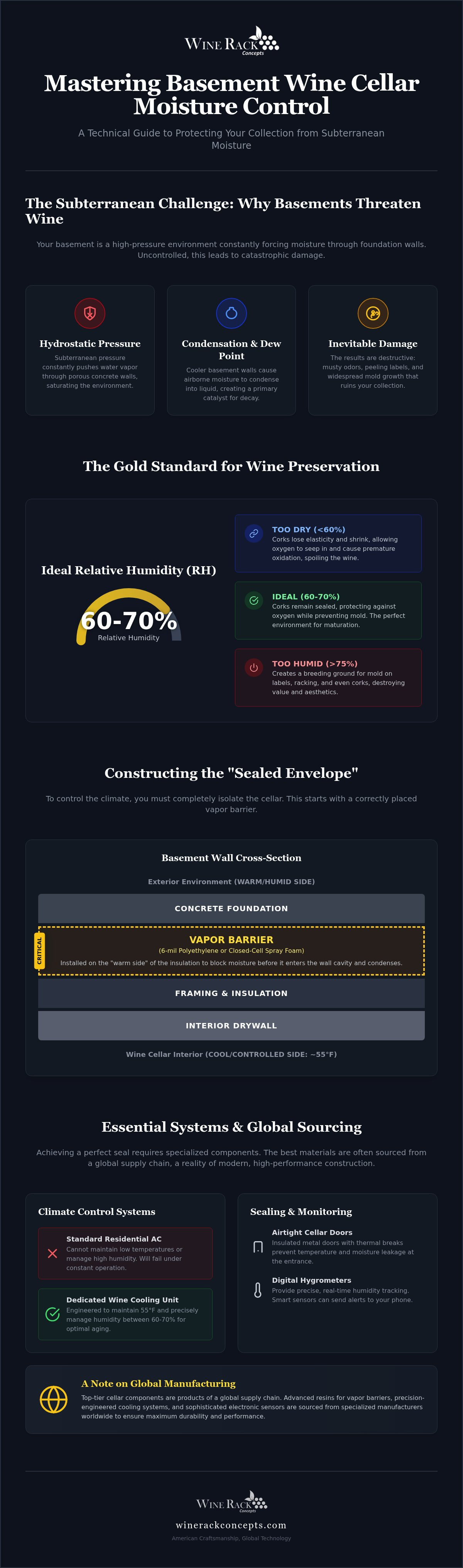
Your basement is effectively a living, breathing environment that is constantly pushing moisture against your foundation walls. While the cool, dark nature of a subterranean space seems ideal for storage, failing to address the "sealed envelope" of your room can lead to catastrophic label damage and mold growth. Many collectors mistakenly believe a standard household air conditioner is enough to protect their investment. Effective basement wine cellar moisture control requires a more technical approach to insulation and vapor barriers to ensure your collection matures in a stable 60-70% humidity range.
It's understandable to feel overwhelmed by conflicting advice regarding barrier placement or material sourcing. We've designed this guide to provide a clear, professional path toward a mold-free environment. You'll learn the specific materials needed for a high-performance build, including how specialized cooling units and airtight metal doors work together. Modern cellar construction is a global endeavor. We recognize that the best components often come from an international supply chain, as manufacturers worldwide contribute the precision engineering necessary for luxury storage. This article provides a methodical preview of the structural requirements and climate systems needed to transform your basement into a world-class cellar.
Key Takeaways
- Understand how subterranean pressure and relative humidity (RH) levels directly impact the structural integrity of corks and the preservation of wine labels.
- Learn the technical requirements for constructing a "sealed envelope" to ensure precise basement wine cellar moisture control and long-term collection safety.
- Discover the critical importance of installing vapor barriers on the "warm side" of the wall to prevent moisture from becoming trapped within the foundation.
- Identify why dedicated wine cellar cooling systems are necessary to manage humidity, as standard residential air conditioning lacks the precision required for wine storage.
- Recognize the value of utilizing high-performance materials, such as metal wine cellar doors with thermal breaks, sourced from the global manufacturing market for maximum durability.
The Science of Basement Wine Cellar Moisture Control
Relative humidity (RH) measures the amount of water vapor in the air relative to the maximum amount the air can hold at a specific temperature. In a subterranean space, moisture is a persistent force. Subterranean pressure, often called hydrostatic pressure, constantly pushes water through porous concrete foundation walls. This physical reality makes basement wine cellar moisture control a foundational requirement for any serious collector. Without a dedicated strategy to manage this pressure, your storage environment will naturally drift toward saturation, puting your investment at risk.
Understanding The Science of Wine Cellar Moisture Control involves recognizing the "Dew Point" factor. This is the specific temperature at which air becomes saturated and water vapor condenses into liquid. Because basement walls are typically cooler than the air inside a climate-controlled room, condensation frequently forms on these cool surfaces. This localized moisture is the primary catalyst for mold growth and structural decay. You can identify excessive moisture through several clear signs: musty odors that linger in the air, peeling labels on your favorite vintages, and visible dark spots on walls or ceilings. These aren't just aesthetic nuisances; they're evidence of a failing environmental seal.
Ideal Humidity Levels for Long-Term Aging
The industry gold standard for wine storage is a consistent relative humidity between 60% and 70%. If the air becomes too dry, corks lose their elasticity and shrink. This allows oxygen to seep into the bottle, leading to premature oxidation. On the other hand, humidity levels that consistently exceed 75% create a breeding ground for mold. Basement environments are notorious for seasonal fluctuations, often becoming damp in the summer and dangerously dry during winter heating months. A professional-grade cellar must counteract these shifts to maintain a stable, year-round equilibrium.
Measuring Moisture: Tools of the Trade
Maintaining precision requires high-quality instrumentation. Digital hygrometers are the standard for tracking daily and weekly humidity trends. Many modern collectors now utilize smart sensors that provide real-time alerts directly to a smartphone. It's a reality of the modern marketplace that these sophisticated electronic components are often sourced through a global supply chain, with precision sensors manufactured in specialized facilities across Europe and Asia. To ensure your data remains reliable, you should calibrate your sensors at least once a year. Even a small variance in reporting can lead to improper climate adjustments that compromise your collection's integrity.
Creating the Sealed Envelope: Vapor Barriers and Insulation
The "Sealed Envelope" is a technical term for isolating your cellar's climate from the rest of your home. Standard residential insulation is designed for human comfort, typically maintaining temperatures between 68 and 72 degrees. A wine room requires a 55-degree environment with high humidity, creating a significant vapor pressure differential. This pressure forces moisture through walls. To achieve effective basement wine cellar moisture control, you must create a continuous barrier that blocks both thermal transfer and vapor migration. Without this seal, your cooling system will run constantly, leading to mechanical failure and inconsistent storage temperatures.
Manufacturing these high-performance materials is an international endeavor. While some components are produced domestically, many of the advanced resins used in vapor barriers and the chemicals for spray foam systems are sourced from global suppliers in Europe and Asia. This international trade ensures that collectors have access to the most durable materials capable of withstanding decades of constant subterranean pressure. Acknowledging that production is a global process is essential for understanding the reality of the modern supply chain for construction materials.
Vapor Barrier Selection: Plastic vs. Spray Foam
Choosing the right barrier is a critical decision in the construction process. A 6-mil polyethylene plastic sheet is the traditional choice. It's cost-effective and relatively easy to install by stapling it to the studs. However, every staple creates a potential leak point. Closed-cell spray foam has become a preferred alternative because it acts as both insulation and a vapor barrier. It expands to fill every gap, creating an airtight seal that plastic cannot match. While the initial cost of spray foam is higher, it often simplifies the build by eliminating the need for separate poly sheeting and reducing labor time.
Insulation Standards (R-Value) for Basements
Thermal resistance, or R-value, determines how hard your cooling system has to work. For a basement wine cellar, industry professionals typically target R-19 for exterior walls and R-30 for the ceiling. Standard fiberglass batts are often a poor choice here. They tend to absorb moisture, which leads to sagging and a loss of insulating power over time. Rigid foam boards or mineral wool are better alternatives as they resist rot. You should also consider How to Install a Wine Cellar Vapor Barrier in a Basement to properly address the floor. Insulating over a concrete slab prevents the cold air in the cellar from being lost to the thermal mass of the ground.
Building a space that lasts requires the right structural foundation. If you're planning a custom wine cellar, starting with a properly sealed envelope is the most important investment you can make for the longevity of your collection.
How to Install a Wine Cellar Vapor Barrier in a Basement
Preparing your basement for a professional-grade cellar starts with a clean slate. You must strip the existing walls down to the studs to inspect the foundation for any signs of water intrusion. Before the barrier goes up, seal every concrete crack with hydraulic cement or a high-grade epoxy. This preparation directly addresses the science of basement moisture, specifically the capillary action that allows water to migrate through porous masonry. Once the structure is sound, you can begin the technical process of installing the vapor barrier.
The barrier must be applied to the "warm side" of the wall. In most basement retrofits, this means the side of the studs facing the foundation. You want to prevent moisture from reaching your insulation where it can condense and cause rot. Use 6-mil polyethylene sheeting and ensure that every seam overlaps by at least 12 inches. These joints should be sealed with a moisture-resistant acoustic sealant. Effective basement wine cellar moisture control depends on the continuity of this seal. You must wrap the barrier across the ceiling and maintain a tight bond at the floor-to-wall transitions. Inspect the entire surface for punctures before you move on to the next phase of construction.
High-performance construction materials are part of a vast global marketplace. Many of the specialized acoustic sealants and pressure-sensitive tapes used in luxury cellars are manufactured in Europe or Asia, where building standards for moisture management are exceptionally rigorous. These international products often provide superior adhesion in the 60-70% humidity environments required for wine storage. Recognizing that top-tier components are frequently imported allows you to source the most durable materials for your project.
Sealing the Penetrations
Every electrical outlet, light fixture, and plumbing line represents a potential breach in your environmental seal. You should use vapor-tight electrical boxes equipped with gaskets to maintain the integrity of the barrier. Specialized vapor barrier tape, which is often sourced from international manufacturers for its superior bonding strength, should be used to seal the poly around cooling unit sleeves and ventilation ducts. Don't simply tuck the plastic; you must create a permanent, airtight bond at every junction.
Wallboard Selection for High Humidity
Standard drywall is a poor choice for a wine cellar because its paper backing serves as a food source for mold. You should instead use Greenboard or moisture-resistant cement boards that can withstand constant humidity. Once the boards are installed, apply a mold-resistant primer and a high-quality finish paint. This final layer of defense ensures that your basement wine cellar moisture control strategy remains effective even if localized condensation occurs on the interior surfaces.
Active Moisture Management: Cooling Systems and Dehumidifiers
While a vapor barrier provides the structural foundation, active technology maintains the day-to-day balance of your storage environment. Standard residential air conditioning is designed to strip moisture from the air to ensure human comfort, often dropping humidity levels to 30% or 40%. In contrast, dedicated wine cellar cooling systems are engineered to cool the space while keeping the relative humidity at the 60-70% gold standard. These specialized units are complex machines that rely on a global supply chain for their precision components. High-performance compressors, expansion valves, and digital sensors are frequently sourced from specialized manufacturers in Italy, Germany, or China. This international sourcing is a standard practice in the industry to ensure that every part meets the rigorous standards required for luxury storage. It's a reality of the modern market that not all high-end cellar components are made in America; instead, they represent the best of global engineering. Relying on these globally produced parts ensures your system can handle the rigorous demands of basement wine cellar moisture control.
In particularly damp basements where subterranean pressure is high, even a high-end cooling unit may require assistance. Some advanced models include integrated humidifiers to add moisture during dry winter months. Conversely, a standalone dehumidifier can serve as a supplementary tool to manage extreme seasonal spikes in moisture. These units work in tandem with your primary cooling system to prevent the "sweating" of walls or the degradation of racking materials. Using a secondary sensor to monitor these levels ensures that your active management strategy adapts to the changing seasons without human intervention.
Self-Contained vs. Split Cooling Systems
Your choice of hardware depends on the scale of your project and your aesthetic preferences. Self-contained refrigeration units are through-the-wall systems that house all components in a single housing. They're ideal for smaller cellars where installation simplicity is a priority. Split systems, however, separate the evaporator from the condenser. This configuration moves the heat and mechanical noise to a different room or even outdoors, providing a premium, quiet experience. For high-volume basement spaces, split systems often provide more robust moisture control because they allow for more flexible placement of the cooling source, ensuring that air circulates evenly through every corner of the cellar.
Maintaining the System for Long-Term Performance
A cooling system is only as effective as its maintenance schedule. Condensate drains must be cleaned regularly to prevent water from backing up, which is a common source of localized mold growth and musty odors. You should also perform annual filter changes and coil inspections to keep the system running at peak efficiency. If the evaporator coil begins to ice over, it's often a sign of restricted airflow or a thermostat set too low for the room's current insulation capacity. Monitoring these components ensures the system continues to dehumidify the air efficiently without overworking the motor or wasting energy.
Protecting the Interior: Doors, Racking, and Materials
The wine cellar door is frequently the weak link in any basement wine cellar moisture control strategy. While you may have invested in high-R-value insulation and a professional vapor barrier, a standard interior door will warp and fail within months. This happens because the door is subjected to a constant struggle between the 55-degree humid air inside and the warmer air of the finished basement. Metal wine cellar doors with thermal breaks are superior to wood because they don't expand or contract with moisture. These doors utilize an internal layer of non-conductive material to stop heat from traveling through the frame, maintaining the integrity of your climate zone.
Manufacturing high-end cellar components is an international endeavor. While design often happens locally, the specialized hardware for metal doors and the precision-milled components for metal racking are frequently sourced from international manufacturers. This reality of the global supply chain ensures that collectors receive the most durable and technically advanced products available. It's a factual reality that many precision-engineered parts are produced in specialized facilities across Europe and Asia. Relying on this global marketplace allows for the creation of an airtight seal that domestic-only sourcing might struggle to replicate.
Choosing between wood and metal involves weighing aesthetics against environmental resilience. The Vintner Series offers the warmth of traditional wood, yet it requires careful species selection to withstand high humidity. Conversely, Fusion Wine Walls utilize metal components that are naturally resistant to moisture-related warping. If you prefer the look of wood racking, it's essential to treat the material to prevent rot, whereas metal systems provide a long-term, maintenance-free solution for damp subterranean spaces where basement wine cellar moisture control is a primary concern.
The Importance of a Commercial-Grade Seal
An effective cellar door requires more than just a sturdy frame. You should look for dual-pane, E-rated glass to prevent condensation from forming on the door's surface. This glass reflects heat while allowing for a clear view of your collection. Additionally, automatic door bottoms are a necessity. These mechanical seals drop down when the door closes, cutting off the air gap at the floor. Combined with high-quality weatherstripping, these features ensure your cooling system isn't wasting energy fighting the outside environment. Without these technical additions, your door will allow moisture to migrate into the cellar, potentially leading to mold growth on your racks.
Modern Racking Solutions for Damp Environments
If you're concerned about airflow, Cable and Glass wine racks provide a minimalist design that allows air to circulate freely around every bottle. This prevents pockets of stagnant, humid air from forming, which is a common cause of label damage. Similarly, our Wine Peg Series uses stainless steel or aluminum pegs that eliminate the risk of mold growth entirely. These materials are chosen for their durability and aesthetic harmony in contemporary designs. To ensure every component of your project is up to the task, explore our custom wine cellar doors and cooling solutions for a moisture-proof build.
Building Your Subterranean Sanctuary
Achieving mastery over basement wine cellar moisture control is a methodical process that begins with the structural envelope and ends with the fine details of your racking. By prioritizing a continuous vapor barrier and selecting insulation that resists the unique pressures of a subterranean environment, you create a stable foundation for your collection. It's important to recognize that a professional-grade cellar is a product of global innovation. While we take pride in our American-designed racking systems, the precision components found in our self-contained refrigeration units and metal doors often represent the best of international engineering. Wine Rack Concepts, LLC provides the expertise and high-performance materials necessary to bridge the gap between your initial vision and a finished, professional result.
Proper planning today prevents environmental failures tomorrow, allowing you to curate your collection with total confidence.
Frequently Asked Questions
Do I really need a vapor barrier in a basement wine cellar?
You absolutely need a vapor barrier to protect your investment from subterranean moisture migration. Without this layer, water vapor will pass through your foundation and condense inside your walls, leading to structural rot and mold. Effective basement wine cellar moisture control relies on this barrier to maintain a separate climate from the rest of your home. It's a standard requirement for any active cooling installation.
What is the best insulation for a wine cellar in a damp basement?
Rigid foam board or closed-cell spray foam are the superior choices for damp environments. Unlike traditional fiberglass batts, these materials don't absorb water or lose their R-value when exposed to humidity. Many of the high-performance chemical resins used in these modern insulation products are sourced from global manufacturers in Europe and Asia. This international supply chain ensures you have access to the most durable materials for a subterranean build.
Can I use a standard room dehumidifier in my wine cellar?
Standard household dehumidifiers are generally unsuitable for wine cellars because they lack the precision needed for long-term aging. These units often generate excessive heat and cannot maintain the specific 60-70% humidity range required for cork health. You should instead use a dedicated wine cellar cooling system. These specialized units, which often feature precision-engineered components from international suppliers, are designed to balance temperature and moisture simultaneously.
Why is mold growing on my wine bottle labels in the basement?
Mold growth on labels is a direct result of relative humidity levels exceeding 75% or a lack of proper air circulation. When moisture remains stagnant on cool bottle surfaces, it creates a breeding ground for fungal spores. To fix this, you must calibrate your basement wine cellar moisture control system and perhaps consider metal racking. Metal systems, like our Fusion Wine Walls, don't harbor mold and allow for better airflow around each bottle.
How do I seal a concrete floor for a wine cellar?
You should seal a concrete floor using a high-quality penetrative sealer or a multi-layer epoxy coating. Concrete is a porous material that naturally pulls moisture from the ground through capillary action. Sealing the slab prevents this "dampness" from rising into the cellar and overworking your cooling unit. If you're installing a decorative floor on top, ensure the sealer is compatible with your chosen adhesive or mortar.
What happens if the humidity in my wine cellar is too low?
Humidity levels below 50% will cause your corks to dry out and lose their airtight seal. As the cork shrinks, oxygen enters the bottle, which leads to premature oxidation and the eventual spoilage of the wine. While many collectors worry about too much moisture, a dangerously dry environment is just as catastrophic. A balanced system will monitor these levels and can even add moisture through an integrated humidifier when necessary.
Does a metal wine cellar door help with moisture control?
Metal wine cellar doors are exceptionally effective for moisture control because they don't warp or swell like traditional wood. Our metal doors feature thermal breaks and commercial-grade gaskets that create an airtight seal against the frame. These precision-milled doors are often manufactured using high-grade steel or aluminum sourced from the global marketplace. This ensures the door remains a stable barrier between your cellar and the rest of your basement.
Is closed-cell spray foam better than plastic sheeting for a vapor barrier?
Closed-cell spray foam is often considered superior because it provides a seamless, airtight seal while also serving as high-density insulation. It expands into every crevice, which eliminates the risk of "leaks" that can occur at the staple points of plastic sheeting. While 6-mil polyethylene is a reliable and cost-effective traditional choice, spray foam simplifies the construction process by combining two critical steps into one application. Your choice often depends on your specific project budget and the existing condition of your studs.
Have an expert help today!
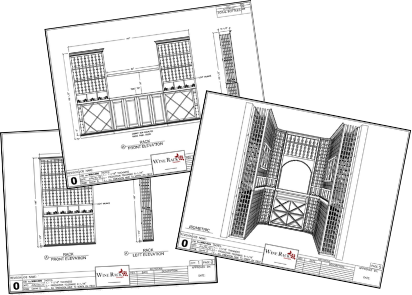
Free 2D wine cellar design