How to Size Your Wine Cellar Cooling Unit: A Technical Planning Guide

*Pictures are renderings. Actual wine racks may look different
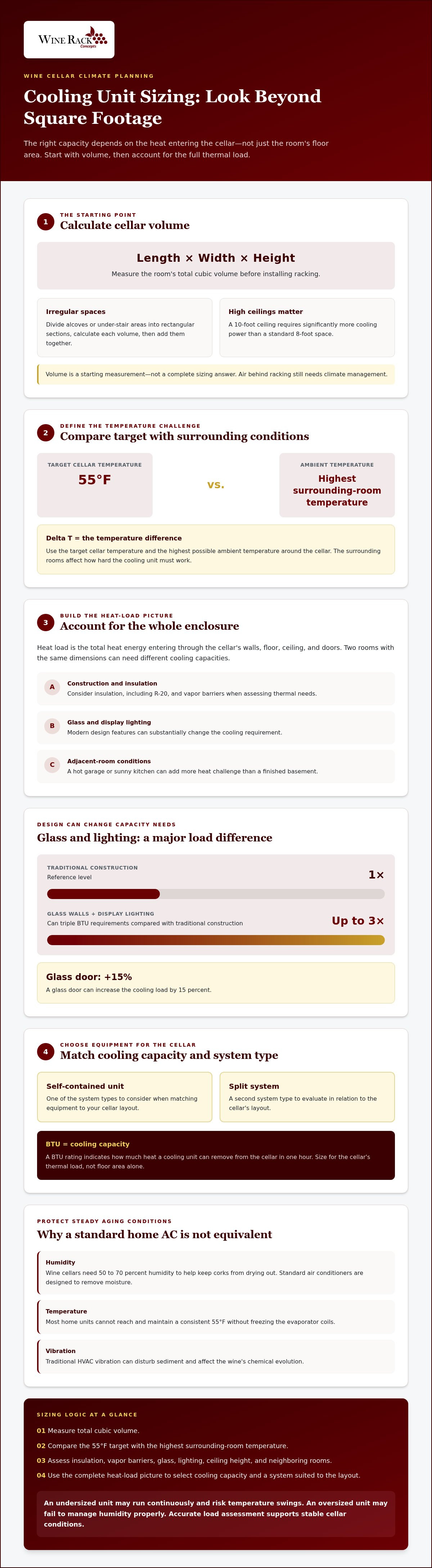
If you select a cooling unit based solely on the square footage of your room, you aren't just guessing; you're risking your entire collection. Many collectors feel a sense of dread when the summer heat rises, fearing their equipment will fail at the most critical moment. The truth is that proper wine cellar cooling unit sizing is a technical calculation of thermal resistance, not a simple measurement of floor space. Relying on a basic rule of thumb often leads to undersized units that run constantly, or oversized units that fail to manage humidity properly, leaving your investment vulnerable.
We understand that the gap between BTU ratings and real-world performance can be confusing, especially when you're factoring in modern design elements like glass walls. This guide simplifies the process by walking you through the precise steps to calculate heat load for your specific environment. You'll learn how variables like R-20 insulation and vapor barriers impact your needs, and why a glass door can increase your cooling load by 15 percent. We'll provide the clarity you need to choose a system that ensures a stable 55°F environment and gives you the confidence to communicate effectively with contractors.
Key Takeaways
- Learn why cubic volume is only the starting point for wine cellar cooling unit sizing and how to account for environmental thermal resistance.
- Discover how modern design features like glass walls and display lighting can triple your BTU requirements compared to traditional construction.
- Understand the functional differences between self-contained refrigeration units and split systems to select the right fit for your cellar's layout.
- Identify the impact of adjacent room temperatures to prevent equipment burnout and ensure long-term climate stability for your collection.
- Acquire the technical vocabulary needed to collaborate effectively with contractors on professional thermal load calculations.
Understanding the Fundamentals of Wine Cellar Cooling Unit Sizing
Creating a sanctuary for your wine collection requires more than just a dedicated room and beautiful racking. It demands a sophisticated climate control strategy that begins with accurate wine cellar cooling unit sizing. At the heart of this process is the British Thermal Unit (BTU), a standard measurement of energy. In our industry, a BTU rating indicates the cooling capacity of a unit, specifically how much heat it can remove from your cellar in one hour. If you don't account for the unique thermal needs of your space, you risk more than just a high energy bill.
Proper sizing ensures thermal stability, which is the cornerstone of long-term aging. Wine is sensitive. When temperatures fluctuate, the liquid inside the bottle expands and contracts. This movement can compromise the seal of the cork, leading to oxidation and the loss of delicate aromatics. If a unit is undersized, it'll run continuously to compensate, leading to premature mechanical failure and dangerous temperature swings during peak summer months. A unit that works too hard won't last, and your collection will pay the price.
The Difference Between Volume and Thermal Load
Calculating the cubic footage of your space is a necessary first step, but it's rarely enough to determine the correct equipment. Two cellars with the exact same dimensions may require vastly different cooling capacities depending on their "heat load." This term refers to the total amount of heat energy entering the space through walls, floors, ceilings, and doors. It's the sum of all thermal challenges the system must overcome.
When planning your project, you must consider the temperature of the surrounding rooms. If your cellar shares a wall with a hot garage or a sunny kitchen, the unit must work harder than if it were adjacent to a finished basement. This distinction is what separates active and passive wine cellars, where active systems must be precisely calibrated to overcome the environmental heat gain of the building. The goal is to reach a steady 55°F regardless of what's happening on the other side of the wall.
Why Standard Air Conditioners Are Not a Substitute
It's tempting to think a high-end residential AC unit can do the job, but these systems are designed for human comfort, not wine preservation. They simply aren't built for the task.
- Humidity Management: Standard air conditioners are designed to remove moisture from the air. In a wine cellar, you need to maintain 50 to 70 percent humidity to keep corks from drying out.
- Temperature Setpoints: Most home units can't reach or maintain a consistent 55°F without freezing the evaporator coils.
- Vibration Control: Traditional HVAC systems often produce significant vibrations. For aging wine, these micro-movements can disturb sediment and alter the chemical evolution of the vintage.
Achieving the perfect wine cellar cooling unit sizing requires looking at these variables as a whole. It's about protecting the integrity of every bottle you've carefully selected.
The Step-by-Step Process for Calculating BTU Requirements
Determining the correct wine cellar cooling unit sizing requires a methodical approach that accounts for every thermal variable in your room. While many online tools offer a "quick fix," understanding the logic behind the numbers allows you to make an informed investment. The process begins with basic dimensions but quickly moves into the nuances of insulation and environmental exposure. It's not just about the space you have; it's about the heat the system must fight.
Calculating Cubic Footage Correctly
Start by measuring the total cubic volume of your space. Multiply the length, width, and height of the room. If your design includes irregular shapes like arched alcoves or under-stair storage, break the room into smaller rectangular sections and sum their volumes. High ceilings are a critical factor. Because heat rises, a room with 10-foot ceilings requires significantly more cooling power than a standard 8-foot space to maintain a stable environment at the bottle level. Always measure the total structural volume before you install racking, as the air space behind your components still requires climate management.
Determining the Temperature Differential
The "Delta T" is the difference between your target cellar temperature (usually 55°F) and the highest possible ambient temperature of the surrounding rooms. If your cellar shares a wall with a garage that reaches 90°F in August, your unit must overcome a 35-degree differential. You must use summer peak temperatures as your baseline. Sizing a system based on spring or autumn averages will lead to equipment failure when the heat is most intense. Efficiency is key here. Choosing ENERGY STAR certified coolers or similar high-efficiency units can help manage the energy load created by these wide differentials without overworking the compressor.
Once you have the volume and Delta T, you must factor in the R-value of your construction. Industry standards recommend a minimum of R-19 insulation, though R-20 is the common baseline for modern calculations. For a cellar with R-20 insulation, a rough estimate is 3.5 to 4.5 BTU per cubic foot. Finally, account for internal heat sources. Every LED display light adds a small amount of heat, and frequent door openings introduce warm, unconditioned air. If you plan on hosting tastings inside the cellar, the body heat of guests must also be included in your final heat load sum. If these variables seem complex, our team can help you finalize a professional thermal load calculation to ensure your wine cellar cooling unit sizing is perfect. Feel free to reach out to our consultants for a detailed review of your plans.
Heat Load Variables: Why Volume is Only the Starting Point
While cubic volume provides a baseline, the specific materials used in your cellar's construction dictate the true wine cellar cooling unit sizing requirements. A room wrapped in high-performance insulation behaves differently than one featuring expansive glass displays. If you overlook these variables, your cooling system will struggle to maintain the necessary 55°F setpoint during peak thermal stress. Understanding these nuances is the difference between a system that lasts decades and one that burns out in its first three years.
Designing with Glass and Modern Racking
Modern aesthetics often prioritize visibility, yet glass is thermally transparent. Single-pane glass offers virtually no insulation, which can triple your BTU requirements compared to a standard insulated wall. If your design includes a glass door, you should account for an approximate 15 percent increase in required cooling capacity. We recommend using dual-pane, tempered glass with a thermal break to mitigate this heat gain.
The choice of racking also influences your climate. Traditional wood racking provides thermal mass, helping to stabilize temperatures. In contrast, modern systems like Fusion Wine Walls or metal peg series allow for superior airflow around each bottle. This increased circulation is beneficial for consistent cooling, but it means the unit must be sized to handle the lack of insulating wood mass. Metal and glass racking styles require the cooling unit to respond more quickly to environmental shifts, making precise sizing even more critical.
The Impact of Insulation and Vapor Barriers
Thermal resistance is measured in R-values, and for a wine cellar, higher is always better. The industry standard is a minimum of R-19 for walls, though we frequently calculate based on R-20 to ensure a buffer for extreme weather. If your walls are finished with stone or brick veneers, don't assume the material provides insulation. These are often heat sinks that require robust backing to prevent thermal transfer into the cellar.
A 6-mil vapor barrier is equally vital. It must be installed on the warm side of the insulation to prevent condensation from forming inside your walls. Without this barrier, moisture will infiltrate the space, causing the cooling unit to work overtime to dehumidify the air. This constant operation leads to equipment fatigue and unstable humidity levels, which should ideally stay between 50 and 70 percent to protect your corks.
Finally, consider your lighting and seals. Every halogen bulb acts as a small heater, adding to the thermal load. Switching to LED display lights reduces this heat output significantly. Even the smallest gap under a door can lead to air infiltration, forcing the system to cool the entire house rather than just the cellar. Professional wine cellar cooling unit sizing accounts for these "hidden" heat sources, ensuring your collection remains in a state of perfect, undisturbed preservation.
Matching Sizing Results with the Right Cooling System Type
Once you've finalized your heat load calculations, the next step is selecting the hardware that can deliver that specific cooling power. Not all systems are created equal. The physical constraints of your home often dictate which technology is the best fit for your wine cellar cooling unit sizing results. If you have a compact cellar under a staircase, a through-the-wall unit might be perfect. If you're building a glass-enclosed masterpiece in the center of a living room, you'll likely need a split or ducted system to manage the thermal load without compromising design.
Self-Contained vs. Split Systems
If your cellar is located on an exterior wall or next to a large, well-ventilated utility room, self-contained refrigeration units are often the most cost-effective solution. These units house the evaporator and condenser in one chassis. They're straightforward to install but require the exhaust space to be at least the same size as the cellar itself to prevent heat recycling.
For larger collections or spaces with significant glass, a split system is usually superior. By separating the noisy condenser from the quiet evaporator inside the cellar, you gain more flexibility in sizing. Split systems can handle higher BTU requirements more efficiently than most through-the-wall models. They're particularly effective when your wine cellar cooling unit sizing indicates a need for high capacity but you want to maintain a minimalist aesthetic without a bulky unit visible in your display.
Ventilation and Exhaust Requirements
Your sizing calculation only works if the unit can breathe. Every cooling system works by removing heat from the cellar and rejecting it elsewhere. If the exhaust area is too small or lacks airflow, the heat will build up, causing the unit to cycle on and off or fail entirely. This is why learning more about custom wine cellar design is essential before finalizing your cooling choice. An integrated approach ensures that your racking and cooling work in harmony.
It's also wise to choose a unit with reserve capacity. We generally recommend selecting a system that provides about 10 to 20 percent more BTUs than your base calculation requires. This buffer ensures that your collection remains protected during record-breaking heatwaves or when you're frequently opening the door to show off your vintages. A unit that runs at 80 percent capacity is far more durable than one forced to run at 100 percent just to keep up.
Professional Support for Precise Cellar Climate Control
While the technical logic behind wine cellar cooling unit sizing is clear, the stakes of a miscalculation are high. If a system is even slightly undersized, it won't just fail to reach 55°F; it will likely suffer from catastrophic mechanical fatigue. Inadequate cooling leads to rapid temperature spikes that push wine through the cork, while insufficient humidity control can invite mold growth or cause corks to shrink and oxidize the vintage. If the unit is forced to run without rest to compensate for an error, the compressor will eventually burn out, often during the hottest week of the summer.
Integrating Cooling with Custom Racking
Your choice of racking is more than an aesthetic decision; it's a functional component of your ventilation system. When you select pieces from the Vintner or Classic series, you must consider how the air will circulate through the bottles. Solid wood racking can create "dead zones" where air becomes stagnant, leading to pockets of warmth that differ from the rest of the room. We recommend placing the cooling unit in a position where it can throw air across the longest dimension of the room, ensuring that even the bottles in the furthest corners receive consistent cooling. The cooling unit should be the first technical decision in your design phase, ensuring the racking layout supports, rather than hinders, the airflow.
Request a Professional Sizing Analysis
A professional thermal load calculation is the only way to guarantee your system's performance. When you work with a specialist, you aren't just getting a product recommendation; you're gaining a partner who understands how every variable, from your vapor barrier to your lighting, interacts. To provide an accurate quote, you'll need to share your room dimensions, insulation types, and the percentage of glass in your design. This ensures your wine cellar cooling unit sizing is based on technical data rather than guesswork.
At Wine Rack Concepts, LLC, we bridge the gap between architectural vision and mechanical reality. We assist with the full integration of your racking and refrigeration to ensure your investment remains protected for decades. Our team acts as a master craftsman and a helpful guide, simplifying complex decisions about moisture control and thermal resistance. Before you make a final purchase, run through this checklist to ensure every technical requirement has been met:
- Confirm the R-value of all six sides of the cellar, including the floor and ceiling.
- Verify the location and seal of the 6-mil vapor barrier on the warm side of the walls.
- Ensure the exhaust area has enough cubic volume to reject heat without recycling it.
- Check that the unit's BTU rating includes a 10 to 20 percent reserve capacity for extreme weather.
Securing the Future of Your Collection
Selecting the right equipment is the most vital technical step in your cellar's construction. It's the difference between a collection that matures gracefully and one compromised by environmental instability. As we've explored, wine cellar cooling unit sizing requires a thorough analysis of your room's thermal resistance, the presence of glass, and the effectiveness of your vapor barrier. By accounting for these variables during the design phase, you ensure that your refrigeration system operates efficiently without the risk of premature burnout.
Our team at Wine Rack Concepts, LLC brings specialized expertise to every project, whether you're building a residential sanctuary or a commercial display. We provide high-quality self-contained refrigeration units and expert guidance on insulation and custom design. We're here to help you move from the initial vision to a finished, professional result with confidence.
Protecting your investment starts with accurate data. We look forward to helping you create a perfectly balanced environment for your finest vintages.
Frequently Asked Questions
How many BTUs do I need per square foot for a wine cellar?
Sizing is actually calculated by cubic volume rather than square footage. For a cellar with R-20 insulation, a standard estimate is 3.5 to 4.5 BTU per cubic foot. If your room has high ceilings or poor insulation, this requirement increases. It's essential to look at the total three-dimensional space to ensure your wine cellar cooling unit sizing is accurate and capable of maintaining a stable climate.
Can I use a larger cooling unit than I need just to be safe?
Over-sizing a unit can be as detrimental as under-sizing. If a unit is too powerful, it will short cycle by turning on and off too frequently. This prevents the system from properly managing humidity, which can lead to dry corks or excess moisture. A unit that cycles too often also suffers from increased mechanical wear. It's better to select a unit with a 10 to 20 percent reserve capacity.
What happens if my wine cellar cooling unit is undersized?
An undersized unit will run continuously without ever reaching the target temperature of 55°F. This constant operation leads to early equipment burnout and high energy costs. More importantly, it leaves your wine vulnerable to temperature fluctuations during the summer. If the system can't overcome the heat load, the wine may age prematurely or develop off-flavors due to heat stress. Protecting your investment requires a unit that handles the peak load.
Does a glass door affect the size of the cooling unit I need?
A glass door significantly impacts your cooling needs, typically increasing the required capacity by about 15 percent compared to a solid, insulated door. Glass has a very low R-value, meaning it allows heat to transfer into the cellar much faster than an insulated wall. When performing your calculation, you must account for the surface area of the glass to ensure the system can compensate for this thermal leak.
Do I need a different sized unit for a basement cellar vs. an upstairs room?
Yes, because the ambient temperature surrounding the cellar dictates the heat load. A basement is naturally cooler and shielded from solar gain, often requiring fewer BTUs. An upstairs room, especially one with exterior walls or proximity to a kitchen, faces much higher ambient temperatures. This creates a larger temperature differential, meaning the unit must work harder and be sized larger to maintain a consistent 55°F environment regardless of the outside conditions.
How does the type of wine rack affect cooling unit sizing?
Racking materials influence airflow and thermal mass. Wood racks provide natural thermal mass that helps stabilize the room's temperature once cooled. Modern metal racks or Fusion wine walls allow for maximum airflow, which is excellent for consistency but requires the cooling unit to respond more quickly to temperature changes. Your wine cellar cooling unit sizing must account for how these materials either block or facilitate air circulation throughout the entire space.
Can I vent my wine cellar cooling unit into a crawl space?
Venting into a crawl space is generally discouraged unless the space is exceptionally large and well-ventilated. Cooling units reject a significant amount of heat. If that heat is trapped in a small crawl space, the ambient temperature will rise, making the unit less efficient and eventually causing it to fail. The exhaust area should ideally be a large, open room or the outdoors to ensure the heat is fully dissipated away from the unit.
Is a vapor barrier required for all wine cellar sizes?
A 6-mil vapor barrier is a non-negotiable requirement for any climate-controlled cellar, regardless of its size. It must be installed on the warm side of the insulation to prevent moisture from migrating into the cellar. Without this barrier, the cooling unit will constantly fight to dehumidify the air, leading to frost on the coils and unstable humidity levels. This protection is essential for the long-term health of your walls and your wine collection.
Have an expert help today!
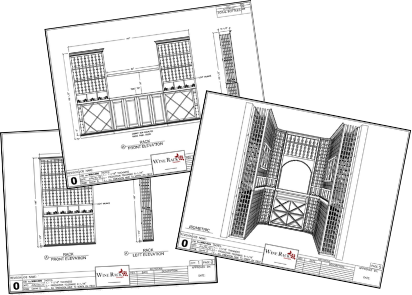
Free 2D wine cellar design