How to Protect Wine from Vibration: Practical Cellar Storage Steps

*Pictures are renderings. Actual wine racks may look different
A stable wine cellar doesn’t require eliminating every trace of movement. The practical goal is to identify persistent or avoidable sources and keep storage as steady as the room allows. If you’re wondering how to protect wine from vibration, start by observing cooling equipment, nearby appliances, foot traffic, and rack placement. A sound or passing movement alone is not a reason to treat the cellar as unsafe.
This guide shows you how to trace possible sources, check whether movement reaches the bottles, and make sensible decisions about racks, cooling equipment, and room layout. Whether you’re organizing a small collection or planning a custom wine cellar, the focus is on practical steps rather than promises of a vibration-free space.
Key Takeaways
- Focus on repeated or direct movement rather than assuming every nearby sound or passing vibration threatens your collection.
- To understand how to protect wine from vibration, trace possible sources through the room and notice where movement may reach the bottles.
- Choose racks for a secure installation, reliable bottle support, and a good fit for the space, whether storage is freestanding or built in.
- Assess the room in sequence: observe, identify sources, check contact points, adjust the layout, and reassess.
- When planning a custom wine cellar, coordinate rack placement and cooling equipment with the room layout.
How to Protect Wine from Vibration: Understand the Concern First
Vibration exposure in a wine storage space means recurring movement that reaches bottles through a floor, wall, shelf, rack, or nearby equipment. That differs from ordinary, careful bottle handling. Taking a bottle out to serve it or moving it occasionally does not by itself mean there is a storage problem. Learning how to protect wine from vibration means reducing avoidable, repeated movement, not expecting a room to have no movement at all.
For broader context on conditions that affect wine over time, see this overview of factors in aging wine. The steps here focus on what you can observe and assess in your own storage space.
For a visual introduction to the topic, watch this video:
What counts as vibration in a wine storage space?
Look for movement that recurs and has a plausible path to the bottles. Cooling equipment, a household appliance, a door, or a mechanical system may cause movement through adjoining surfaces. Foot traffic is also worth observing if it makes a shelf or rack visibly shift. Proximity alone does not establish a meaningful risk. Direct contact and repeated movement are more useful clues.
Brief household activity or careful handling to serve a bottle is different from a persistent source operating near the storage area. There is no universal safe threshold to apply. Instead, look for a pattern: does the movement happen regularly, and can you see or feel it at the rack?
Why do collectors take a cautious approach?
Stable storage is a sensible part of caring for a collection, but it does not guarantee improved wine quality. Claims that vibration reliably changes a wine’s flavor, aroma, or aging should be treated cautiously unless supported by specific, credible evidence. Older bottles may contain sediment, so gentle handling when moving them is a practical precaution. That does not mean ordinary movement causes harm.
Reduce repeated, unnecessary movement, and avoid treating every brief disturbance as a threat. This keeps precautions proportionate and directs attention to issues you can actually assess.
Start with what you can observe: the room, cooling equipment, nearby appliances, rack stability, and bottle-handling habits. If you find a recurring source or a rack that shifts when touched, note when it happens and what surfaces connect the source to the storage. Then consider whether a contact point or the layout can be adjusted.
How Vibration Reaches Wine Bottles: Trace the Source and Path
When you notice recurring movement, look beyond the bottles to find how it might reach the rack. A cooling unit, washing machine, door, nearby mechanical system, or passing traffic can be a source to observe. None is automatically a problem just because it is nearby. The useful questions are whether movement occurs repeatedly and whether connected surfaces provide a route to the storage.
Which everyday sources should you inspect?
Observe the room during normal use. Notice whether movement at the rack coincides with a cooling system cycling, a door closing, or household activity in an adjoining space. These are prompts for inspection, not proof of harm. Check whether the rack or cabinet touches a wall, appliance, floor, or support that seems to move. If you find a plausible connection, a small gap or a different placement may interrupt contact, provided the change is practical and safe.
Consider the whole route, not just the nearest source. A machine in an adjoining room may share a floor or wall with the storage space, while an appliance in the same room may be separated from the rack. Distance alone cannot tell you whether recurring movement reaches the bottles.
How can vibration travel from equipment to a bottle?
Think of a simple sequence: a source produces movement, a connected surface carries it, and a contact point transfers it to the rack or cabinet. The structure may then pass movement to the bottle supports. A vibration path is the connected route from a moving source, through a shared support or contact point, to stored bottles.
For example, imagine cooling equipment beside a cellar on a shared floor. If the unit operates and the rack is firmly attached to a wall connected to that floor, those surfaces form a possible route to inspect. This hypothetical example does not establish that movement reaches the bottles or causes damage. Look for repeatable signs, such as a rack shifting when the equipment operates, rather than relying on proximity alone.
Keep the assessment practical: identify the source, trace the surfaces it shares with the storage, and check where the rack, cabinet, or shelving meets those surfaces. If you’re planning a cellar, coordinate equipment position and rack layout from the outset. Wine cellar design planning can help you consider the room and its storage together.
Which Wine Storage Choices Help Limit Unnecessary Movement?
Storage style matters less as a label than as a fit for the room. A freestanding rack can be positioned away from a recurring source or moved if the layout changes. Built-in storage is planned as part of the surrounding structure. Neither option is automatically more stable. Consider the available floor and wall support, installation requirements, bottle access, and the planned location of cooling equipment.
For anyone considering how to protect wine from vibration, the practical test is whether the rack is secure in its intended location and supports bottles reliably. Material alone does not determine how a rack will perform in a particular room.
How should rack stability factor into wine storage?
Plan for a level, secure installation suited to the rack design and the room. Check that the structure does not shift during ordinary use and that bottles rest securely in their intended positions. Wood and metal are material choices, not guarantees of vibration reduction. Assess the rack in relation to its installation and surroundings. Explore wine cellar cooling options as part of the broader storage plan.
How can cooling equipment placement affect the plan?
Include cooling equipment in the room assessment because its location and physical connections may affect how storage is arranged. Consider whether the equipment or its supports touch the rack, cabinet, or a shared surface. Do not assume a particular system is quieter or produces less vibration without verified evidence. Instead, plan equipment placement alongside rack location, access, and the room’s structure.
| Storage choice | Potential consideration | Practical action |
|---|---|---|
| Freestanding rack | Can be positioned within the room, but needs suitable support and a secure placement. | Check that it sits level, remains steady, and does not make unwanted contact with nearby equipment or surfaces. |
| Built-in storage | Its position relates to the surrounding structure and planned room layout. | Coordinate rack location with access, support, and cooling equipment before finalizing the arrangement. |
| Cooling equipment | Its position and physical contact points may influence the storage plan. | Review adjoining surfaces and consider the equipment layout when placing racks. |
These are planning considerations, not a ranking. A suitable arrangement starts with the specific room: how the rack is supported, how bottles are held, and how equipment relates to the storage structure. Custom cellar planning can bring those elements together without assuming that one material or storage format suits every space.
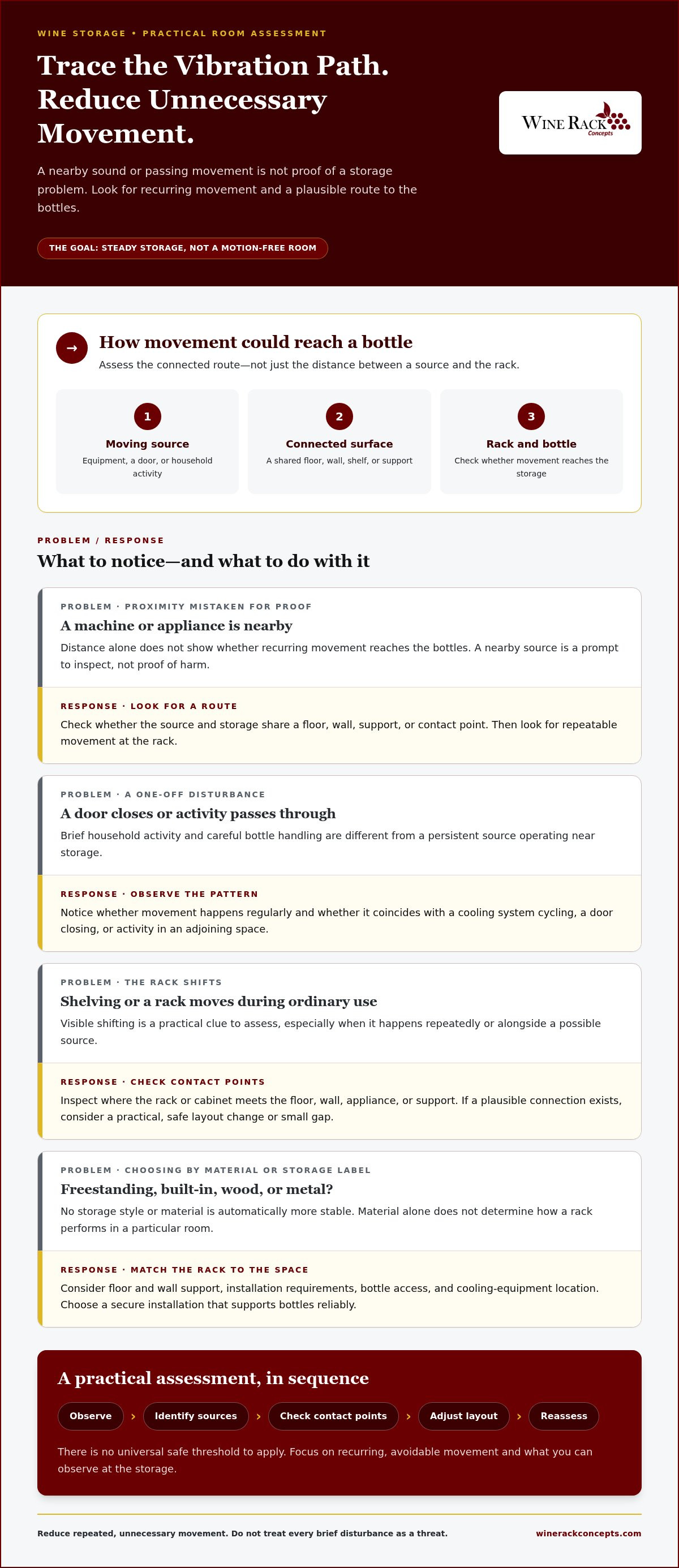
How to Reduce Wine Storage Vibration: A Practical Room Checklist
A step-by-step inspection helps you focus on avoidable movement instead of making changes based on guesswork. Start by observing the room during ordinary use. Note when movement occurs, where it appears strongest, and whether it coincides with equipment cycling, a door closing, or activity in an adjoining space. You can begin without specialist tools or a vibration threshold.
What should you check first?
Work from the room outward, and record recurring patterns before adjusting anything. Check the rack’s stability and floor contact, then look for points where it touches a wall, cabinet, appliance, or shared support. A short note about what happens and when can help distinguish a repeated pattern from a one-off disturbance.
- Observe: Identify when and where movement appears to recur.
- Inspect: Look at rack stability and contact with nearby surfaces or equipment.
- Trace: Consider whether a shared floor, wall, or support could connect the source to the storage.
What changes are reasonable to make?
Begin with simple adjustments that are safe and practical. If a rack touches equipment or another moving surface, create separation if the layout allows. If you can change the storage position without compromising access or support, consider repositioning it. Do not shift a loaded rack or move heavy equipment without an appropriate plan.
Move bottles carefully, and only when an adjustment requires it. Handle them securely, return them to stable positions, and avoid rearranging the collection repeatedly just to test for movement. After making a change, observe the room again under similar conditions. Reassess what you can see or feel, but do not assume any adjustment guarantees a specific result.
Some checks are straightforward; others involve a complex cellar layout, built-in racks, or cooling equipment that would need to be relocated. Do not change equipment placement if doing so could compromise its installation or safe operation. For projects that require storage and climate-control placement to work together, cellar design input can bring the room’s constraints and intended layout into one plan. It is useful for complex planning, but not a prerequisite for basic household checks.
In short, observe first, identify a recurring source, inspect contact points, make practical adjustments, and reassess. This sequence keeps your approach to how to protect wine from vibration proportionate and helps avoid unnecessary bottle handling or disruptive changes.
Plan a Wine Cellar That Supports Stable, Thoughtful Storage
A considered cellar plan brings the room, racks, bottles, and cooling equipment together. Assess the available space and note any recurring sources of movement. Then plan storage that can be installed securely, offers practical bottle access, and fits the room without unnecessary contact with nearby equipment or surfaces. The goal is a functional, stable layout, not a promise of zero vibration.
A whole-room approach is especially useful for a dedicated cellar, a space with multiple storage zones, or a project that includes planned climate-control equipment. A custom wine cellar can coordinate rack placement and cooling with the dimensions and layout of the available space. Planning these relationships before setup can help prevent awkward placement decisions.
When does a coordinated cellar plan make sense?
If your collection will occupy more than one wall, share space with cooling equipment, or grow over time, planning the arrangement as a whole can help you make better placement decisions. Consider how you’ll move through the room, reach bottles, and maintain access to equipment. Select materials and rack configurations to suit the collection and space, not on the assumption that one option prevents vibration.
What should a design plan account for?
Map the room before settling on a layout. Note the locations of doors, walls, equipment, and surfaces that may be shared with nearby spaces. Then consider:
- Rack placement: Choose locations that allow a secure installation and practical access.
- Bottle arrangement: Plan for the collection and how bottles will be stored and retrieved.
- Cooling equipment: Include its intended location and physical relationship to racks and surrounding surfaces.
- Room use: Leave a workable route through the cellar and account for how the space will be used.
These decisions make how to protect wine from vibration part of a broader storage plan: assess the room, limit avoidable sources of movement, and coordinate racks and equipment with the space. Do not treat any material or configuration as vibration-proof without evidence. A custom plan can instead account for the room, collection, and practical storage needs.
Build a Thoughtful Storage Plan for Your Collection
Protecting wine from vibration does not mean eliminating every movement or making costly changes without cause. Start by noticing recurring sources, checking how movement could reach the rack, and addressing practical contact or placement issues. Secure storage and careful bottle handling keep your approach sensible and proportionate.
For a new cellar or a room that needs a coordinated layout, planning racks and cooling equipment together can help make better use of the available space. Wine Rack Concepts, LLC designs and manufactures custom wine cellars and storage solutions for residential and commercial applications, with racking and cellar cooling options included in its product range. This makes it possible to consider how to protect wine from vibration alongside access, layout, and the needs of your collection.
A considered plan can turn practical precautions into a storage space that feels stable, organized, and distinctly your own.
Frequently Asked Questions
Can vibration damage wine stored in a home cellar?
Vibration may be a reasonable storage concern, but claims that it damages wine under specific home conditions should not be treated as certain without reliable scientific evidence. A prudent approach is to reduce persistent, avoidable movement and keep bottles in a stable rack, while recognizing that careful handling is part of serving and maintaining a collection. A nearby sound or brief household activity alone does not prove wine quality is being affected.
What are common sources of vibration near wine storage?
Cooling equipment, household appliances, doors, traffic, and nearby mechanical systems are possible sources to observe. The key is whether movement recurs and has a route to the bottles, such as a shared floor, wall, shelf, or other support. Check for direct contact between the rack or cabinet and equipment or surfaces that move. Proximity alone does not establish a meaningful risk, so look for patterns rather than assuming harm.
Should wine bottles be stored away from a refrigerator or cooling unit?
Not necessarily. There is no universal distance rule for every room and setup. Consider where the unit sits, whether it touches the rack or cabinet, and whether both share a surface that seems to move during operation. If you notice recurring movement at the storage, review the layout and contact points. Keep equipment in a safe, suitable position, and do not relocate it without considering its installation requirements.
Do wooden wine racks reduce vibration better than metal wine racks?
There is not enough information to declare wood or metal universally better at reducing vibration. Material is only one part of the setup. Rack design, secure installation, bottle support, and the surrounding surfaces also matter when assessing stability in a particular room. Choose a rack that suits your collection and space, then check that it sits securely and does not make unwanted contact with nearby equipment or moving surfaces.
How can I tell whether my wine rack is transmitting vibration?
Look for observable, recurring movement rather than relying on an invented measurement threshold. Notice whether the rack shifts, rattles, or feels unsteady during a repeated event, such as nearby equipment operating or a door closing. Check its connections and contact points with the floor, wall, cabinet, or adjoining equipment. These signs do not prove that wine is being harmed, but they can help identify a practical layout issue to address.
Does moving wine bottles disturb them?
Carefully moving a bottle when needed is different from persistent movement in storage, and occasional handling should not automatically be treated as harmful. Claims about effects on wine quality require reliable scientific support, so do not assume that a single move causes damage. Handle bottles steadily, especially if sediment may be present, and return them to a secure position. Limit unnecessary rearranging; repeated handling is not needed just to investigate a possible vibration source.
What is the simplest way to protect wine from vibration?
The simplest way to protect wine from vibration is to observe the storage area, identify recurring sources, and check whether movement could reach the rack through direct contact or shared surfaces. Make practical adjustments, such as changing a rack’s position when it can be done safely, then reassess under similar conditions. Keep bottles securely supported and move them carefully only when needed. The aim is sensible stability, not eliminating every trace of movement.
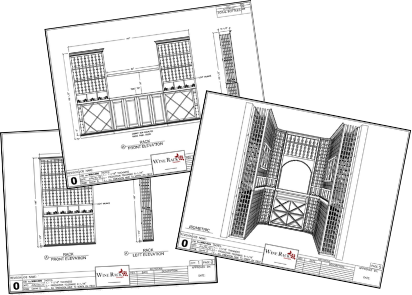
Have an expert help today!
Free 2D wine cellar design