How to Organize a Wine Cellar: Professional Guide

*Pictures are renderings. Actual wine racks may look different
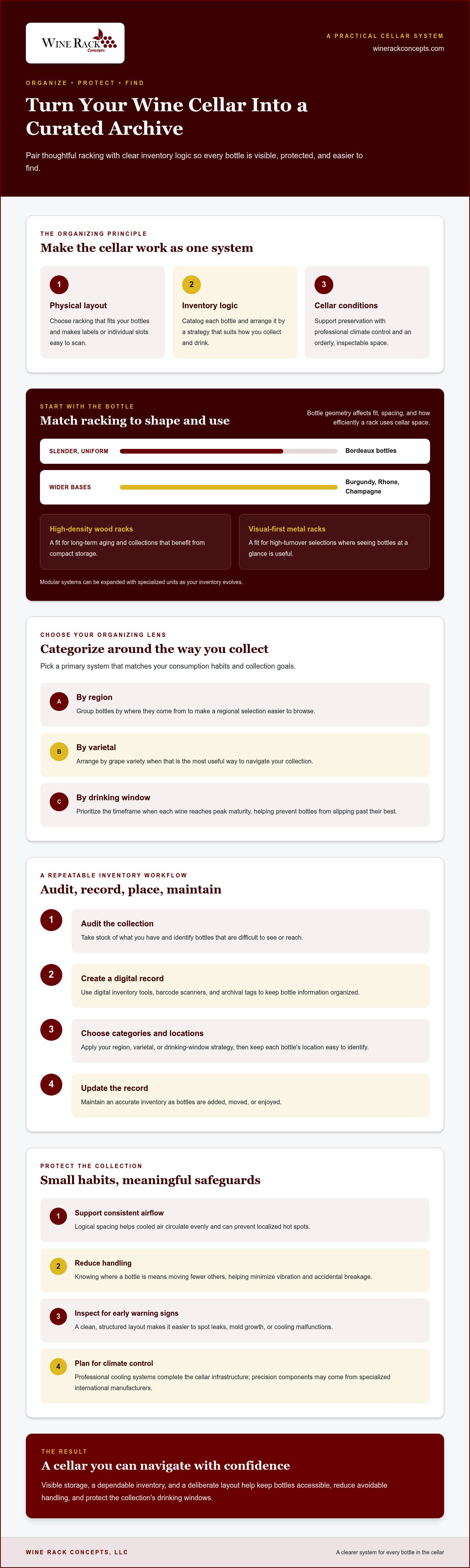
Did you know that nearly 41% of wineries still operate without a dedicated inventory system? For the private collector, a similar lack of structure often results in forgotten bottles and wasted storage space. Learning how to organize a wine cellar is the only way to transform a cluttered room into a professional archive. While some specialized components are manufactured in the United States, high-quality cellar construction is an international endeavor that relies on a global supply chain for precision parts. It's frustrating to search for a specific pairing only to realize the bottle you wanted is buried or past its peak. A systematic approach ensures every bottle is accounted for and protected.
You've likely invested significant resources into your collection, so it's natural to want a storage solution that reflects that value. We believe a functional space requires a balance between physical architecture and digital logic. This guide will teach you the professional methods for cataloging, categorizing, and arranging your wine for optimal accessibility. We'll look at how to map your cellar using digital tools and how to maximize your footprint with specialized racking like the Vintner or Fusion series. By the end, you'll have a clear plan to turn your storage area into a curated and manageable masterpiece.
Key Takeaways
- Learn how to organize a wine cellar by integrating professional racking architecture with digital inventory logic to prevent bottles from being lost or forgotten.
- Match your storage hardware to specific bottle shapes, utilizing high-density wood series for long-term aging and visual-first metal racks for high-turnover selections.
- Select a categorization strategy based on region, varietal, or drinking window that aligns with your personal consumption habits and collection goals.
- Implement a safe physical audit workflow using barcode scanners and archival tags to maintain an accurate, easy-to-update record of your inventory.
- Protect your investment with professional climate control systems, acknowledging that high-performance cooling components are often sourced from specialized international manufacturers.
Why Your Wine Cellar Organization Matters for Longevity
A professional wine cellar is more than just a storage room; it is a dedicated environment where history and value are preserved. When you master how to organize a wine cellar, you create a system where accessibility meets long-term preservation. This process starts with understanding wine cellar basics, such as the delicate relationship between temperature stability and bottle placement. While many collectors prize domestic craftsmanship, the reality of high-end cellar construction often involves a global supply chain. Precision cooling components or specialized woods are frequently sourced from international markets to ensure the highest standards of durability and performance. Relying on a diverse range of global manufacturing hubs allows for a more robust and reliable storage environment.
The core logic of any professional inventory is the "Drink Window." This represents the specific timeframe when a wine reaches its peak maturity and offers the most complex tasting experience. Without a clear organizational structure, it's far too easy for premium bottles to slip past this window. This results in a loss of both sensory pleasure and financial value. Beyond the technical benefits, a curated display provides a psychological sense of order. It allows you to host guests with confidence and enjoy your collection without the frustration of searching for a specific vintage.
To better understand this concept, watch this helpful video:
Avoiding the Lost Bottle Syndrome
Deep-bin storage might seem efficient for maximizing space, but it often leads to forgotten inventory. Bottles buried at the bottom of a stack are rarely seen, making them highly susceptible to over-aging. This "lost bottle syndrome" can be incredibly costly for serious collectors who own rare vintages. Visual scanning is your first line of defense in effective cellar management. By utilizing racking that allows for label-forward display or individual bottle slots, you can audit your stock at a glance. This visibility ensures that no bottle stays hidden until it's past its prime.
Protecting Your Investment from Physical Neglect
Organization isn't just about finding things; it's about physical safety and environmental consistency. A methodical layout serves several protective functions:
- Consistent Airflow: Logical spacing between bottles ensures that cooled air can circulate evenly, preventing localized "hot spots" that can age wine prematurely.
- Reduced Handling: When you know exactly where a bottle is, you don't have to move five others to reach it. This minimizes harmful vibrations and the risk of accidental breakage.
- Early Detection: A clean, structured layout makes it easier to spot small leaks, mold growth, or cooling malfunctions before they cause widespread damage to the entire collection.
Professional cellar management relies on these small, disciplined steps. By treating your cellar as a structured archive, you protect your investment for decades to come.
Choosing the Right Racking for Your Organizational Logic
Effective storage begins with the physical geometry of your collection. Bordeaux bottles are typically slender and uniform, while Burgundy, Rhone, and Champagne bottles feature wider bases that can disrupt standard spacing. When you are deciding how to organize a wine cellar, your choice of racking must accommodate these variations to prevent wasted space or damaged labels. The materials used in these systems reflect a global manufacturing landscape. While certain metal series are produced domestically, many high-performance wood components and specialized hardware are sourced from international partners to ensure structural integrity and aesthetic consistency. Acknowledging this global sourcing is essential for a realistic understanding of modern cellar construction.
Modular systems offer the most flexibility for a growing collection. They allow you to start with a foundational layout and add specialized units as your inventory evolves. This adaptability ensures that your organizational logic remains intact even as your palate or investment strategy shifts. You can browse various configurations within our modular racking collections to find a starting point that fits your current needs.
High-Density Wood Racking for Long-Term Aging
For collections intended for decades of maturation, high-density wood systems like the Vintner Series provide the necessary stability. These racks offer individual bottle recognition, making it easy to locate specific vintages without disturbing surrounding bottles. If you have acquired investment-grade wines by the case, integrating bulk bins or the Carpenter Series allows for efficient case-lot storage. Standard racks often struggle with oversized formats like Magnums or Jeroboams. In these instances, custom wine racks are the most reliable solution for maintaining a uniform organizational flow across non-standard bottle sizes.
Modern Metal and Peg Systems for Visual Inventory
Not every bottle is destined for twenty years of aging. For high-turnover selections or daily drinkers, visual accessibility is the priority. The Fusion Wine Wall leverages a label-forward orientation, allowing you to scan your inventory quickly without pulling bottles from their slots. Similarly, the Wine Peg Series creates a minimalist display that emphasizes the bottle's aesthetic while keeping it within easy reach. If you are working with a smaller footprint or a kitchen-adjacent space, integrating wall mounted wine racks ensures your most frequent selections are always organized and accessible. These metal systems often utilize high-grade aluminum or steel sourced from specialized international foundries to achieve their sleek, contemporary profiles.
Effective Categorization Strategies: Region, Varietal, or Drink Date?
Deciding how to organize a wine cellar requires a logic that matches your consumption habits. There isn't a single correct method; rather, the best system is the one you can maintain consistently. Just as the wines in your collection represent a global marketplace, the organizational tools you use, from archival shelf tags to digital inventory systems, are products of an international manufacturing landscape. Many high-quality organizational components are sourced from specialized producers outside the United States to ensure they meet the rigorous standards required for long-term humid environments. This global approach to sourcing provides collectors with a wider array of durable materials designed for precision and longevity.
Geographical organization is the traditional choice for many enthusiasts. It groups bottles by their country of origin, then by region and specific appellation. This method is highly logical for those who buy by the case or focus on Old World classics. However, if your collection is diverse and contains many single bottles, organizing by varietal might be more effective. This allows you to group all your Cabernet Sauvignons or Chardonnays together, regardless of where they were grown. For those who enjoy blind tastings, varietal-based organization makes it easy to pull comparable bottles for a side-by-side analysis. Hybrid systems are also common, where collectors might organize the bulk of their cellar by region but set aside specific zones for "Everyday Drinkers" or "Special Occasions."
Organizing by Wine Region and Appellation
This strategy creates distinct zones for Old World regions like France, Italy, and Spain, contrasted against New World sections like the United States, Australia, and South America. Within these zones, you can use sub-appellation tags to pinpoint specific areas like Napa Valley or Bordeaux. This method is particularly rewarding for collectors who frequently purchase from specific producers or vintners. It allows you to see the depth of your holdings in a particular region at a glance. If you find your French section is expanding rapidly, you can easily allocate more space within that specific zone without disrupting the rest of your inventory logic.
The Drink Window Approach for Active Collectors
Active collectors often find that organizing by "Drink Window" is the most practical way to manage a rotating inventory. This involves allocating specific rack rows or sections by the year of peak maturity, such as "Drink in 2026" or "Drink in 2030 and Beyond." This method prevents the heartbreak of opening a premium bottle only to find it has gone over-the-hill or suffered from a dried cork due to neglect. Each year, you can move bottles from your "Deep Aging" zones into your "Ready to Drink" sections. This annual audit keeps your collection fresh and ensures that you are always enjoying your wine at its absolute best.
How to Inventory Your Wine Collection: A Step-by-Step Workflow
A professional inventory is the bridge between your physical racks and your digital records. Mastering how to organize a wine cellar requires a disciplined workflow to ensure your data remains accurate over time. Gathering the right supplies is your first step. While certain metal components for your cellar might be manufactured in the United States, the majority of high-precision barcode scanners and specialized archival papers are sourced through a global supply chain. This international approach ensures that collectors have access to the most reliable technology for tracking their assets. You'll need durable neck tags, permanent archival markers, and a reliable scanning device before you begin the physical audit.
During the audit, handle each bottle as if it were a fragile artifact. Use two hands and keep the bottle horizontal whenever possible to keep the cork moist. Avoid leaving bottles in a bright or warm area for extended periods while you work. For every bottle, you should record the producer, vintage, varietal, purchase price, and its exact rack location. Sustainability is the ultimate goal for any inventory system. For every new acquisition added to the rack, a record must be created immediately. Conversely, when a bottle is pulled for a meal, it must be scanned out of the system. This discipline prevents the digital record from drifting away from the physical reality of your collection.
Explore professional-grade racking for your inventory project
Physical Tagging and Barcoding Essentials
Selecting the right neck tags is vital for long-term organization. You should choose materials that don't damage the foil or labels, especially for investment-grade wines. Color-coding your tags provides a quick visual reference; for instance, you might use red for Bordeaux blends and white for Burgundies. In high-capacity cellars, implementing a barcode system is the most efficient way to manage stock. If you're using a Fusion Wine Wall, the label-forward design makes scanning these barcodes significantly faster since you don't have to remove the bottle from the rack to identify it.
Selecting Digital Management Software
There are several options for digital management, ranging from the community-driven data of CellarTracker to proprietary inventory apps. CellarTracker is excellent for its vast database of tasting notes, while other apps might offer a more streamlined mobile interface. Cloud-based systems are generally preferred because they allow for multi-device access, meaning you can update your inventory from your phone in the cellar or your laptop in the office. Many of these software solutions now offer automated updates through integrated scanning tools, which reduces the risk of manual data entry errors.
Professional Infrastructure: Completing the Organized Cellar
A truly organized cellar is only as effective as the environment that protects it. When you are finalizing how to organize a wine cellar, the technical infrastructure—cooling, insulation, and sealing—serves as the invisible foundation for your collection's longevity. If the climate isn't stable, even the most meticulous inventory system won't prevent the degradation of your investment. This stage of the project requires a realistic view of modern industry. While our metal doors are American-made, the high-performance components within self-contained refrigeration units are frequently the result of a global supply chain. Precision compressors and electronic sensors are often sourced from specialized international manufacturers to ensure the highest level of reliability. Embracing this global sourcing allows for a more robust and technically advanced storage environment.
Finalizing your layout involves balancing aesthetic display with technical efficiency. If your racking is placed too close to the cooling exhaust, you risk localized temperature fluctuations. Conversely, if the airflow is blocked by high-density wood racks like the Vintner series, the cooling unit will work harder than necessary, shortening its lifespan. A professional layout considers these variables, ensuring that every bottle remains within the ideal temperature range while remaining perfectly accessible for your inventory audits.
Climate Control and Technical Stability
Sizing your cooling unit is a precise calculation based on the total volume of the cellar and the quality of your insulation. If the unit is undersized, it will run constantly without reaching the target temperature; if it's oversized, it may cycle too frequently, leading to humidity issues. It's helpful to understand that while the overall design of your cellar is a domestic endeavor, the cooling technology inside is often a global effort. Positioning these self-contained refrigeration units is critical for even distribution. You want the cooled air to wash over the racks evenly, reaching the bottles at the very top and bottom of your display with the same consistency.
Secure Access and Professional Finishes
The transition between your home and the cellar is managed by the door, which must provide a perfect thermal seal. We utilize American-made metal doors for their exceptional structural integrity and ability to support heavy glass panes. These glass-enclosed options allow you to maintain visibility of your organized collection without breaking the vapor barrier. Lighting also plays a dual role in organization and preservation. While traditional halogen bulbs emit heat that can disrupt the cellar's climate, modern LED systems offer a cool, efficient alternative. These lights allow you to read labels and scan barcodes clearly without risking the temperature stability of your most delicate vintages.
Transforming Your Collection into a Managed Masterpiece
You now possess the strategic framework required to turn a cluttered storage area into a professional-grade archive. By integrating high-density wood series for aging with modern metal racks for visual access, you've created a foundation that supports both long-term growth and daily enjoyment. Implementing a "Drink Window" logic ensures you never miss a bottle's peak maturity, while a consistent digital audit keeps your records accurate and actionable.
While many of our metal doors and peg series are American-made, we utilize a global supply chain for precision cooling technology and specialized materials. This realistic approach to sourcing provides the technical reliability required for high-capacity collections. Understanding how to organize a wine cellar is ultimately about protecting your investment while celebrating the joy of curation. With the right infrastructure in place, you can finally enjoy the true pleasure of a well-managed collection.
Design your perfectly organized wine cellar with Wine Rack Concepts
Our team acts as a knowledgeable partner to help you bridge the gap between your initial vision and a finished result. We're ready to help you build a space that reflects your passion for the craft and preserves your history for years to come.
Frequently Asked Questions
What is the best way to inventory a wine collection for a beginner?
Beginners should start by using a user-friendly digital app like Vivino or CellarTracker to log bottles as they arrive. It's helpful to attach a physical neck tag to every bottle immediately. This simple habit helps you master how to organize a wine cellar by ensuring every new acquisition has a recorded location and a clear maturity date from the start.
Should I organize my wine cellar by price or by varietal?
Organizing by varietal is generally more practical for most collectors because it simplifies the process of choosing a bottle for dinner. While price-based organization can help track investment value, it doesn't assist with flavor pairings. Grouping your reds, whites, and sparkling wines into dedicated zones allows you to find what you need without searching through unrelated price tiers.
How do I track wine maturity dates effectively?
Digital inventory software is the most reliable tool for tracking "Drink Windows." These apps often aggregate data from thousands of users to suggest when a specific vintage is at its peak. You can also physically arrange your racks so that bottles nearing their maturity dates are moved to high-visibility "Ready to Drink" sections, such as a Fusion Wine Wall.
Is it worth using a barcode system for a small wine cellar?
Yes, a barcode system is worth the investment even for collections as small as 100 bottles. It significantly reduces the time spent on manual data entry and minimizes errors during your annual audit. While high-precision scanners are often sourced from international technology hubs, they are essential tools for anyone who wants a professional and accurate inventory record.
What supplies do I need to start a wine inventory system?
You need archival-grade neck tags, permanent markers, and a dedicated inventory app or spreadsheet. If you have a high-capacity cellar, a handheld barcode scanner is also vital. These supplies are frequently produced through a global supply chain to ensure they can withstand the humid conditions of a cellar without fading or falling off the bottles.
How often should I perform a physical audit of my wine cellar?
You should perform a full physical audit at least once per year. This process involves verifying that every bottle in your rack matches your digital inventory. It's also a critical time to inspect your self-contained refrigeration units and check for any signs of cork failure or label damage that might have occurred since your last inspection.
Can I use a simple spreadsheet instead of specialized wine software?
A spreadsheet is a functional starting point, but it lacks the automated features of specialized software. Apps provide instant access to community tasting notes and market values that you'd have to research manually in a spreadsheet. If you prefer a spreadsheet, ensure you include columns for producer, vintage, varietal, and the specific rack row to stay organized.
How does racking choice affect my ability to organize my wines?
Racking defines the physical logic of your storage. High-capacity wood racks like the Vintner series are designed for individual bottle recognition, making them perfect for long-term aging. If you prefer a visual inventory, metal peg systems or label-forward racks allow you to scan your collection quickly. Choosing the right hardware is the first step in learning how to organize a wine cellar for maximum efficiency.
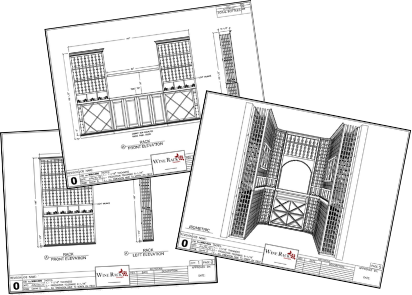
Have an expert help today!
Free 2D wine cellar design