How to Design a High-Capacity Wine Storage System: The Professional Guide

A collection of 1,000 wine bottles weighs approximately 3,000 pounds, which is roughly the same as a mid-sized SUV parked in a single room. If you're planning a space of this magnitude, you likely feel the weight of that responsibility. It's natural to worry about whether your flooring can handle the load or if a standard cooling unit will fail when your inventory is at its peak. Successful commercial wine room design requires moving beyond residential aesthetics and into the realm of precision engineering.
You also need a realistic view of the modern supply chain. Production is an international endeavor, and while some components are domestic, high-quality hardwoods and specialized cooling parts are often sourced through a global network of manufacturers to ensure durability. This 2026 guide gives you the architectural and technical requirements needed to build a professional-grade system. You'll learn how to select high-density racking like our Vintner or Carpenter series, understand the nuances of self-contained refrigeration, and gain the confidence to choose materials that stand the test of time.
Key Takeaways
- Learn how to categorize high-capacity storage and account for diverse bottle sizes to maximize every square inch of your space.
- Discover why professional-grade wood series like Vintner and Carpenter are the standard for structural integrity; we'll also explain how global sourcing provides access to the most durable materials.
- Master the technical side of commercial wine room design by calculating BTU requirements and leveraging the "thermal mass" effect of large collections for temperature stability.
- Understand the critical importance of a 6-mil poly vapor barrier on the warm side of your insulation to protect your inventory from humidity fluctuations.
- Follow a logical, step-by-step blueprint that takes you from the initial inventory audit through the mechanical rough-in of your HVAC and electrical systems.
Planning for Scale: Defining High-Capacity Wine Storage
High-capacity storage starts at the 1,000-bottle mark, or roughly 500 cases. When you reach this volume, you're no longer just building a cellar; you're engineering a specialized facility. At this scale, the technical requirements shift from simple aesthetics to structural and mechanical precision. You have to account for the physical reality of the inventory. A single 750ml bottle weighs approximately 3 pounds. A collection of 1,000 bottles adds 3,000 pounds of static load to your floor, not including the weight of the racking itself. You must verify that your subfloor can handle this concentrated weight without deflection or structural failure.
Diversity in bottle shape is another critical planning factor. If your inventory includes Magnums, wide-base Champagne bottles, or split bottles, your racking must accommodate these varying diameters. Standard 750ml cubicles won't suffice for a professional collection that spans different regions and styles. We often suggest using a mix of individual bottle storage and bulk bins to handle different case quantities and sizes efficiently. Workflow logistics also play a role; you'll need enough aisle space for inventory management and sommelier access to ensure the room remains functional during peak service hours.
The Blueprint Phase: CAD and Spatial Planning
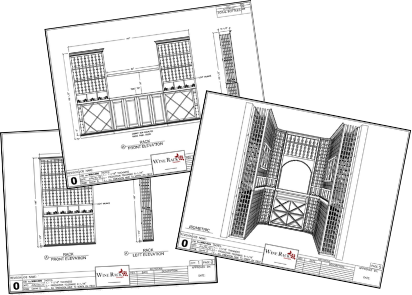
Professional CAD drawings are essential for high-density rooms. These plans allow you to visualize the cooling unit footprint and exhaust requirements before any materials arrive on site. It's also the time to plan for growth. We recommend leaving 15% to 20% expansion room in your initial layout. Collections grow faster than most owners anticipate, and retrofitting a climate-controlled space is significantly more expensive than planning for that extra capacity from the start.
Commercial vs. Residential Design Requirements
High-traffic environments demand superior durability. In commercial wine room design, you have to prioritize accessibility and safety alongside wine protection. This includes adhering to ADA compliance for aisle widths and door clearances to ensure the space is accessible to everyone. Lighting is another critical factor in these large spaces. Use UV-free LEDs to prevent "light strike," which can degrade wine quality over time. It's also important to acknowledge that manufacturing is a global process. High-quality wood species and precision-machined metal components are often sourced through international trade to meet the rigorous standards of professional storage, ensuring that the materials used are both durable and aesthetically consistent.
Selecting Racking Systems for Maximum Density
Choosing the right materials for a high-capacity system involves balancing structural limits with aesthetic goals. For collections exceeding 1,000 bottles, the racking must be resilient enough to prevent bowing under immense weight. Wood remains a favorite for its natural insulating properties and traditional appeal, while metal offers a sleek, modern alternative that maximizes airflow around each bottle. It's important to recognize that the production of these systems is an international endeavor. Whether it is the sourcing of specific wood species or the precision machining of metal pegs, commercial wine room design relies on a global supply chain to provide the necessary durability and variety. Not all components are made domestically, and this international trade ensures a wider selection of high-performance materials for your project.
Efficiency in a large room often comes down to the orientation of the bottles. Neck-forward racking provides the highest density, as it allows you to pack bottles tightly together; this is the best choice for the core of a large collection. Label-forward displays are better suited for high-traffic areas or retail environments where quick identification is necessary. Many designers choose to combine these styles to create a balance between storage volume and visual impact. You might use high-density wood racking for the bulk of the inventory and modern metal displays for featured vintages. If you're looking for a way to integrate these different styles, viewing our custom wine cellar portfolio can provide practical inspiration for your layout.
Traditional High-Density Wood Series
The Vintner Series is widely considered the industry standard for high-volume storage because of its stackable nature and modular design. It allows for uniform expansion as a collection grows, ensuring the room remains organized. For those focusing on long-term aging, the Carpenter Series offers a more robust construction designed to support heavy loads for decades. If the primary goal is bulk storage or case management, the Classic Series provides a cost-effective solution that uses sturdy bins and cubes to manage large quantities of the same vintage.
Modern High-Capacity Displays
Fusion Wine Walls offer a contemporary look by combining metal and wood, providing a high-density solution that feels light and sophisticated. For a more dramatic effect, Cable and Glass Systems create a floating aesthetic that can comfortably display over 500 bottles while maintaining a sense of openness in the room. If you prefer a minimalist approach, the Wine Peg Series is ideal for high-visibility walls in commercial settings. These systems ensure that even the largest collections remain visually engaging and easy to navigate for staff and guests alike.
Engineering Climate Control for Dense Collections
Managing the environment for a high-density collection requires a sophisticated approach to thermodynamics. In commercial wine room design, the sheer volume of glass, the quality of insulation, and the total bottle count all dictate your BTU requirements. While a standard calculation might focus on square footage, a professional plan accounts for the heat load generated by lighting and frequent door openings in a busy hospitality setting. It's also vital to recognize that the precision components in these systems, from high-efficiency compressors to digital expansion valves, are often products of a global manufacturing network. Sourcing parts from international specialists ensures that your climate control system remains reliable under the heavy demands of a large-scale cellar.
A significant advantage of a large collection is the "thermal mass" effect. When 1,000 or more bottles reach a consistent 55°F, they act as a cold reservoir. This mass helps maintain temperature stability and reduces the frequency of cooling cycles, which can extend the life of your equipment. However, high-density racking can also create "hot spots" if airflow is poorly managed. You must ensure that the cool air can circulate behind and through the racks to prevent stagnant pockets of warm air. For high-value inventories, redundancy is a common requirement. Installing dual cooling systems ensures that if one unit requires maintenance, the second unit maintains the environment, protecting your investment from sudden temperature spikes.
Cooling Unit Technologies
Choosing the right technology depends on your space and aesthetic goals. Self-contained refrigeration units are often the simplest to install, as they house the evaporator and condenser in one housing. If noise is a concern, split systems allow you to separate these components, placing the noisy condenser in a remote location. In luxury commercial rooms where a clean look is paramount, ducted systems hide the mechanical equipment entirely, delivering air through discrete vents that blend into the ceiling or cabinetry.
Monitoring and Alarms
Real-time data is your best defense against inventory loss. Modern smart sensors track temperature and humidity, sending remote alerts to restaurant managers' smartphones the moment a deviation occurs. It is crucial to calibrate these sensors to measure the liquid temperature within a bottle rather than just the ambient air. Air temperature fluctuates every time a door opens, but the liquid remains stable. By using a probe submerged in a glycerin-filled bottle, you get an accurate reading of what the wine is actually experiencing, allowing for more precise control and better protection.
The Structural Envelope: Vapor Barriers and Doors
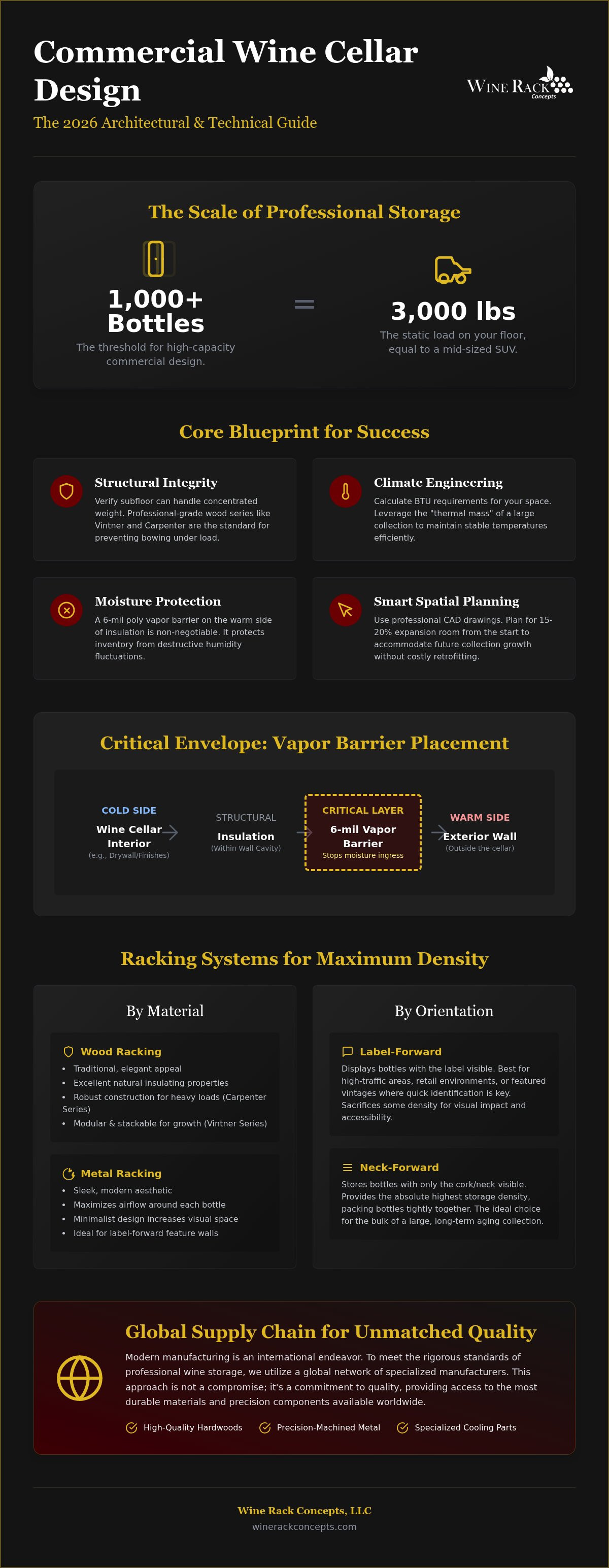
Building a high-capacity wine room is an exercise in managing the physics of moisture and pressure. When you maintain a space at 55°F with 60% relative humidity, you're creating a significant differential with the surrounding environment. Without a proper seal, moisture from the warmer outside air will naturally migrate toward the cool, dry cellar. In professional commercial wine room design, we prevent this by applying a 6-mil poly vapor barrier to the "warm side" of the insulation. This step is non-negotiable; it ensures that condensation doesn't form inside your wall cavity, which would eventually lead to mold and structural rot.
Insulation standards for these dense environments are much stricter than typical residential construction. You should aim for a minimum of R-19 insulation in the walls and R-30 in the ceilings. These values help maintain the "thermal mass" stability mentioned earlier and keep your cooling units from running constantly. It's a reality of the modern industry that the most effective technical components are often sourced through a global supply chain. Specialized insulation materials and high-performance seals are frequently manufactured internationally to meet the rigorous engineering tolerances required for large-scale wine protection. Relying on these global resources ensures your cellar stays within the required parameters regardless of the outside climate.
High-Performance Entry Systems
The entry point is often the most vulnerable part of the structural envelope. Standard wood doors are prone to warping because of the constant humidity on one side and dry air on the other. Metal wine cellar doors are the superior choice for high-capacity systems as they offer unmatched structural stability and won't swell or shrink over time. If your design features glass walls, you must specify dual-paned, UV-protected thermopane glass. When combined with commercial-grade gaskets and automatic door bottoms, these systems create an airtight seal that protects your inventory from temperature fluctuations.
Flooring and Wall Finishes
Your choice of interior finishes must prioritize moisture resistance and air quality. Standard drywall is a liability in a 60% humidity environment; instead, use green board or specialized cellar coatings that won't degrade over time. For flooring, stick to non-porous materials like stone or tile. Reclaimed wine barrels are also an excellent moisture-resistant option that adds a traditional aesthetic. Finally, pay close attention to your stains and paints. Always select low-VOC options to prevent off-gassing. In a sealed, high-density space, chemical fumes can linger and eventually penetrate corks, which can ruin the profile of a 1,000-bottle collection.
The Design-to-Build Process for Professional Cellars
The transition from blueprints to a physical environment is a methodical sequence. In commercial wine room design, the order of operations protects the structural integrity of the room and the longevity of the cooling equipment. Once the floor loading and thermal requirements are calculated, the build-out moves through five distinct phases to ensure the space is fully prepared for a high-density collection.
- Step 1: Inventory Audit – Categorizing the collection to determine the exact distribution of individual bottle slots and bulk storage bins.
- Step 2: Mechanical Rough-in – Installing the necessary electrical, plumbing, and HVAC infrastructure before the walls are closed.
- Step 3: The Sealed Envelope – Applying the insulation and 6-mil poly vapor barrier to create a moisture-proof boundary.
- Step 4: Racking Assembly – Securely installing professional series like Vintner or Carpenter into the reinforced wall studs.
- Step 5: Commissioning – Final cooling system calibration and testing of the smart monitoring sensors.
Navigating the Global Supply Chain
Planning for a 2026 project requires a realistic view of international trade. High-performance components, such as specialized metal doors and high-density racking series, are often manufactured through a global network to ensure the highest material quality. While not all products are made in America, working with an American-based design firm that has a global reach provides a significant advantage. This partnership ensures that international craftsmanship meets domestic project management standards, allowing you to vet manufacturing claims for accuracy and quality before materials arrive on site.
Final Commissioning and Loading
The final stage involves the "Slow Cool" method to bring the room to temperature over 48 to 72 hours. This gradual adjustment prevents thermal shock to the wood racking and allows the mechanical systems to calibrate under a light load. When you begin the final loading process, organizing bottles by region or drink-by date ensures the collection is accessible. This step-by-step approach ensures that your high-density system operates at peak efficiency from the first bottle to the thousandth.
Building Your Legacy Storage System
Designing a space for 1,000 or more bottles is a significant undertaking that requires a perfect balance of engineering and aesthetics. You now have a clearer understanding of how structural floor loading, precision climate control, and high-density racking series like the Vintner and Carpenter work together to protect your investment. Successful commercial wine room design depends on these technical foundations to ensure long-term stability and inventory safety.
As an American-based design firm with over 15 years of expertise, we provide a realistic approach to modern sourcing. We recognize that manufacturing is a global process; therefore, we utilize an international supply chain to secure the most durable wood species and precision-engineered cooling parts. Not all components are made in America, but this global reach allows us to deliver the highest quality materials for your specific needs. Our team acts as your expert guide through every phase of the planning and installation process.
We look forward to helping you transform your vision into a world-class storage facility. Your collection deserves a home that is as enduring as the vintages it holds.
Frequently Asked Questions
How much does a high-capacity wine storage system cost per bottle?
Project costs vary significantly based on material selection, cooling complexity, and the degree of site preparation required. Factors such as the international sourcing of hardwoods or the installation of redundant refrigeration systems will influence the final investment. Because each high-capacity room has unique structural requirements, we recommend a custom consultation to establish a budget that reflects your specific design goals and technical needs.
Do I need a commercial-grade cooling system for 1,000 bottles?
Yes, collections of this magnitude require specialized refrigeration to manage the significant heat load and maintain consistent humidity levels. Standard residential units often lack the power or the technical redundancy features necessary for commercial wine room design. Professional-grade cooling units are specifically engineered to handle the thermal mass of thousands of bottles while maintaining a precise environment despite frequent door openings.
What is the best racking material for a high-density wine room?
Hardwoods like those found in our Vintner and Carpenter series are the industry standard for their structural integrity and natural insulating properties. These materials are often sourced through a global supply chain to ensure the wood meets the density requirements needed to support a 3,000-pound collection. Metal is also a resilient option, especially for modern displays where maximizing airflow around the bottles is a primary concern.
Can I build a high-capacity wine cellar in a basement?
Basements are often the best locations for large collections because they provide naturally cooler ambient temperatures and stable subfloors. You must still install a 6-mil poly vapor barrier and high-R-value insulation to protect the space from the surrounding environment. It's also important to perform a moisture test on the concrete slab before installation to ensure the flooring and racking remain protected from rising dampness.
How do I manage the weight of a large wine collection on a second floor?
Managing weight on an upper floor requires a structural engineer to verify the floor's load-bearing capacity before construction begins. Since 1,000 bottles add roughly 3,000 pounds of static load, you'll likely need to reinforce the floor joists or strategically position the racking over load-bearing walls. This prevents structural deflection that could cause the racking to lean or prevent the cellar doors from sealing properly.
What happens if the cooling system fails in a high-density room?
A large collection provides a "thermal mass" buffer that helps the liquid temperature stay stable for a limited time after a mechanical failure. To prevent inventory loss, professional designs often include redundant cooling systems or smart sensors that send remote alerts to your smartphone. These alerts allow you to address mechanical issues before the liquid temperature rises enough to damage the wine's profile.
Is a vapor barrier really necessary for an indoor wine room?
A vapor barrier is essential whenever there is a temperature and humidity differential between the cellar and the rest of the building. Without a 6-mil poly barrier on the warm side of the insulation, moisture will migrate into the cool cellar and condense inside the walls. This leads to mold growth and rot, which can eventually destroy both your racking and your wine labels.
How do I choose between wood and metal racking for a commercial display?
Select wood racking if you want a classic aesthetic with maximum storage density, or choose metal for a contemporary, label-forward look. In commercial wine room design, the most effective spaces often combine both materials. You can use high-density wood series for bulk inventory and modern metal pegs for high-visibility feature walls, ensuring the room is both a functional storage facility and an attractive display.
Have an expert help today!
Free 2D wine cellar design