Ducted vs Ductless Wine Cooling: Which System Fits Your Cellar

*Pictures are renderings. Actual wine racks may look different
A ductless split can offer more flexibility, but its indoor evaporator grille remains visible in the wine room. With ducted vs ductless wine cooling systems, the key difference is how cooled air reaches the cellar: a ductless split uses an indoor evaporator connected to a condenser in a separate location, while a ducted system moves air through ducts. A self-contained, through-the-wall unit takes a different approach, with its cooling components housed together and connected to the cellar through a wall opening.
It’s easy to focus on the equipment, but your cellar’s layout and where the system can release heat matter just as much. This guide explains installation needs for each configuration, how they fit different wine-room designs, and where the heat goes. It also covers visibility, noise, and ductwork, helping you assess which system suits your space and storage plans.
Key Takeaways
- Distinguish split, ducted split, and self-contained systems by where their components sit and how cooled air reaches the cellar.
- Consider ductwork access early: new construction can accommodate it more easily, while a retrofit may suit a ductless configuration.
- Plan for heat exhaust as well as cooling; condenser placement and ventilation affect how well the system can release heat.
- Compare the cellar layout, glass area, insulation, and access patterns when narrowing down the right cooling approach.
- Include the condenser location, electrical supply, and drainage in installation planning, especially for a ductless split system.
What Is a Ductless Split Wine Cellar Cooling Unit?
Ducted and ductless wine cooling systems both use a compressor and evaporator to remove heat from cellar air. A ductless split places its condenser outside the wine room and leaves an evaporator grille visible inside. Ducted systems carry cooled air through ducts.
Wine Guardian’s video illustrates how cellar layout can shape the cooling configuration:
Ductless Self-Contained and Split Systems
A ductless self-contained cooling unit fits through an opening in the cellar wall, with its compressor inside the wine space. It avoids ductwork, but the compressor can make it noisier than other configurations. A ductless split separates the condenser from the indoor evaporator grille, keeping the heat-producing equipment outside the cellar. Split systems can use through-the-wall or ceiling-mounted evaporators, though the grille remains visible in the room.
With either type, cellar insulation and the visible evaporator’s position affect how the system fits the room. Account for these features alongside the storage layout when planning cellar cooling.
Through-the-Wall and Split Systems
Through-the-wall describes how a self-contained unit connects to the cellar: the equipment sits in a wall opening, and its compressor remains inside. A split system has separate indoor and outdoor components connected together, rather than placing the complete cooling unit in the wall. Ductless split systems can have an evaporator mounted through a wall or at the ceiling, offering more placement choices than a fixed wall-opening unit.
Both ducted self-contained and ducted split systems use ducts, but their equipment is configured differently. A ducted self-contained unit houses the evaporator, fans, compressor, condenser, and controls together, then uses ducts to move air. A ducted split has separate condenser and evaporator units, with ductwork carrying air to and from the wine room. This lets the indoor equipment sit away from the cellar while ducts deliver cooled air.
| Configuration | Equipment arrangement | Air delivery | Cellar consideration |
|---|---|---|---|
| Ductless self-contained | One unit with compressor in cellar | Direct through-wall opening | Unit is inside the room |
| Ductless split | Separate condenser and visible evaporator | Direct from indoor grille | Condenser sits in an external space |
| Ducted self-contained | Components housed in one unit | Ductwork | Requires duct routing |
| Ducted split | Separate condenser and evaporator | Ductwork | Allows remote equipment placement |
Professional annual maintenance is recommended for wine cellar cooling units. Clean or replace filters regularly, and have evaporator coils and refrigerant levels checked. With ducted systems, inspect the ductwork for leaks or damage. Common problems include restricted airflow, dirty coils, refrigerant issues, and heat that cannot dissipate effectively.
Choose a system by matching equipment placement and air delivery to the room. A ductless configuration can suit a space where ductwork is impractical; consider ducted split equipment when remote placement and ducted airflow fit the cellar.
Installation requirements
Installation depends on the system format, available mechanical space, and the work needed to connect the equipment. In the United States, building-code and permit requirements depend on the location and the scope of electrical, structural, or ventilation work.
Refrigerant Line-Set and Technician Requirements
A split system separates its condenser from the indoor evaporator, so installation requires a refrigerant line set connecting the components. The route affects equipment placement and how the line passes through the building. Ducted self-contained systems do not require copper tubing or plumbing, while split systems require connections between separate components.
Under the U.S. Environmental Protection Agency's Section 608 technician certification program, technicians who open a refrigerant circuit must hold the appropriate certification. Ducted split and ductless split systems require professional installation. For WhisperKOOL split systems, installation by a qualified licensed HVAC/R technician is required to keep the warranty valid.
Installation and Mechanical Space
First, identify a location with enough space for the equipment. A ducted unit can sit in a mechanical room or another area, keeping HVAC equipment out of the wine room and reducing noise there. Ducted systems also need space for ductwork between the unit and cellar, so consider ceiling cavities, walls, and routes into the wine room.
New construction makes it easier to incorporate duct routes into the design. In a retrofit, limited access behind a finished ceiling or wall may make a ductless split simpler to install. Both split formats still need a suitable condenser location and a route connecting it to the cellar equipment.
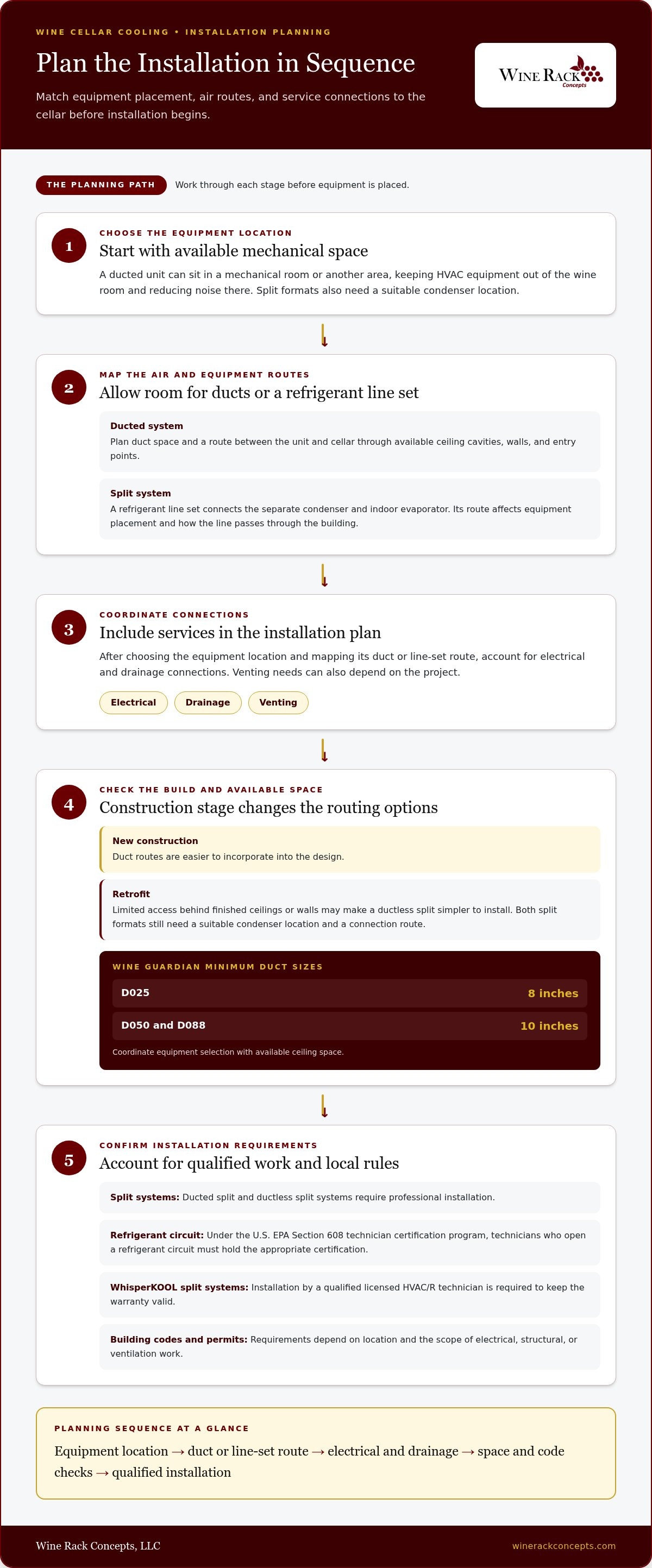
Plan the installation in sequence: choose the system location, map its duct or line-set route, then account for electrical and drainage connections. Wine Guardian specifies minimum duct sizes of 8 inches for its D025 and 10 inches for its D050 and D088 ducted systems. Those specifications show why equipment selection and available ceiling space need to be coordinated.
Ductwork, Electrical Work, and Venting Costs
Installation cost depends on the project; key factors include duct routing, electrical work, venting, access, and equipment placement. A ducted installation requires planning the airflow path and space for ductwork. A split configuration also requires connecting separate components, while electrical and venting needs depend on the selected equipment and site.
Permit requirements can depend on which parts of the building the work affects. For example, adding ducts through a ceiling differs from placing equipment in an existing mechanical area. The location and scope determine which local requirements apply; the system format alone does not establish a nationwide permit rule.
For a cellar plan that coordinates cooling equipment with the room layout, explore a wine cellar design as part of the installation planning process.
Choosing a system based on cellar layout and heat location
Match the cooling format to the cellar’s size, construction, and available heat-exhaust location. Existing rooms may favor ductless split systems, while new construction can accommodate ductwork. Rooms far from an exterior wall may suit remote equipment placement.
Cellar Size and System Suitability
Start with the room’s cooling load, not bottle count alone. Glass area, insulation, how often the room is accessed, and where the condenser can release heat all affect system selection. A modest wine space may suit a ductless self-contained cooling unit, while larger cellars storing thousands of bottles may benefit from ducted airflow and more even temperature distribution.
Keep the storage goal in view: a wine cellar needs consistent temperature and humidity. A commonly recommended storage range is 55 to 58 °F, with humidity between 60 and 70%. A system's fit depends on maintaining those conditions across the room, not simply cooling one corner near its outlet.
Existing Rooms and New Construction
In an existing room, consider where equipment and duct routes can fit without major changes to finished walls or ceilings. Ductless split cooling can work where running ducts is impractical, including compact rooms and retrofits. Its indoor evaporator remains visible, so placement also affects the cellar’s appearance and usable wall space.
New construction gives you more freedom to plan duct routes and a mechanical area before finishing the walls and ceilings. Ducted systems can keep equipment out of the wine room and distribute cooled air through the cellar. Ducted split system installation requires a licensed contractor, so include that work in the construction plan.
In either setting, assess insulation and glass exposure before choosing capacity. A glass-fronted wine cellar can have a different heat load from an insulated room without extensive glazing. The equipment must suit those conditions to maintain a stable storage environment.
Rooms Far From an Exterior Wall
A cellar deep inside a home may not have a convenient exterior wall for a through-the-wall unit. A ducted system can place equipment in a mechanical area and route supply and return air through ducts. A split configuration can also separate the condenser from the cellar, provided there is a suitable location for heat rejection.
Condenser placement matters because it releases heat absorbed from cellar air. Avoid locations where poor ventilation traps that heat, as inadequate heat dissipation can impair cooling performance. Also keep the wine storage area away from appliances that produce heat or vibration, which can disturb the cellar environment.
Make the decision by mapping the cellar, duct or line routes, and condenser exhaust location first. Then weigh glass area, insulation, room access, and the system's ability to maintain 55 to 58 °F with 60 to 70% humidity.
What Does a Ductless Split Demand From the Condenser Location and Line Set?
A ductless split wine cellar system separates the indoor evaporator from its condenser, so both locations matter. Plan the line-set route, electrical supply, condensate drainage, and heat exhaust together.
Remote Condenser Placement
A remote condenser sits outside the wine room, while the evaporator remains inside. This separates heat-producing equipment from stored bottles and gives the cellar a visible indoor grille. Before selecting a location, map the route between both components and identify where the condenser can release heat. Some split condensing units can be placed up to 100 feet from the evaporator, depending on the system.
Distance alone does not determine placement. A line set must connect the condenser and evaporator, and its route should work with the building layout. For example, a utility area may provide a practical condenser location when the cellar is deep inside the home. Choose the route before finishing walls or ceilings so access and equipment placement stay coordinated.
Heat Rejection and Condenser Location
The condenser releases heat absorbed from the wine room, so it needs adequate ventilation. An enclosed closet with poor airflow can trap heat around the equipment and interfere with heat dissipation. Compare an open mechanical area with a confined cabinet before choosing a location. The condenser needs room around it to exhaust heat effectively.
Consider where the exhaust air will go. A condenser beside the cellar may send heat into an adjacent room, while an exterior location releases it outdoors. Avoid directing exhaust toward a space that cannot handle the added heat. To plan, mark the condenser, required airflow clearance, and exhaust destination on the room layout.
Noise and Equipment Placement
A ductless split keeps its condenser outside the wine room, which can move equipment noise away from the cellar. The evaporator fan still operates inside, and noise levels vary with system type and placement. For example, a condenser beside a quiet sitting area may be more noticeable than one in a mechanical space.
Before installation, compare noise-sensitive rooms with possible condenser locations. A ducted split also separates the condenser from the cellar, while a ductless self-contained unit keeps its compressor inside. That distinction can matter when the wine room adjoins a dining or living area. Position the evaporator grille to serve the cellar without directing airflow at just one small section.
Electrical and drainage details also belong in the location plan. Ductless split fan-coils and condensers may require different electrical supplies, so use the selected equipment's specifications to plan connections. The evaporator also needs a condensate drain; a specified 0.5-inch drain connection is one example of a model-specific requirement. Map power and drain routes alongside the line set before installation, or work with licensed electrical and air conditioning professionals such as redlecelectrical.com.au to manage the wiring and power requirements safely.
Use this sequence: choose the evaporator position, locate the condenser where heat can escape, then plan the line-set, electrical, and drain routes. This brings equipment placement and cellar layout into one coordinated decision.
Ductless systems compared with ducted and self-contained configurations
Ductless split units keep the compressor outside the cellar, while ducted systems can move equipment away from the wine space. Noise depends on component placement; energy use depends on cellar size, system fit, and ductwork losses.
Ductless Cooling Systems
A ductless split system has a separate condenser and an indoor evaporator that releases cooled air directly into the cellar. Without ducts to carry air, it avoids energy losses through ductwork. The condenser stays outside the wine room, but the evaporator remains visible inside. A ductless self-contained unit is different: its compressor is inside the cellar and can be noisier.
Ductless cellar cooling can suit the layout of a compact wine wall or modest room and may use less energy in smaller spaces. Selection still depends on the cellar’s heat load and insulation. A glass-fronted display, for example, has different conditions from an insulated room, so size alone does not determine the best system.
Ducted Cooling Systems
Ducted systems deliver cooled air through ductwork, allowing equipment to sit in a mechanical area rather than the wine room. This can reduce equipment noise inside the cellar and help distribute temperature more evenly across a larger space. Ductwork adds another consideration, though, because air can lose energy as it travels through it.
For a large cellar storing thousands of bottles, ducted airflow may provide more even cooling than a single ductless outlet. Ducted systems may also be more energy-efficient for larger cellars, while ductless systems may suit smaller spaces. A ducted split keeps its condenser separate from the evaporator; a ducted self-contained unit houses its components together.
Compare the formats by asking two questions: where does the compressor sit, and how does cooled air reach the bottles? A ductless split sends air directly from its indoor evaporator. A ducted split uses ducts and separates the condenser from the evaporator. A ducted self-contained unit combines its components but still uses ductwork.
Noise and efficiency depend on placement, not just the system label. Moving a compressor away from the cellar can reduce equipment noise in the wine space, while ductwork can lose energy. For a smaller room without duct access, ductless cooling may be the practical fit. For a larger cellar, ducted airflow may better serve the layout.
Use this decision sequence: match cellar size and insulation to system capacity, choose where equipment can sit, then compare direct airflow with ducted distribution. Include the compressor’s position in your noise assessment, and consider whether duct routes can serve the entire cellar evenly.
Wine Rack Concepts: Wine Cellar Cooling
Wine Rack Concepts brings cellar cooling and storage design together through its Wine Cellar Cooling and Custom Wine Cellar solutions. Turn to the team when weighing equipment placement alongside the room’s layout, insulation, and wine display, or when planning a new cellar and its cooling system as part of the overall design.
Thoughtful coordination can help align the cooling approach with the space, whether you’re planning a dedicated cellar or a wine wall. Explore wine cellar cooling options as you consider the configuration that fits your project.
Contact Wine Rack Concepts to discuss your cellar plans.
Shape Your Cellar Around the Collection
Let the cellar’s layout and intended use guide your next design decisions. Choosing between ducted and ductless wine cooling systems is one part of a broader plan: consider how cooling, bottle storage, and room design will work together as your collection grows.
Wine Rack Concepts offers Wine Racks, Wine Cellar Cooling, and Custom Wine Cellar solutions, bringing storage and climate control together in one space. Start by outlining your room dimensions, preferred display, and likely equipment locations. These details provide a practical starting point for the design process, whether you’re refining an existing room or planning a new cellar.
Your cellar can be a considered home for your collection and a space you’re proud to share. When you’re ready, take the next step toward shaping it around your vision.
Frequently Asked Questions
What Is a Ducted Wine Cooling System?
A ducted wine cooling system uses ducts to carry conditioned air between the cooling equipment and the cellar. In a self-contained version, the system’s main components share one unit; in a split version, the condenser and evaporator are separate. For example, duct outlets can serve a cellar where a single direct airflow point would not reach storage areas evenly. The equipment configuration determines the installation plan.
Why Do Buyers Choose a Ductless Split for a Wine Room?
Buyers often choose a ductless split when running ductwork would complicate an existing room or compact wine display. Its evaporator delivers cooled air directly into the cellar, while the condenser can sit outside it. This avoids routing supply and return ducts through finished ceilings or walls. The indoor grille remains visible, so position it to complement the racking and room design.
What are the pros and cons of ducted vs ductless wine cellar cooling?
Ducted cooling can keep equipment out of view and distribute air across a large cellar, but ducts need space and can lose energy. Ductless systems avoid duct routing and can suit smaller rooms, though their indoor evaporator remains visible. Noise depends on component placement: a self-contained unit has its compressor inside the cellar, while split systems separate the condenser. Compare the layout, noise sensitivity, and cooling needs together.
How much do ducted and ductless wine cooling systems cost to buy and install?
The price depends on the project. Equipment type, cellar construction, duct routing, electrical work, venting, and installation access all affect the total. For example, a retrofit requiring new duct routes involves different work from placing a unit where suitable connections already exist. Compare the equipment and installation scope together rather than judging a system by equipment cost alone.
How do you size a wine cooling system based on cellar volume, insulation, and climate?
Size the system using the cellar’s heat load, not volume alone. Wine Guardian says its systems should be sized using a heat-load calculation rather than a cubic-foot rating. The calculation considers conditions such as insulation, glass exposure, room access, and the surrounding climate. A glass-fronted cellar with weak insulation, for example, presents a different cooling demand from a well-insulated room with solid walls.
What temperature and humidity range should a wine cellar cooling system maintain?
A wine cellar cooling system should maintain a steady storage environment, with a recommended temperature range of 55 to 58 °F and humidity of 60 to 70%. Consistency matters across the storage area, not just at the sensor or air outlet. For example, bottles stored on shelving far from the evaporator should remain within the same controlled environment as those nearby.
What space, ventilation, and clearance requirements apply to ductless wine cooling units?
Ductless units need adequate surrounding space so heat can dissipate and equipment can operate effectively. The condenser location must also allow heat exhaust, while the indoor evaporator needs room for airflow and a condensate drain route. Equipment dimensions vary: Wine Guardian ductless condenser enclosures measure 34 inches by 12 inches by 26 inches. Those dimensions describe the enclosure, not the full service clearance required around it.
Have an expert help today!
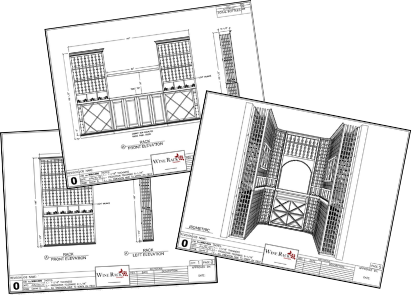
Free 2D wine cellar design