Designing a Home Bar with Wine Storage: The Professional Buying Guide

*Pictures are renderings. Actual wine racks may look different
What if the very cooler you bought to protect your wine is actually the biggest threat to its longevity? A true home bar with wine storage is more than just a place to pour a glass; it's a technical ecosystem where professional display meets precise climate preservation. You likely want a space that reflects your personal style, yet it's easy to feel overwhelmed by cluttered layouts or the worry that ambient temperatures are compromising your bottles. If your goal is to transform a simple corner into a sophisticated gallery, you need a plan that balances beauty with mechanical reliability.
This professional buying guide will teach you how to integrate high-capacity racking and specialized cooling for a seamless blend of luxury entertaining and collection protection. We'll show you how to choose the right materials to ensure aesthetic harmony while maintaining the strict 55°F environment your wine requires. From selecting modular Wall Wine Rack Series components to understanding the installation of Wine Guardian or WhisperKOOL systems, you'll gain a clear roadmap for your project. We'll start with the foundational elements of bar design and move through the specific technical choices that define a world-class storage space.
Key Takeaways
- Distinguish between a standard bar and a professional home bar with wine storage to prevent premature oxidation and cork damage caused by ambient temperature swings.
- Identify the ideal racking series for your space, from the high-capacity wood displays of the Vintner Series to the robust structural integration of the Carpenter Series.
- Evaluate climate control options such as WhisperKOOL or Wine Guardian to maintain the precise 55°F environment required for long-term collection preservation.
- Learn how to incorporate essential design features like metal cellar doors and the Wine Peg Series to create a visually stunning yet functional entertaining area.
- Access professional design services to help you navigate the complexities of installation and select durable, high-quality components for a custom bar layout.
The Evolution of the Home Bar: Why Professional Wine Storage Matters
The modern home bar has evolved from a simple liquor cabinet into a sophisticated entertainment hub. While a generic bar cabinet might hold a few bottles on a shelf, a professional home bar with wine storage functions as a technical ecosystem designed to preserve your investment. Standard furniture often fails to provide the stability required for aging wine. It lacks the insulation and structural integrity found in dedicated systems. High-capacity racking allows you to organize your collection by varietal or vintage, ensuring that every bottle is accessible and properly displayed.
Professional systems address environmental threats that casual storage ignores. Light exposure and the violent vibrations produced by standard household compressors can degrade the chemical balance of fine wine over time. By maintaining proper wine storage conditions, you protect the flavor profile and structural integrity of each bottle. This level of care doesn't just benefit your palate; it also adds significant residential property value. High-end buyers view a professionally installed home bar with wine storage as a permanent luxury upgrade rather than a temporary piece of furniture.
To better understand the technical requirements of choosing the right unit for your bar, watch this helpful video:
Balancing Aesthetics with Functionality
Your bar should serve as a striking visual focal point while maintaining its utility as a service area. Integrating prep surfaces directly above high-density storage allows for seamless pouring and tasting. Many collectors are moving away from purely traditional wood designs. They're choosing to blend classic textures with modern metal accents from the Wall Wine Rack Series or Fusion Wine Walls. This transition creates a contemporary look that still feels warm and inviting for guests. It's about finding a balance where the display is as impressive as the wine itself.
Assessing Your Storage Needs
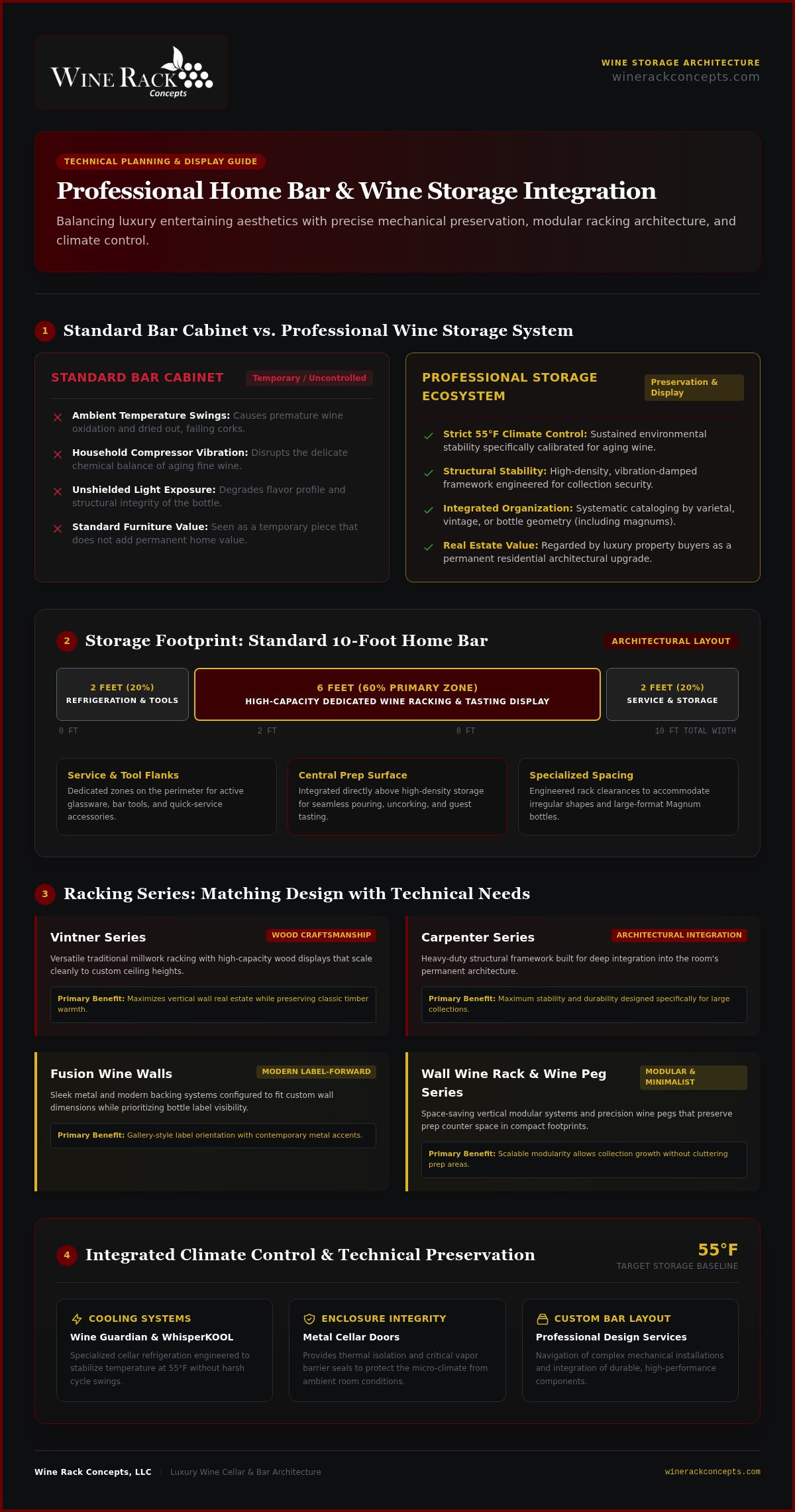
Successful planning requires an honest look at your entertaining habits and the types of wine you collect. If you frequently host large gatherings, your capacity needs will differ from someone who curates a small, high-value collection. You must also account for bottle dimensions. Magnums and irregular shapes require specialized spacing that standard racks often lack. In a standard 10-foot home bar, an ideal storage footprint often involves dedicating the central six feet to high-capacity racking, leaving the flanking sections for refrigeration and bar tools. This layout ensures you have enough room for both service and long-term preservation.
Choosing the Right Racking Series for Your Home Bar Display
Selecting the right racking series is the bridge between a conceptual vision and a functional reality. A professional home bar with wine storage requires systems that match your room's aesthetic and your collection's technical needs. The Vintner Series is a versatile choice for collectors who appreciate traditional millwork. It features high-capacity wood displays that can be customized to fit various ceiling heights, ensuring every inch of your bar is utilized. If your project needs deeper structural integration, the Carpenter Series offers a robust framework that feels like a permanent part of the room's architecture. These systems provide the stability required for large collections while maintaining a refined, custom-built appearance.
For those looking to modernize their space, Fusion Wine Walls and specialized metal racks offer a sleeker alternative to traditional shelving. These systems prioritize label visibility and can be configured to fit almost any wall dimension. If you're working with a smaller footprint, the Wall Wine Rack series provides vertical, space-saving options that keep your bottles accessible without crowding the prep area. This modularity allows you to scale your storage as your collection grows, ensuring your bar remains organized and visually balanced over time.
Wooden Wine Racks: Classic Elegance
White Oak is a favored material for its durability and timeless grain. Using modular wooden wine racks allows your storage to grow as you acquire more bottles. This adaptability is particularly helpful when planning for temperature-controlled storage, as the racking must fit precisely within the bar's footprint to avoid obstructing airflow. Traditional wood series offer a sense of warmth and history that complements classic bar designs, making them a staple for luxury residential builds.
Metal and Modern Systems: The Contemporary Edge
Metal wine racks offer a contemporary edge that thrives in high-traffic environments. These systems are easy to maintain and highly resistant to the humidity found in cooled enclosures. Cable Wine Racks create a "floating" bottle effect that turns your collection into a piece of illuminated art, especially when paired with glass walls. These modern systems are ideal for creating a minimalist backdrop that focuses entirely on the wine labels themselves. If you're unsure which series best fits your specific layout, you can consult a free design service to visualize your options before starting the build.
Protecting Your Collection: Integrated Climate Control Systems
A common misconception is that a standard air conditioner or a dark corner of the room provides enough protection for a wine collection. In reality, ambient room temperature is the primary enemy of long-term preservation. While humans find 70°F comfortable, wine requires a stable, cooler environment to thrive. Fluctuations in heat cause the liquid inside the bottle to expand and contract, which can push air past the cork and induce premature oxidation. Adhering to proper wine storage guidelines ensures that your home bar with wine storage maintains a consistent 55°F to 58°F, protecting the chemical balance of every vintage.
Choosing the right mechanical system depends on your bar's location and the availability of ventilation. Self-contained refrigeration units are a popular choice because they house all components in a single chassis, making them relatively easy to install. However, they require a dedicated space to exhaust heat and can produce noticeable mechanical noise. Split cooling systems offer a more refined solution by separating the evaporator from the condenser. This allows you to place the louder compressor outdoors while the silent cooling unit remains inside the bar area. Leading brands like WhisperKOOL, Wine Guardian, and CellarPro provide specialized equipment designed to handle the high-humidity requirements of a professional wine environment.
Sizing Your Cooling Unit
Calculating the BTU requirements for your bar is a critical step that goes beyond simple cubic footage. You must account for the thermal resistance of your walls, the heat output of your lighting, and the frequency of door openings. Professional wine cellar cooling requires a perfectly sealed envelope to function efficiently. This involves installing a 6-mil polyethylene vapor barrier on the warm side of the walls and using high-R-value insulation. Without these foundational elements, your cooling unit will work too hard, leading to shortened equipment life and inconsistent humidity levels that can dry out natural corks.
Cooling for Glass Enclosures
Modern glass-walled wine bars are visually stunning, but they present unique challenges for temperature management. Glass has a very low R-value, meaning heat gain from the surrounding room is significantly higher than in a standard wall. To maintain a stable climate, you'll need a higher-capacity unit and perhaps insulated, double-paned glass with UV protection. WhisperKOOL is often preferred for residential bar settings because of its reputation for quiet operation and sleek, unobtrusive design that blends into high-end cabinetry. Using silent cooling options ensures that your mechanical systems don't disrupt the ambiance while guests are enjoying the space.
Essential Design Elements for a High-Performance Home Bar
High-performance design isn't just about looks; it's about the technical synergy between materials and environment. A home bar with wine storage needs to handle heavy loads while maintaining strict environmental seals. Metal cellar doors are essential for this purpose. These American-made components feature magnetic gaskets and thermal breaks that prevent cool air from escaping the enclosure. Without a proper seal, your cooling system will struggle to maintain the 55°F target required for preservation.
For the visual backdrop, the Wine Peg Series offers a minimalist approach that emphasizes the collection itself. These precision-milled pegs allow bottles to "float" against the wall, creating a clean aesthetic that doesn't sacrifice bottle density. This modern look is often paired with cold-emitting LED lighting. Unlike traditional halogen bulbs, LEDs don't emit infrared heat or UV radiation. This protects your wine from premature aging and prevents labels from fading over time.
Don't overlook what's underfoot during the planning phase. A full wine rack can weigh several hundred pounds, especially when utilizing high-capacity wood series. Choosing a durable material like stone or reinforced tile ensures the floor can handle the concentrated load without cracking or shifting. This structural foundation is just as important as the racking itself for long-term stability.
Access and Ergonomics
Efficiency in a bar setup mirrors the logic of a professional kitchen. You should plan a "work triangle" between your sink, the prep surface, and the wine storage area. This layout minimizes unnecessary movement during service. A well-planned home bar with wine storage keeps frequently served bottles in easy-access zones, perhaps using a small section of the Vintner Series for daily pours while long-term vintages remain in high-density back-bar racking.
Display and Presentation
How you orient your bottles changes the entire feel of the room. Label-forward racking, like that found in the Fusion Wine Walls series, provides immediate visual impact and makes inventory management simple. Neck-forward racking remains the standard for maximizing bottle counts in more traditional or compact settings. Integrating a tasting table or a dedicated "pouring station" within the rack itself adds a layer of sophistication. It creates a specific destination for guests to gather and sample your collection. For a deeper look at material choices and professional layouts, explore our guide to custom wine racks.
Request a professional bar design consultation
Transforming Your Space with a Custom Home Bar Design
Transitioning from a conceptual vision to a finished installation requires a shift from inspiration to technical implementation. A professional home bar with wine storage is a permanent architectural upgrade that demands higher precision than a standard retail furniture purchase. While DIY bar kits might offer a quick solution, they often lack the structural integrity to support high-density racking or the insulation required for active cooling. By choosing custom wine cellars and integrated bar designs, you ensure that the materials and dimensions are perfectly calibrated for your specific home environment.
The design process moves through several critical stages to ensure lasting quality. It begins with a detailed assessment of your space, where technical requirements like vapor barriers and electrical loads are balanced against your aesthetic goals. Navigating this path involves refining initial sketches into a functional blueprint that accounts for bottle types, service areas, and cooling exhaust. Utilizing American-made components, such as specialized metal doors, provides a level of reliability that generic imports rarely match. These components are engineered to withstand the humidity of a cooled enclosure while maintaining the sophisticated look of a luxury entertaining space.
Collaborating with Master Craftsmen
Working with a professional design team allows you to solve traditional storage problems with modern, creative solutions. If you're trying to fit a bar into a unique architectural feature like an under-stair nook or a small alcove, customized dimensions are a necessity rather than a luxury. Master craftsmen understand how to adapt the Vintner or Wall Wine Rack series to maximize bottle counts without overcrowding the prep area. They ensure that the technical requirements, such as proper airflow for a WhisperKOOL unit, are integrated into the cabinetry from the very beginning. This collaborative approach removes the guesswork and prevents costly errors during the installation phase.
Taking the Next Step
The first step toward your new bar is gathering accurate data for your space. You should prepare detailed measurements that include ceiling heights, wall depths, and the location of any existing utilities. Understanding the timeline is also essential for a smooth project. Custom racking and specialized climate systems require a steady, methodical production cycle to meet professional standards. Once the design is finalized, the components are manufactured and shipped for a precise on-site installation. This deliberate pace ensures that every detail, from the seal on your metal door to the placement of your LED accents, is executed with the quiet confidence of a specialist.
Elevate Your Entertaining with a Professional Bar Design
Creating a home bar with wine storage is a sophisticated process that moves beyond mere aesthetics to embrace technical mastery. You now understand that protecting a collection requires a precise balance of climate control, structural integrity, and ergonomic layout. By selecting specialized racking like the Vintner or Wall series and integrating whisper-quiet cooling solutions, you ensure your investment remains protected while serving as a stunning focal point. This transition from a simple service area to a professional-grade gallery reflects a deep pride of ownership and a commitment to the joy of curation.
Our expert design team brings decades of experience to every project, helping you navigate the nuances of vapor barriers and high-performance insulation. We utilize durable, American-made metal cellar doors to maintain the perfect thermal seal, ensuring your entertaining space remains efficient and reliable. This collaborative approach simplifies complex decisions, allowing you to focus on the pleasure of hosting guests in a space that is uniquely yours.
Your vision of a transformed space is within reach. We're ready to help you build a bar that stands as a testament to your passion for fine wine and timeless design.
Frequently Asked Questions
How do I choose between a wine fridge and a custom wine rack for my bar?
Choosing depends on whether you prioritize immediate serving temperature or long-term collection display. A wine fridge is a standalone appliance for service, while a custom home bar with wine storage using the Vintner or Carpenter series allows for higher bottle density and professional climate integration. Custom racking offers a permanent architectural look that integrates with your cabinetry. If you have investment-grade bottles, a dedicated cooled enclosure with custom racking is often the superior choice for preservation.
Can I install a wine cooling system in an existing home bar cabinet?
You can install a cooling system in an existing cabinet provided you create a properly sealed thermal envelope. This involves adding high-R-value insulation and a continuous vapor barrier to prevent condensation and mold. You must also ensure there is a path for the unit to exhaust heat into a well-ventilated area. Using self-contained units from WhisperKOOL or Wine Guardian can work well for these smaller conversions, provided the structural requirements for weight and seal are met.
What is the best wood for a home bar with wine storage?
White Oak is widely considered the premier choice for a home bar with wine storage due to its exceptional durability and natural resistance to decay. It handles the higher humidity levels of a cooled environment without warping or degrading. Other options like All-Heart Redwood or Mahogany are also popular for their moisture tolerance. Selecting a dense, high-quality hardwood ensures your racking remains stable under the heavy weight of a full collection while providing a timeless, luxury aesthetic.
Do I need a vapor barrier for a cooled home bar area?
A vapor barrier is absolutely essential for any cooled home bar area to protect your home's structure. You must install a 6-mil polyethylene sheet on the warm side of the walls before adding insulation. This barrier prevents warm, moist air from migrating into the wall cavity, where it would otherwise condense against the cool cellar walls and cause mold growth. Skipping this step can lead to significant moisture damage and poor cooling performance over time.
Are metal wine racks better than wood for a modern bar look?
Metal wine racks, such as the Wall Wine Rack Series or Fusion Wine Walls, are often preferred for achieving a minimalist, contemporary aesthetic. They offer a label-forward orientation that turns your bottles into a visual focal point. While wood provides a traditional feel, metal systems are highly durable and easy to clean in high-traffic bar areas. They allow for a more open, floating look that complements modern materials like glass and polished stone in high-end residential designs.
How much bottle capacity should a standard home bar have?
Standard residential bar layouts typically aim for a capacity of 50 to 150 bottles depending on your entertaining needs. If you are a serious collector, you might utilize high-density racking from the Vintner Series to push that number higher within the same footprint. It's important to balance storage with prep space; a standard 10-foot bar often dedicates about 60% of its back-wall area to wine storage to ensure there is still room for sinks and glassware.
Can I customize the height of the Vintner or Carpenter series racks?
Yes, both the Vintner and Carpenter series are designed with modularity in mind to accommodate various ceiling heights and room dimensions. These systems can be stacked or trimmed to fit specifically into your bar's footprint, whether you are building in a full-height room or a compact under-stair nook. This flexibility allows you to create a seamless, built-in appearance that looks like a custom millwork project while benefiting from the engineering of a professional racking system.
What cooling unit brand is best for a small home bar enclosure?
WhisperKOOL, Wine Guardian, and CellarPro all offer specialized units designed specifically for smaller enclosures and cabinets. WhisperKOOL is frequently chosen for residential bars because of its reputation for quiet operation and sleek design. Wine Guardian offers versatile ducted options that can be hidden away, while CellarPro is known for high-performance units that handle challenging heat loads. Selecting the right brand depends on your specific ventilation availability and the total cubic footage of your bar area.
Have an expert help today!
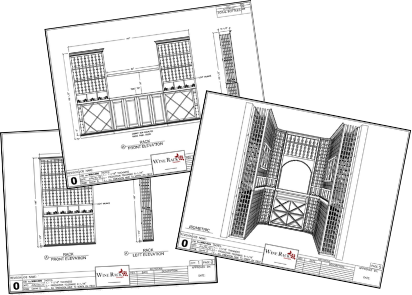
Free 2D wine cellar design