Creative Under Stairs Wine Cellar Ideas for Luxury Home Storage

*Pictures are renderings. Actual wine racks may look different
What if the most awkward, overlooked corner of your home could become its most sophisticated architectural feature? Most homeowners view the triangular void beneath a staircase as a place for seasonal storage or a simple utility closet, but this "dead space" offers the perfect footprint for a high-performance gallery. Designing a cellar in such a confined area requires a delicate balance of technical precision and aesthetic vision. You likely recognize the potential for a stunning display, but you might also worry about the challenges of sloped ceilings, foot traffic vibrations, or maintaining the strict climate requirements your collection demands.
In this guide, we'll explore several creative under stairs wine cellar ideas that transform these structural constraints into design opportunities. You'll discover how to navigate the complexities of vapor barriers and specialized cooling systems while selecting materials that reflect your personal style. We'll walk through the essential components of a professional-grade installation, from custom Vintner Series racking to seamless glass enclosures. By the end of this article, you'll have a clear roadmap for converting that neglected alcove into a precision-engineered showcase that protects your investment and elevates your home's value.
Key Takeaways
- Discover why the under-stair area is a naturally stable environment for storage and how to transform this "dead space" into a high-value architectural feature.
- Explore a variety of under stairs wine cellar ideas, from the timeless warmth of Vintner Series wood racking to the sleek, minimalist appeal of Fusion Wine Walls.
- Identify the technical requirements for active climate control, including how to select self-contained refrigeration units that fit within compact footprints.
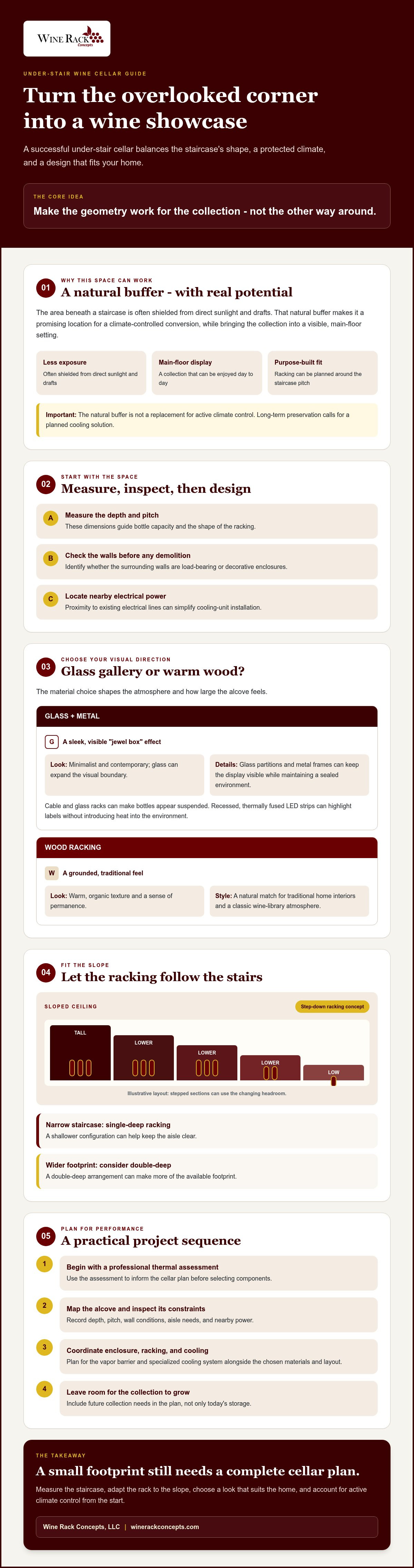
- Master the "step-down" racking technique to navigate sloped ceilings and optimize storage capacity with double-deep configurations.
- Follow a proven planning process that starts with a professional thermal assessment and accounts for your collection's future growth.
Maximizing the Potential of Under-Stair Wine Storage
Transforming the triangular void under a staircase is a specialized architectural undertaking. It represents a sophisticated shift in how homeowners utilize "dead space" within a luxury floor plan. While many areas of a home experience frequent temperature fluctuations, the core area under a staircase often remains shielded from direct sunlight and drafts. This natural buffer helps maintain proper wine storage conditions, making it an ideal candidate for a climate-controlled conversion. When you move your collection from a hidden basement to a main-floor display, you change the way people interact with your home.
To better understand the possibilities of these unique spaces, watch this helpful video:
Beyond utility, integrating under stairs wine cellar ideas into your home's layout creates a psychological shift from simple storage to a curated home feature. Investing in a custom wine cellar adds measurable sophistication and resale value to a residential property. It's a statement of pride in ownership. It shows a commitment to the joy of curation, turning a once-neglected alcove into a precision-engineered gallery for your investment.
Assessing Your Space for a Wine Conversion
Measuring the depth and pitch of your staircase is the first step in determining your bottle capacity. If the staircase is narrow, you might consider single-deep racking to keep the aisle clear. If the space is wider, double-deep options can significantly maximize the footprint. It's vital to identify whether the surrounding walls are load-bearing or merely decorative enclosures before any demolition begins. You should also evaluate the proximity to existing electrical lines. Having power nearby simplifies the installation of wine cellar cooling units, which are essential for long-term preservation and protection of delicate corks.
The Architectural Appeal of Hidden Cellars
A well-executed design serves as a striking visual focal point in hallways or living areas. Unlike traditional basement cellars that remain tucked away, these main-floor displays allow you to enjoy your collection daily. You can balance open-concept visibility with protective storage by using glass partitions and metal frames. This approach creates a "jewel box" effect that highlights your labels while maintaining a sealed, climate-controlled environment. If you're looking for a way to merge modern aesthetics with functional storage, our free design service can help map out these complex geometries to ensure a perfect fit.
Design Styles: Modern Glass vs. Traditional Wood Racking
Choosing between a sleek, transparent gallery and a rich, wooden library is the most significant aesthetic decision you'll make. This choice dictates the atmosphere of your hallway or living room. While glass-enclosed metal systems offer a modern edge, solid wood racking provides a timeless warmth that many collectors prefer. Your material selection also impacts how large the area feels. Glass expands the visual boundary; wood grounds it with a sense of permanence and tradition.
The Modern Glass Enclosure
For contemporary homes, a glass-fronted cellar under the stairs creates a stunning "jewel box" effect. Using American-made Metal Wine Cellar Doors ensures a durable, airtight seal while maintaining a minimalist profile. If you want your bottles to appear as if they're suspended in mid-air, Cable and Glass Wine Racks are the ideal solution. Lighting is crucial here. Recessed, thermally fused LED strips can highlight the labels without introducing heat into the environment. This style works exceptionally well for under stairs wine cellar ideas that aim for a high-tech, minimalist aesthetic.
Classic Wood Racking for Under-Stair Nooks
Traditional home styles often benefit from the organic texture of high-quality wood. The Classic Series and Vintner Series are designed to provide a cohesive, custom-built look. Wood isn't just an aesthetic choice; it possesses natural insulation properties that complement your climate control system. You can customize the finishes of the Carpenter Series to match your existing staircase cabinetry, making the cellar look like an original part of the home's architecture. This approach creates a cozy, established library feel for your collection.
Whether you lean toward the transparency of Fusion Wine Walls or the sturdy elegance of mahogany, the right racking system must accommodate the unique pitch of your stairs. If you're unsure which material best suits your home, you can explore your options through our free design service to visualize the final result before construction begins.
Essential Climate Control for Under-Stair Cellars
Creating a professional environment for your collection involves more than just fitting racks into a corner. Active cooling is a fundamental requirement for long-term aging. Without it, your bottles remain at the mercy of your home's ambient temperature shifts, which can lead to premature oxidation and damaged corks. For the compact footprints typical of these projects, self-contained refrigeration units are frequently the most efficient choice. These systems house the compressor and evaporator in a single housing, making them easier to install in confined areas.
One of the most challenging technical aspects of under-stair builds is managing heat exhaust. Every cooling unit generates heat as it pulls warmth from the cellar. If this exhaust is trapped in a small, unventilated space behind the stairs, the system will eventually overheat and fail. You must plan for the exhaust to be directed into a larger, well-ventilated room or ducted to the home's exterior. To understand the specific requirements for different footprints, you can review the technical specifications for our wine cellar cooling systems.
Vapor Barriers and Insulation Requirements
Vapor barriers are non-negotiable in any climate-controlled under-stair project. When you maintain a 55°F environment inside a warmer home, moisture naturally migrates toward the cold space. A 6 mil vapor barrier must be installed on the warm side of the insulation to prevent condensation, which can lead to mold and structural rot. For optimal performance, interior walls should have an R-11 insulation rating, while the ceiling and any exterior walls require an R-19 rating. These standards ensure your cooling unit operates efficiently without excessive wear. For a deeper look at these technical foundations, see our article on Insulation and Vapor Barriers for Wine Cellars.
Managing Vibration from Foot Traffic
While many under stairs wine cellar ideas focus on visual appeal, few address the physical impact of daily foot traffic. Constant vibration from residents walking up and down the stairs can disturb the delicate sediment in your wine. Over time, these micro-vibrations may interfere with the natural chemical aging process. To protect your investment, you can use rubber gaskets between the racking and the wall to dampen movement. Specialized mounting hardware can also help decouple the racking from the staircase stringers. In high-traffic homes, structural reinforcements provide an additional layer of stability, ensuring your collection ages in a peaceful, undisturbed environment.
Custom Racking Strategies for Sloped Ceilings
Navigating the sharp angles of a staircase requires a modular approach to design. While standard rectangular racks leave significant gaps in sloped spaces, the "Step-Down" technique allows you to follow the pitch of the stairs precisely. By using varying rack heights, you can create a tiered effect that mirrors the architecture above. This strategy works exceptionally well when you mix materials to solve geometric problems. You might use the structured warmth of the Vintner Series for the main body of the cellar and bridge the narrowest gaps with the Wine Peg Series. This hybrid method ensures a custom-fit look that maximizes every square inch of your footprint.
For those seeking a seamless, wall-to-wall aesthetic, Fusion Wine Walls provide a modern solution that adapts to almost any angle. These systems allow for label-forward display, which makes your collection easier to browse while maintaining a clean profile. In the tallest section of the enclosure, you can implement double-deep racking to effectively double your bottle capacity. This high-density approach is one of the most practical under stairs wine cellar ideas for collectors who need to house a growing inventory without expanding the room's dimensions.
Optimizing the Lowest Points of the Staircase
The narrowest part of the staircase triangle is often the most difficult to utilize. Instead of leaving this area empty, you can use it for bulk storage or case bins. These larger compartments are perfect for original wooden crates or larger format bottles that don't fit in standard 750ml cubicles. If the angle is particularly sharp, you might use this "triangle" space as a dedicated display area for a few choice bottles, angling them toward the glass for maximum visual impact. You must also consider access; ensure that the items stored in the deepest, lowest corners are those you don't need to reach on a daily basis.
High-Density vs. Minimalist Display
Deciding between bottle count and visual "breathing room" is a pivotal choice in your design process. If your primary goal is to house 200 or more bottles, the Vintner Series offers the necessary density through vertical stacking and double-deep options. Conversely, if you want a spacious, gallery-like feel, Cable and Glass Wine Racks provide a minimalist alternative. These systems prioritize the architectural beauty of the home, allowing light to pass through the cellar and into the surrounding room. Balancing your inventory needs with the desired aesthetic ensures that the finished space feels intentional rather than overcrowded.
Planning Your Under-Stair Wine Cellar Project
Transforming your home with creative under stairs wine cellar ideas requires a methodical roadmap to ensure long-term success. The process begins with a comprehensive site survey and thermal assessment to verify the structural integrity of the staircase and the insulation needs of the enclosure. You must then define your collection size and account for future growth. Most collectors find their inventory expands faster than expected; for those in the Rocky Mountain region who outgrow their residential space, garage condos for sale colorado through The Garage Condo Guy provide a high-end alternative for secure storage. After establishing these parameters, you should consult with a professional designer to create CAD or VR models. These tools allow you to select the right materials and cooling infrastructure before any construction begins. Finally, professional installation and system calibration ensure your environment maintains the precise levels required for preservation.
Budgeting for a Custom Build
Understanding your cost drivers is essential for a realistic project plan. While glass enclosures and custom metal doors offer a high-end visual impact, your primary investment should focus on long-term protection. High-quality insulation and a robust cooling unit are the foundations of any successful build. If you're deciding where to allocate your resources, prioritize the infrastructure that prevents spoilage. You can read more about balancing these factors in our post on Custom Wine Cellar Design. Investing in durability early on prevents expensive repairs or collection loss later.
Leveraging Professional Design Services
Working with a specialist helps you avoid the common pitfalls associated with awkward stair geometries and thermal bridging. Our free design consultations provide a clear path forward by translating your vision into 3D renderings. These visualizations allow you to see how different racking series, such as the Carpenter or Vintner lines, fit within your specific pitch. This phase is critical for ensuring all custom wine cellars meet technical standards for airflow and weight distribution. By utilizing professional modeling, you can confidently move from the inspiration stage to a finished, professional result.
Transform Your Overlooked Space into a Curated Showcase
Turning the void beneath your staircase into a professional-grade cellar is a journey from wasted square footage to an architectural masterpiece. You've discovered that success lies in the details; specifically, the integration of expert climate control and high-performance insulation. Whether you prefer the timeless library feel of the Vintner Series or the minimalist transparency of a glass enclosure, the right materials protect your investment for years to come. By exploring these diverse under stairs wine cellar ideas, you've seen how technical precision meets architectural beauty.
Your collection deserves a home that reflects its value. We specialize in providing the durable components needed for these complex environments, including American-made metal cellar doors and specialized peg series. Every custom project benefits from our deep understanding of climate control integration, ensuring your bottles age in a stable, vibration-free atmosphere. It's time to stop seeing a storage problem and start seeing a design opportunity.
We look forward to helping you visualize a space that brings both sophistication and value to your residence. Your dream cellar is closer than you think.
Frequently Asked Questions
Is it possible to build a wine cellar under any staircase?
Most staircases can be converted, provided there is sufficient space and structural integrity. You need to ensure the area isn't restricted by major plumbing stacks or HVAC ducting that can't be moved. A site survey determines if the enclosure can be properly insulated and sealed. If the staircase is on an exterior wall, additional moisture barriers are required to maintain stability and protect the climate of the enclosure.
Do I need a cooling system for an under-stair wine cellar?
Active cooling is essential if you plan to age wine for more than a few months. While under-stair areas are often thermally stable, they rarely stay at the required 55°F to 58°F without assistance. Dedicated wine cellar cooling systems, particularly self-contained units, are designed to manage these small volumes. Without active regulation, fluctuations in home temperature can compromise the seal of the corks and the quality of your vintage.
How many bottles can I realistically fit under my stairs?
Capacity typically ranges from 50 to 200 bottles depending on the staircase dimensions. Most under-stair voids offer between 60 and 220 cubic feet of volume. To maximize this space, you can use double-deep racking in the tallest section or high-density series like our Vintner collection. Using a mix of bulk bins and individual bottle cubicles helps you utilize the sharpest angles of the slope effectively and efficiently.
What is the best material for under-stair wine racking?
The "best" material depends on your aesthetic goals and the environment. High-quality woods like mahogany or redwood, found in our Classic Series, offer natural insulation and a traditional look. For contemporary under stairs wine cellar ideas, metal and glass systems like the Fusion Wine Walls create a minimalist, label-forward display. Metal is often preferred in modern designs for its durability and sleek, low-profile appearance that makes small spaces feel larger.
How do I handle the sloped ceiling when installing wine racks?
You can manage sloped ceilings by using a "step-down" racking technique. This involves installing racks of decreasing heights to follow the pitch of the stairs exactly. Our specialized design services often utilize modular series that can be trimmed or tiered to fit these unique geometries. For the most acute angles where traditional racks won't fit, the Wine Peg Series offers a flexible solution for wall-mounted display in tight corners.
Can I use a glass door for an under-stair wine room?
Yes, glass doors are a popular choice for creating a visual showcase. However, you must use dual-paned, tempered, and UV-protected glass to maintain the internal climate. Our Metal Wine Cellar Doors provide the necessary structural support and airtight seals required for refrigerated spaces. These doors ensure that your collection remains visible while staying protected from the heat and light of the surrounding living area, maintaining your home's aesthetic harmony.
How do I prevent vibration from the stairs from damaging my wine?
You can mitigate vibration by decoupling the racking from the staircase structure. Use rubber gaskets or vibration-dampening mounts between the racks and the walls. It's also effective to build an independent internal frame that doesn't directly touch the stair stringers. These structural reinforcements ensure that the micro-vibrations from daily foot traffic don't disturb the sediment or interfere with the chemical aging process of your wine, preserving its flavor profile.
What is the average depth of an under-stair wine cellar?
Average depths usually fall between 24 and 36 inches. A depth of 13.5 inches is standard for single-deep racking, while double-deep configurations require approximately 27 inches. You should also account for a few inches of clearance for insulation and the vapor barrier on the back wall. If the space is exceptionally deep, you might include a small walkway or "reach-in" aisle to access bottles stored at the rear of the unit.
Have an expert help today!
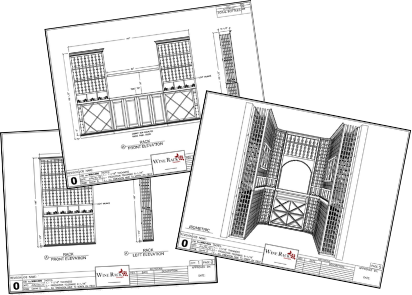
Free 2D wine cellar design