Case and Diamond Bin Wine Racks: A Professional Guide to Bulk Storage

*Pictures are renderings. Actual wine racks may look different
What if the greatest limitation in your wine cellar isn't the square footage, but the geometry of your racks? Most collectors eventually reach a point where individual bottle slots no longer suffice for a growing inventory or those beautifully oversized Champagne and Magnum bottles. It's a common frustration to find yourself stacking cases on the floor because your current system lacks the flexibility for bulk storage. Transitioning to case and diamond bin wine racks allows you to reclaim that wasted space while maintaining the sophisticated look of a professional cellar.
You likely understand that high-capacity storage shouldn't mean sacrificing the safety of your labels or the accessibility of your favorite vintages. In this guide, you'll discover the functional and aesthetic differences between case and diamond bin wine racks to optimize your high-capacity wine storage effectively. We'll explore how specialized series like the Vintner and Classic utilize these designs to accommodate diverse bottle shapes and ensure your floor-to-ceiling space is used with precision. From maximizing bottle density to protecting your investment, we'll provide the clarity you need to choose the right bulk solution for your unique collection.
Key Takeaways
- Identify whether your inventory requires the rectangular precision of case bins or the triangular versatility of diamond bins for maximum spatial efficiency.
- Preserve the integrity and resale value of your collection by using case racks designed specifically to house original wooden cases and cardboard boxes.
- Master the art of storing Magnums and Champagne bottles using case and diamond bin wine racks that prevent rolling while accommodating diverse bottle shapes.
- Learn to integrate high-capacity bins with professional series like Vintner or Classic to maintain a sophisticated aesthetic without sacrificing storage density.
- Understand how the strategic placement of bulk racking impacts cellar climate control, ensuring consistent airflow from premium cooling systems to every bottle.
Understanding Case and Diamond Bin Wine Racks for High-Capacity Storage
Scaling a wine collection requires a strategic shift in how you view your available space. While individual bottle racking is excellent for display and quick access, it often leaves significant gaps in high-capacity environments. Professional cellars solve this by incorporating case and diamond bin wine racks. These units provide the structural foundation for bulk storage, allowing you to stack bottles or boxes vertically. Case bins are characterized by their rectangular, open-shelf design. They're specifically sized to house original wooden cases or standard cardboard boxes, keeping your inventory organized by the lot. Diamond bins utilize a diagonal, cross-hatched layout that creates triangular and diamond-shaped openings. This geometry is ideal for loose bottles, as the angled walls prevent rolling and allow for high-density stacking.
When to Transition from Individual Racking to Bins
Every collector eventually hits a tipping point where individual slots become a bottleneck. If you find yourself leaving boxes on the cellar floor or struggling to find room for case-lot purchases, it's time to integrate bulk bins. Managing a collection of several hundred bottles requires a balance between accessibility and density. Buying wine by the dozen is more cost-effective, but it quickly consumes individual rack space. Transitioning to case and diamond bin wine racks allows you to store these bulk acquisitions together, simplifying your inventory management. The transition involves moving from a "one bottle at a time" mindset to a more professional, scalable system. If you're unsure how to distribute these elements, our free design service can help you visualize the most efficient layout for your specific bottle count.
Materials and Construction Standards
Bulk storage demands exceptional structural integrity because the weight of dozens of bottles adds up quickly. A fully loaded diamond bin can easily exert hundreds of pounds of pressure on the lower supports; therefore, load-bearing capacity is the most critical factor when selecting wooden wine racks for bulk use. Our Carpenter and Classic series are engineered to handle this weight without sagging or compromising the safety of your collection. These series prioritize thick, sturdy components that reflect foundational wine cellar storage principles. Whether you prefer the traditional look of solid wood or want to integrate modern metal accents, the construction must remain the priority. Choosing a high-quality series ensures your cellar remains a safe, professional environment for your most valuable vintages, and your racks don't sag over time.
The Benefits of Case Wine Racks for Uniform Collections
For the serious collector, purchasing wine by the case isn't just about volume; it's about provenance and future value. Keeping premium vintages in their Original Wooden Case (OWC) or factory cardboard is essential for preserving resale potential and ensuring the bottles remain undisturbed during their maturation. While both case and diamond bin wine racks offer high-density storage, case racks excel at maintaining the organizational integrity of these uniform acquisitions. These rectangular units provide a flat, stable surface that prevents the weight of stacked boxes from crushing those at the bottom. Case racks are the primary choice for long-term aging of unopened boxes.
Structural stability is a hallmark of professional-grade case storage. Unlike loose stacking on a floor or a simple shelf, these racks are engineered to distribute the weight of full cases evenly across the frame. This setup simplifies inventory management significantly. Instead of moving three individual bottles to find a fourth, you can identify an entire lot by the markings on the box exterior. This methodical approach transforms a cluttered cellar into a streamlined, professional environment where every dozen bottles has a dedicated home.
Standard Dimensions for Case Racking
Precision in sizing is vital because wine cases are not universally uniform. A standard 12-bottle OWC typically requires different clearance than a flatter 6-bottle lay-down case. Our Vintner series addresses this variety by offering adjustable shelving options, allowing you to customize the vertical spacing as your collection evolves. Depth is another critical factor. Most cases measure approximately 13 to 15 inches in length; therefore, your racking must be deep enough to ensure the boxes don't protrude into the aisles. Choosing the correct depth maintains a clean visual line and prevents accidental bumps as you move through the cellar.
Accessibility and Retrieval Efficiency
Storing cases doesn't have to mean sacrificing ease of access. Incorporating pull-out shelves into your wooden wine racks allows you to slide a heavy case forward to inspect the label or retrieve a single bottle without unstacking multiple boxes. This feature is particularly helpful for lower levels where crouching makes inventory checks difficult. To further enhance efficiency, many collectors use a consistent labeling system on the front of the rack or the box itself. If you're planning a high-capacity space and want to ensure every case is perfectly positioned, our free design service can help you map out the ideal configuration for your specific inventory needs.
Diamond Bin Wine Racks: Maximizing Versatility and Aesthetic Appeal
Diamond bins represent a sophisticated intersection of architectural beauty and practical storage. While case racks prioritize the box, diamond bins are designed for the bottles themselves. The primary geometric advantage lies in the diagonal "X" structure, which creates stable, triangular cradles. This layout naturally prevents bottles from rolling, even when a bin isn't fully loaded. Integrating case and diamond bin wine racks ensures your cellar can handle everything from standard Bordeaux shapes to the most challenging silhouettes in your collection.
Versatility is perhaps the greatest strength of the diamond configuration. Collectors often struggle with "odd" bottle shapes like wide-bottomed Pinot Noirs, heavy Champagne bottles, or oversized Magnums. These bottles rarely fit in standard individual racking without scraping the labels or forcing the wood. Diamond bins provide the necessary clearance for these diverse shapes, making them a visual focal point in any custom cellar design. Beyond aesthetics, the diagonal layout promotes superior breathability. In a climate-controlled room, airflow must reach every bottle to prevent hot spots. The open structure of these bins allows air to circulate freely around the glass, maintaining a consistent temperature throughout the stack.
Solid Diamond vs. Open Slat Designs
Choosing between solid panels and open-slat designs depends on your specific aesthetic and cooling requirements. Our Vintner series features an open-slat look that maximizes airflow, making it a favorite for high-performance cellars. Solid diamond bins, often found in our Classic series, offer a more traditional, furniture-grade appearance. Both styles provide exceptional weight distribution across the diagonal supports. If your cellar utilizes a high-output wine cellar cooling system, the open-slat design is often the more efficient choice for maintaining thermal stability.
Capacity Calculations for Diamond Bins
Calculating your storage needs requires understanding the volume of each opening. A standard 12x12 diamond bin section typically accommodates 9 to 12 standard 750ml bottles. This capacity fluctuates slightly if you're storing larger Champagne or Turley-style bottles. Managing partial bins is also simpler with diamonds; the triangular corner spaces created by the "X" are perfect for smaller three-bottle lots. To avoid label scuffing, we recommend stacking bottles carefully with labels facing upward. If you're designing a space for a diverse collection, our free design service can help you calculate the exact diamond count needed to house your current and future inventory.
Comparing Case vs. Diamond Bins: Which Fits Your Collection Best?
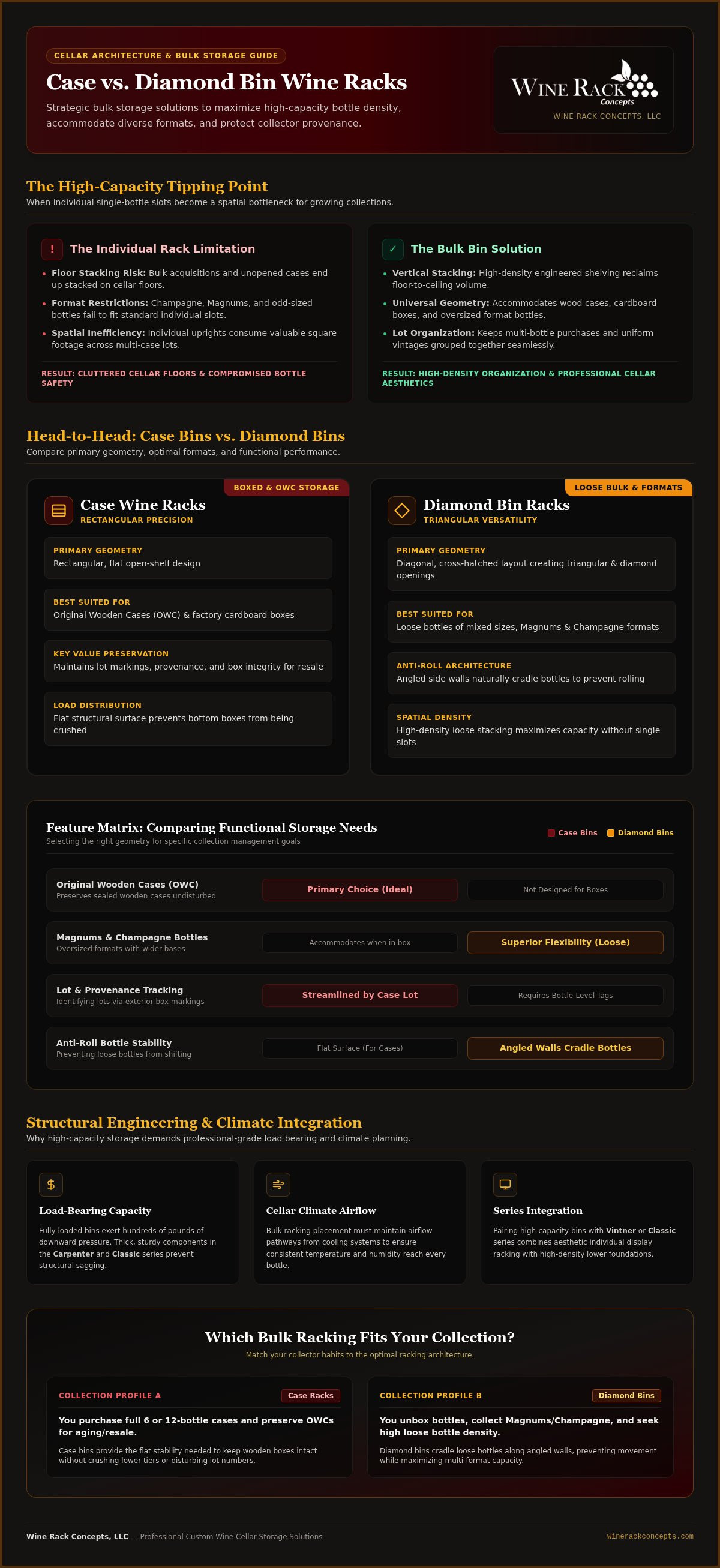
Selecting between case and diamond bin wine racks depends heavily on the current composition of your inventory and your future acquisition strategy. If your collection consists primarily of original wooden cases, rectangular bins provide the flat surfaces required for stable vertical stacking. Diamond bins offer a different advantage by cradling loose bottles of varying diameters in a secure, diagonal layout. Both options significantly increase storage density compared to individual bottle racking, making them essential for any high-capacity environment. Cost-effectiveness is another major factor; bulk storage solutions typically reduce the overall cost per bottle stored by utilizing shared structural supports rather than individual dividers.
Your choice should also reflect how you interact with your wine. Case racks are ideal for investment-grade collections where boxes remain sealed for years to preserve provenance. If you prefer to have a wide variety of daily drinkers or mixed varietals easily accessible, diamond bins allow you to grab a single bottle without unstacking heavy boxes. Balancing these two styles ensures your cellar remains both a high-density warehouse and a functional tasting space.
Bottle Shape and Size Compatibility
Case bins are the logical choice for standard Bordeaux and Burgundy boxes, as their dimensions are optimized for these rectangular footprints. If you frequently purchase oversized glass, such as 1.5L Magnums or wide-bottomed Turley bottles, diamond bins provide the necessary clearance that boxes cannot. A hybrid approach is often the professional recommendation for most collectors. By mixing both styles, you create a versatile system that adapts as your tastes evolve. This flexibility prevents the frustration of finding a beautiful new acquisition that simply won't fit into your existing rack configuration.
Design and Installation Considerations
Integrating bulk storage requires careful planning to ensure the weight is distributed safely across your cellar floor. Floor-to-ceiling integration in a custom wine cellar allows you to maximize every inch of vertical space, but it demands professional-grade structural integrity. Our Classic and Carpenter series are built with the thick, durable components necessary to support these heavy loads without sagging. You can read more about custom wine racks to understand how different materials and finishes can harmonize with your existing decor while providing the strength your collection requires.
Integrating Bulk Racking into Your Custom Wine Cellar Design
Integrating case and diamond bin wine racks into a cohesive cellar layout requires more than just measuring empty wall space. It involves creating a functional flow where high-density storage complements your primary display areas. Many modern designs successfully mix metal wine racks with bulk wood bins to achieve a contemporary, high-contrast look. This combination allows for the sleek, label-forward presentation of metal alongside the warm, structural reliability of our Vintner or Classic series. A professional design ensures these diverse elements feel unified rather than fragmented, turning a simple storage room into a curated experience.
Safety is a paramount consideration when you're managing the sheer mass of bulk storage. A single section of fully loaded diamond bins can weigh several hundred pounds; therefore, proper anchoring to the wall studs is mandatory. This is especially true for floor-to-ceiling installations or in regions prone to seismic activity. Professional installers prioritize these structural requirements to prevent tipping and protect both the collection and the cellar's occupants. When you invest in a custom wine cellar, you're investing in the peace of mind that comes from a structurally sound environment.
Bulk Storage and Climate Control
Strategic placement of bulk bins directly impacts the efficiency of your wine cellar cooling system. If you place deep diamond bins or dense case stacks directly in the path of the cold air return, you risk creating "dead zones" where temperature fluctuates. It's vital to ensure cold air can reach the center of deep bins to maintain thermal stability for every bottle. For large, bin-heavy rooms, consulting on commercial wine cellar refrigeration helps determine the necessary BTU capacity and airflow patterns needed to penetrate high-density sections effectively.
Final Planning and Customization
The final phase of your project involves selecting finishes that harmonize with your existing decor. Whether you're matching dark wood stains to your flooring or choosing hardware that complements metal cellar doors, these details elevate the room from a storage area to a luxury retreat. Moving from the initial planning stages to a finished installation is a methodical process that benefits from expert guidance. Every material choice and layout decision should serve the ultimate goal of protecting your investment while reflecting your personal style and curation habits.
Ready to maximize your space? Get a Free Design Quote
Elevating Your Collection with Professional Bulk Storage
Building a high-capacity cellar requires a thoughtful balance between the rigid organization of case racks and the geometric flexibility of diamond bins. By integrating case and diamond bin wine racks, you ensure that every bottle, from standard Bordeaux to oversized Magnums, is stored with the structural integrity it deserves. Utilizing durable series like the Vintner, Carpenter, or Classic provides the weight-bearing capacity needed for serious curation while maintaining a sophisticated aesthetic that reflects your pride of ownership.
Strategic placement of these units also safeguards your investment by optimizing airflow and climate control efficiency. This professional approach prevents temperature fluctuations and ensures your most valuable vintages age under ideal conditions. Whether you're managing a growing residential collection or a commercial inventory, the right bulk storage system acts as a bridge between simple utility and a world-class display. Our team provides expert design consultations and national support to help you transform your storage vision into a professional reality.
We look forward to helping you create a functional, beautiful space that celebrates your passion for fine wine and protects your collection for years to come.
Frequently Asked Questions
What is the difference between a case wine rack and a diamond bin?
Case racks utilize a rectangular design specifically sized to hold original wooden cases or cardboard boxes on flat shelves. Diamond bins use a diagonal "X" structure to create triangular and diamond-shaped openings for loose bottles. While both are types of case and diamond bin wine racks, case racks prioritize the storage of intact boxes, whereas diamond bins focus on loose bottle density and visual variety.
How many bottles can a standard diamond bin wine rack hold?
A standard 12x12 diamond bin section typically holds 9 to 12 standard 750ml bottles. This capacity varies depending on the bottle diameter, as larger formats like Champagne or Turley bottles will reduce the total count. The triangular corner spaces created by the diagonal supports are also useful for storing smaller three-bottle lots, ensuring you maximize every inch of the available storage space.
Are diamond bin wine racks safe for long-term aging?
Diamond bins are exceptionally safe for long-term aging because they provide a stable, non-rolling environment for your collection. The diagonal supports distribute weight evenly, which prevents excessive pressure on the lower bottles in a stack. This layout also promotes excellent airflow, which is critical for maintaining the consistent temperatures required for a collection to mature properly and safely over many years.
Can I store different sized bottles like Magnums in a case rack?
Case racks are engineered for standard 6-bottle or 12-bottle rectangular boxes; therefore, they aren't the primary choice for loose Magnums unless those bottles remain in their original cases. If you're storing loose 1.5L bottles, diamond bins are the superior alternative. They offer the necessary clearance and height that standard rectangular shelving often lacks for oversized glass and non-standard bottle formats.
Do bulk wine racks damage the labels on my bottles?
Bulk racking won't damage labels if the bottles are stacked with care and precision. In diamond bins, it's best to place bottles with the labels facing upward to prevent scuffing against the wood supports. Our Vintner and Classic series utilize smooth, high-quality finishes and rounded edges to minimize the risk of tearing or marking your labels during retrieval or routine inventory management.
Should I choose wood or metal for my high-capacity bulk racking?
Wood is generally the preferred material for high-capacity bulk racking due to its superior weight-bearing capacity and structural rigidity. Series like our Carpenter or Classic are specifically engineered to handle the immense pressure of dozens of stacked bottles. While metal racks are excellent for modern display, solid wood bins provide the durability and timeless aesthetic required for heavy, floor-to-ceiling storage configurations.
How do I calculate the weight capacity needed for bulk wine bins?
Calculating weight capacity requires multiplying your bottle count by approximately 3 pounds per bottle. A single diamond bin holding 12 bottles weighs roughly 36 pounds, but a full rack section can quickly exceed several hundred pounds. It's vital to ensure your case and diamond bin wine racks are anchored to wall studs and that the floor can support the concentrated load of a high-density system.
Can bulk racking be integrated with a wine cellar cooling system?
Bulk racking is easily integrated with premium cooling systems like WhisperKOOL or Wine Guardian to maintain a stable environment. It's important to place bins so they don't block the cold air return or create airflow dead zones in the room. Professional design ensures that cold air circulates through the center of deep diamond bins, protecting your collection from localized hot spots and temperature fluctuations.
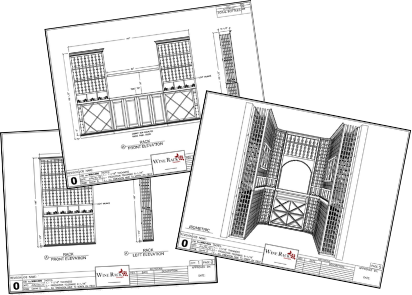
Have an expert help today!
Free 2D wine cellar design