Built-In Wine Racks for Kitchen Cabinets: Design & Install

*Pictures are renderings. Actual wine racks may look different
That empty overhead cabinet above the refrigerator might look like the natural spot for a few bottles, but it's often the quickest way to spoil good wine. Standard upper boxes simply don't match bottle proportions, leaving glass protruding awkwardly while ambient cooking heat and appliance vibrations compromise delicate corks. Incorporating dedicated built-in wine racks for kitchen cabinets solves this tension, transforming underutilized nooks into safe, intentional displays that elevate your entire room.
You don't need to choose between serious bottle preservation and seamless kitchen design. In this guide, you'll discover how to integrate wine storage into island endcaps, base runs, and pantry walls to keep every vintage protected from heat, light, and sudden temperature shifts. We'll break down essential cabinet depth requirements, compare classic wood lattice grids with minimalist metal pegs, and provide a clear framework to help you choose and install the right system for your space.
Key Takeaways
- Selecting the right built-in wine racks for kitchen cabinets requires matching bottle dimensions to 12-inch uppers or 24-inch base boxes so bottles sit flush without awkward neck protrusion.
- Strategic positioning away from heat sources like ranges and vibrating appliances like dishwashers is essential to protect cork elasticity and delicate wine sediment.
- Material options range from traditional wood lattice and individual cubbies to architectural metal pegs, allowing you to choose between space-efficient neck-out storage and dramatic label-forward displays.
- Factoring in bottle diameters beyond standard Bordeaux sizes ensures your custom layout comfortably accommodates wider Pinot Noir, Burgundy, and Champagne bottles without label friction.
What Are Built-In Wine Racks for Kitchen Cabinets?
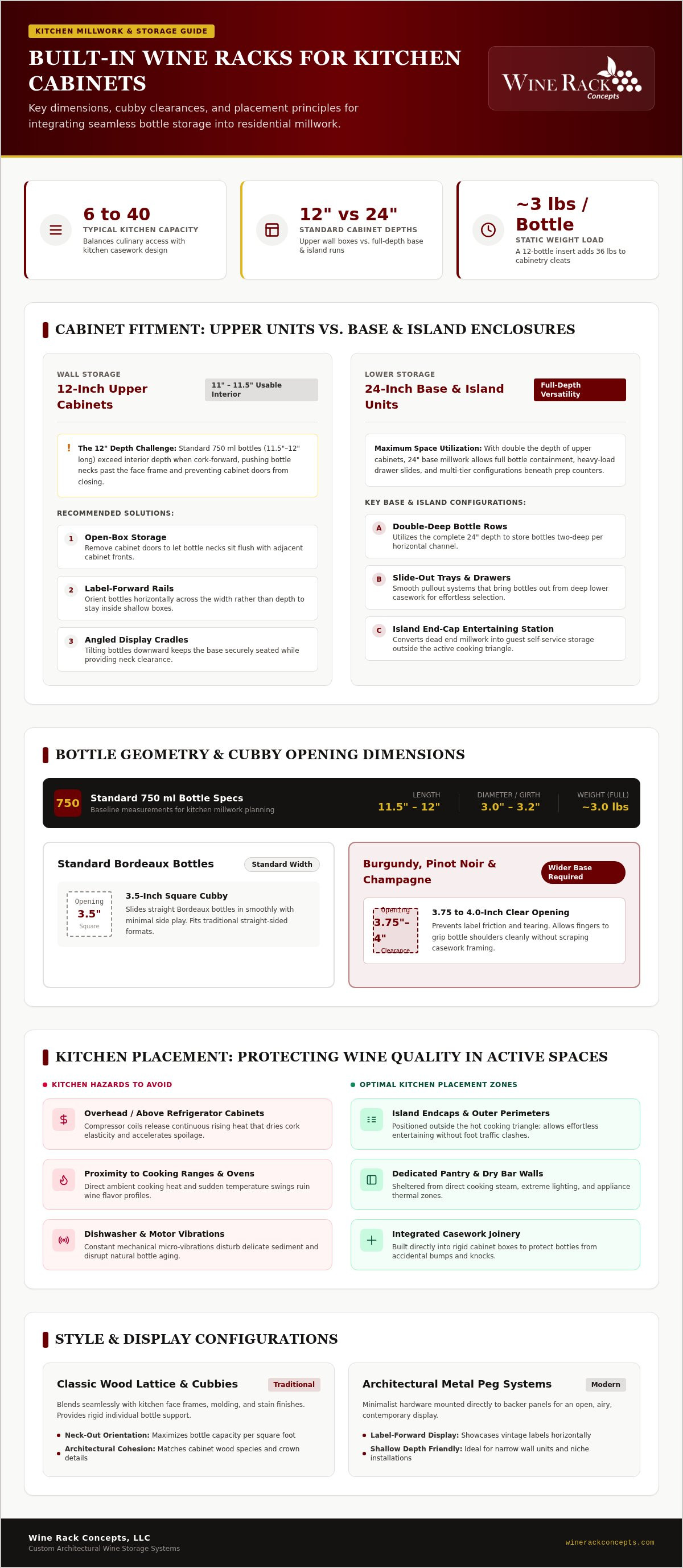
Unlike standalone wire wire frames or rolling bar carts, built-in wine racks for kitchen cabinets are structural joinery components integrated directly into your millwork layout. Rather than treating bottles as temporary countertop clutter, these purpose-built systems secure vintages flush within your existing casework. Most residential kitchen installations accommodate between 6 and 40 bottles, striking the ideal balance between easy culinary access and sophisticated culinary architecture.
To see how a standard cabinet box transforms into a clean, integrated bottle display, watch this practical walkthrough:
Core Configurations: Upper Cabinets, Base Units, and Islands
Where you place your racking dictates how it functions during weeknight cooking and weekend gatherings. Upper cabinet inserts position favorite vintages at eye level, using open cubbies or geometric dividers to create an inviting focal point above counter surfaces. In contrast, standard 24-inch base cabinets offer the necessary depth for horizontal columns or smooth pullout trays beneath prep surfaces. Converting an island end-cap turns dead perimeter millwork into an entertaining station, letting guests serve themselves without entering your cooking triangle.
Integrated Built-Ins vs. Freestanding Countertop Storage
Freestanding countertop racks consume valuable workspace and leave fragile glass exposed to everyday kitchen accidents. Specifying wooden wine racks built directly into cabinet boxes secures every bottle within rigid framing, significantly improving bottle stability and protecting developing wines from accidental bumps.
Visual cohesion sets built-ins apart from temporary storage. By matching cabinet wood species, finish stains, face frames, and crown molding, your built-in wine racks for kitchen cabinets look like an intentional part of the home's original architectural blueprint.
Key Dimensions and Sizing for Kitchen Cabinet Wine Storage
Precision millwork hinges on fractions of an inch. When planning built-in wine racks for kitchen cabinets, standard box dimensions collide directly with bottle geometry. A typical 750 ml bottle measures roughly 11.5 to 12 inches long and 3 to 3.2 inches wide. If your cabinetry fails to account for both bottle length and girth, you risk protruding necks, pinched labels, or shelves buckling under concentrated dynamic weight.
Upper Cabinet Fitment: Solving the 12-Inch Depth Challenge
Standard wall cabinets feature an exterior depth of 12 inches, leaving a usable interior depth of approximately 11 to 11.5 inches. Because standard bottles match or exceed that depth, traditional cork-forward racking pushes bottle necks past the cabinet face frame, preventing doors from closing.
To preserve clean architectural sightlines within upper cabinets, consider these strategic adjustments:
- Convert to open-box storage: Remove cabinet doors entirely and let bottle necks rest intentionally flush with neighboring cabinet fronts.
- Utilize label-forward rails: Orient bottles horizontally across the width rather than the depth, keeping glass contained within shallow boxes.
- Incorporate angled display cradles: Tilting bottles downward slightly keeps the base seated while maintaining necessary neck clearance.
Base Cabinet and Island Sizing: Maximizing Full-Depth Enclosures
Standard 24-inch base cabinets provide exceptional versatility. With double the depth of wall units, lower millwork easily accommodates double-deep bottle rows, slide-out storage trays, or integrated stemware rails positioned directly above horizontal columns.
Opening dimensions matter just as much as overall depth. While Bordeaux bottles slide neatly into a 3.5-inch square cubby, wider bottles like Burgundy, Pinot Noir, and Champagne require 3.75 to 4 inches of clear opening space to prevent label friction. Vertical clearance must also allow fingers to comfortably grip the bottle shoulder without scraping the frame above.
Liquid glass is deceptively heavy. A standard full bottle weighs around three pounds, meaning a modest 12-bottle insert adds 36 pounds of static weight to a single shelf run. Always verify structural cleats and reinforce shelf pins before loading lower units. If you are calibrating dimensions for wider formats or unique cabinet boxes, collaborating on a custom cabinet wine storage design ensures your inserts fit your exact millwork down to the millimeter.
Popular Styles and Materials: Wood, Metal, and Modern Systems
Selecting the right materials for built-in wine racks for kitchen cabinets involves striking a balance between your home's millwork and the visual presence of your collection. While traditional kitchens often rely on tailored woodwork to blend into surrounding cabinetry, modern open-concept spaces increasingly incorporate architectural hardware that turns stored wine into graphic art. Both approaches offer dependable bottle stability, yet each creates a distinctly different interior presence.
Classic Hardwood Racking: Carpenter, Classic, and Vintner Approaches
Nothing matches the warmth and visual continuity of finely milled timber. Traditional systems utilize species like white oak, maple, or rich mahogany to echo perimeter casework finishes. In transitional or classic spaces, precision options from the Carpenter Series, Classic Series, and Vintner Series provide familiar layouts such as diamond bins, individual framed cubbies, and scalloped horizontal rails. When sourcing wooden wine racks, note that not all products are made in America, so verify material sourcing and timber stability to ensure your frames withstand the ambient humidity shifts common near kitchen prep zones.
Modern Metal and Peg Systems: Fusion Wine Walls and Cable Racks
For minimalist, industrial, or contemporary kitchens, architectural metal solutions break away from solid wooden partitions. Instead of hiding bottles deep inside dark cubbies, precision metal systems suspend glass across open cabinet niches, island end panels, or shallow wall recesses.
Modern metal hardware configurations include:
- Wine Peg Series: Precision-engineered metal pins mounted directly into reinforced cabinet backer boards, holding bottles horizontally by the neck and base.
- Fusion Wine Walls: Sleek metal hardware mounted on textured wood panels, creating a striking contrast against painted cabinet boxes.
- Cable Wine Racks: Tensioned stainless steel cables that suspend bottles mid-air, delivering an ultra-light, floating display inside glass-front cabinets.
Opting for architectural metal wine racks introduces a label-forward format to your built-in wine racks for kitchen cabinets. This orientation lets you read vintage information immediately without handling or rotating the bottle, keeping delicate sediment settled until it's time to pour.
Kitchen Placement Guidelines: Preserving Wine Quality in Active Spaces
Kitchens are inherently dynamic environments where temperatures fluctuate rapidly. Between simmering stockpots, cycling refrigeration compressors, and radiant oven heat, the ambient climate can quickly threaten delicate vintages. When integrating built-in wine racks for kitchen cabinets, finding a stable microclimate within your floor plan is just as critical as choosing the right millwork.
Identifying Kitchen Danger Zones: Heat, Steam, and Vibration
Several standard cabinet locations look convenient on paper but spell disaster for wine chemistry. Warm air naturally pools near ceilings, and motorized appliances introduce localized environmental stress.
- Above the refrigerator: Refrigerator compressor coils exhaust heat continuously upward, steadily cooking bottles stored in overhead cabinetry.
- Directly flanking ranges and ovens: Radiant heat causes rapid liquid expansion, pushing corks outward and compromising vacuum seals.
- Adjacent to dishwashers: Dishwasher wash cycles vent intense steam while mechanical pumps generate micro-vibrations that shake settling bottle sediment.
- Unshaded window perimeters: Direct exposure to sunlight triggers photochemical reactions, resulting in light strike that prematurely ruins natural wine aromas.
Selecting Ideal Cabinet Locations for Short-Term Bottle Holding
Passive built-in wine racks for kitchen cabinets work best as short-term holding zones for wines you plan to open within several months. To protect those bottles, install racking inside base cabinets along interior partition walls, where ground-level temperatures remain cooler and buffered from exterior weather shifts. Island endcaps facing outward toward dining spaces and dedicated dry bar stations outside the primary cooking triangle also provide cool, shaded havens.
Bottles designated for multi-year cellaring require strict 55-degree baselines and elevated humidity levels that open kitchen casework cannot maintain. For serious long-term preservation, pair your kitchen service station with dedicated wine cellar cooling systems situated in a conditioned room.
How to Plan Your Custom Built-In Wine Rack Project
Careful planning turns an ambitious kitchen concept into functional cabinetry. Before ordering materials, audit how you actually entertain and consume wine. Built-in wine racks for kitchen cabinets work best when sized for active rotation rather than static collecting, making an 8- to 24-bottle capacity the sweet spot for most households. Start by evaluating whether your project calls for retrofitting existing casework or building a brand-new cabinet run, then map your layout with a custom wine storage design.
Retrofitting Existing Cabinetry vs. New Custom Construction
Modifying existing casework is often the fastest path to an upgrade. You can remove standard cabinet doors and interior adjustable shelving, sliding a tailored insert directly into the structural carcass. Precision measuring is paramount here. You must measure the clear opening between face frames rather than interior box walls, accounting for European concealed hinge plates if doors remain.
When retrofitting, plan around hidden kitchen infrastructure:
- Route around low-voltage wiring used for under-cabinet task lighting.
- Inspect cabinet backs for hidden plumbing chases or electrical outlet boxes.
- Add matching scribed filler strips or perimeter molding to lock the insert flush with adjacent millwork.
Working with Professional Storage Designers
Translating raw measurements into balanced joinery requires careful calibration. A professional designer maps out your bottle mix to ensure your racking provides balanced structural support without sagging over time. They also help align wood stains, lacquer sheens, and hardware accents to mirror your cabinet pulls and surrounding millwork.
Collaborating with an experienced specialist takes the guesswork out of clear openings and dynamic weight loads. Schedule a free custom design consultation to verify your cabinet dimensions and ensure your built-in wine racks for kitchen cabinets fit seamlessly into your living space.
Bring Architectural Wine Storage into Your Kitchen
Integrating built-in wine racks for kitchen cabinets bridges functional daily convenience with elevated interior design. Success comes down to precision: sizing openings to protect wider bottles, matching joinery to existing door profiles, and situating storage away from the thermal stresses of active appliances. With decades of dedicated wine storage manufacturing and custom millwork expertise, Wine Rack Concepts, LLC tailors precision layouts to your room's exact dimensions using architectural-grade materials, from hand-finished hardwoods to modern metal pegs and cable systems.
Transforming an underutilized cabinet box or island end panel into a dedicated wine showcase brings effortless hospitality to your culinary space. With the right layout and structural support in place, your bottles will remain protected, beautifully organized, and ready for your next uncorking.
Frequently Asked Questions
Can you put a built-in wine rack in standard 12-inch upper kitchen cabinets?
Yes, but you need to account for bottle length. Standard 750 ml bottles measure roughly 11.5 to 12 inches long, so cork-forward bottles will sit flush or protrude slightly beyond an 11-inch clear interior depth. To make built-in wine racks for kitchen cabinets work inside upper boxes, builders typically remove the cabinet door for an intentional open cubby look, angle the cradles slightly, or choose horizontal label-forward racking rails.
How do you keep wine from spoiling in a warm kitchen environment?
Position your racking in low base cabinets or an island endcap away from heat-producing appliances like ovens, dishwashers, and refrigerators. Kitchen cabinet racks provide passive storage, making them ideal for everyday bottles opened within a few months. For valuable bottles requiring long-term aging at a consistent 55 degrees, avoid unconditioned kitchen cabinetry altogether and rely on a dedicated wine cellar cooling unit in a temperature-controlled space.
What is the best wood species to use for built-in kitchen wine racks?
Dense hardwoods like white oak, hard maple, and mahogany are ideal choices. They offer exceptional structural rigidity and resist warping when minor humidity shifts occur from cooking steam. White oak wine racks are especially popular for transitional kitchens due to their tight grain, natural rot resistance, and ability to take stains that match surrounding millwork. Always ensure timber finishes cure fully so uncured stain odors don't penetrate natural bottle corks.
Can built-in wine racks hold larger Champagne and Pinot Noir bottles?
Yes, provided the cubbies or pins are dimensioned properly during design. Standard Bordeaux bottles fit 3.5-inch openings, but wider Champagne, Burgundy, and Pinot Noir bottles measure up to 3.75 inches in diameter. When specifying built-in wine racks for kitchen cabinets, plan for clear cubby openings of 3.75 to 4 inches. Alternatively, modern metal peg systems offer flexible spacing that accommodates wider glass profiles without label scraping.
Is it better to store wine horizontally or vertically in kitchen cabinetry?
Storing wine horizontally is significantly better. Horizontal orientation keeps the wine in constant contact with the cork, preventing it from drying out, shrinking, and allowing oxygen into the bottle. Vertical storage dries the cork within weeks, accelerating oxidation and spoiling the wine. Unless you plan to drink a bottle within two or three days, always keep it on its side in dedicated horizontal racking.
How do you convert an existing kitchen cabinet into a built-in wine rack?
Start by removing the cabinet door and detaching all adjustable interior shelving. Next, measure the exact interior opening height, width, and depth, accounting for any protruding face frames. You can then slide a precision-built wood grid, diamond bin, or metal peg backing panel directly into the cabinet carcass. Secure the insert to the cabinet frame with discreet fasteners and finish with matching trim molding for a seamless look.
What is the difference between built-in wine racks and under-counter wine coolers?
Built-in wine racks provide passive, unconditioned ambient storage within standard wood millwork, making them perfect for active bottle rotation and aesthetic kitchen display. Under-counter wine coolers are motorized mechanical appliances that actively chill bottles to specific serving or cellaring temperatures. Many homeowners combine both by using an active cooler for temperature-sensitive whites and champagnes while using cabinet racking for ready-to-pour reds and daily table wines.
Have an expert help today!
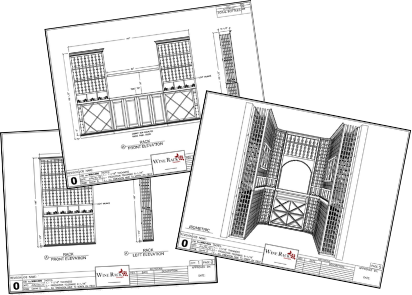
Free 2D wine cellar design