Affordable Wine Cellar Ideas: A Comprehensive Cost Breakdown

*Pictures are renderings. Actual wine racks may look different
*Pictures are renderings. Actual wine racks may look different
Could a professional wine sanctuary be more attainable than the six-figure price tags often suggest? Many collectors find themselves stalled by sticker shock from luxury builders or overwhelmed by the technicalities of climate control. It's a common fear that choosing an affordable path leads to subpar materials that won't protect your investment. However, a strategic wine cellar cost breakdown reveals that high-quality storage is often a matter of smart modularity rather than raw square footage. You can achieve a sophisticated result by focusing on essential infrastructure while scaling your aesthetic choices to fit your specific needs.
We understand that you want a space that feels curated and secure without hidden costs like vapor barriers causing budget overruns. This guide promises to provide a realistic roadmap for both DIY enthusiasts and those seeking a semi-custom build. We'll explore specific racking options like the Vintner and Carpenter series that fit mid-range budgets and explain where to prioritize cooling systems. You'll also learn about the durability of American-made metal doors and how they integrate with various storage components. By the end of this article, you'll have the clarity needed to transition from an initial vision to a professional, finished result.
Key Takeaways
- Learn how to categorize your project into DIY, semi-custom, or full-custom tiers to align with your specific financial goals.
- A detailed wine cellar cost breakdown helps you prioritize high-impact areas like climate control while finding savings in modular racking.
- Identify why investing in specialized insulation and durable metal wine cellar doors is a non-negotiable step for protecting your collection.
- Discover how modular options like the Vintner Series allow you to scale your storage over time through a strategic phase-building approach.
- Leverage a free professional design service to maximize every square inch of your space and avoid common budget overruns.
Understanding the Wine Cellar Cost Breakdown
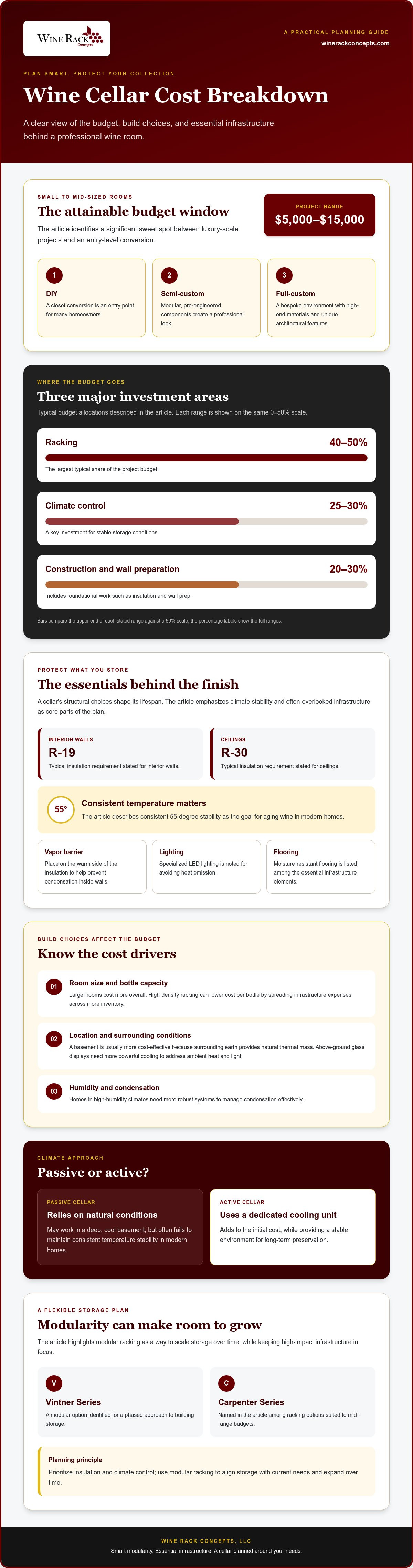
A professional wine room is often perceived as a luxury reserved for massive estates, but a transparent wine cellar cost breakdown reveals options for every scale. While many builders focus on six-figure projects, there is a significant sweet spot between $5,000 and $15,000 for small to mid-sized rooms. Most projects fall into one of three categories. A DIY closet conversion is the entry point for many homeowners. Semi-custom modular builds provide a professional look using pre-engineered components. Full-custom designer cellars offer a bespoke environment with high-end materials and unique architectural features.
Success depends on balancing your investment across three main areas. You'll typically allocate 40-50% of the budget to racking, 25-30% to climate control systems, and 20-30% to construction elements like insulation and wall prep. Investing in a custom wine cellar design is a strategic move that saves money. It prevents material waste and ensures technical compatibility from day one, which keeps your project on track and within your financial goals.
To better understand how these design choices impact your total investment, watch this helpful video:
Beyond the obvious components, you must account for infrastructure expenses that often go overlooked. This includes vapor barriers to prevent mold, specialized LED lighting that won't emit heat, and moisture-resistant flooring. These elements are essential for creating a stable environment. For a broader perspective on storage standards and historical context, you can refer to Wikipedia's overview of wine cellars.
The Baseline: What Influences the Bottom Line?
Size and bottle capacity significantly influence the final invoice. While larger rooms cost more overall, high-density racking often lowers the cost per bottle because infrastructure expenses are spread across more inventory. Location is another major variable. A basement build is usually more cost-effective because the surrounding earth provides natural thermal mass. Conversely, an above-ground glass display requires more powerful cooling to fight ambient heat and light. Local geography also matters; homes in high-humidity climates need more robust systems to manage condensation effectively.
Passive vs. Active Cellars: Budget Implications
A passive cellar relies solely on natural conditions. It might work in a deep, cool basement, but it often fails to maintain the consistent 55-degree stability required for aging in modern homes. An active cellar requires a dedicated cooling unit. While this adds to the initial wine cellar cost breakdown, it protects the thousands of dollars you've invested in your wine collection. Active Climate Control is the gold standard for long-term preservation, providing a stable environment that is also ideal for storing premium spirits from Whisky Fix alongside your wine.
While the aesthetic choices define the room's character, the structural choices define its lifespan. A precise wine cellar cost breakdown must prioritize the invisible infrastructure that keeps your bottles safe. For real estate investors, this systematic approach is similar to managing a portfolio; just as you might use REI Reply to handle business marketing and support, you must ensure your cellar's foundation is robust. If you cut corners on the foundation, you risk losing both your inventory and your investment in cooling equipment. Success requires a balance between functional protection and visual appeal.
Creating a climate-controlled environment requires much higher standards than a standard living space. You'll typically need R-19 insulation for interior walls and R-30 for ceilings to maintain a consistent 55-degree temperature. A vapor barrier is equally critical; it sits on the "warm" side of the insulation to prevent condensation from forming inside the walls. Without it, you face the dual threat of mold growth and cooling unit burnout from overwork. One way to streamline this is by using closed-cell spray foam; for high-performance insulation solutions, check out Third Coast Spray Foam. It serves as both high-grade insulation and a seamless vapor barrier in a single application, often saving on labor costs during the construction phase.
Modern designs often feature glass walls, but these come with what many builders call a "glass wall tax." Because glass has poor insulating properties, you'll need a significantly more powerful cooling unit to compensate for thermal loss. For the entry itself, specialized metal wine cellar doors are a superior choice over standard exterior doors. These are engineered with thermal breaks and high-grade gaskets to ensure an airtight seal. While wood doors offer a classic look, American-made metal options provide unmatched durability and a sleek, contemporary aesthetic that resists warping in humid environments. You can achieve a high-end look by using standard-sized doors rather than custom entries to keep the budget manageable.
Your choice of flooring and lighting further refines the budget. Sealed concrete is a highly affordable, moisture-resistant option that fits a modern industrial style. On the luxury end, reclaimed wine barrel flooring adds a rich, historical texture but increases the material cost significantly. For illumination, standard LED strips are budget-friendly, provided they don't emit UV rays or heat. UV-filtered display lighting is the premium choice for protecting rare labels from light damage. If you're unsure how to balance these variables, a professional design consultation can help you allocate your resources effectively.
Affordable Racking Series: Wood vs. Metal Options
Once your infrastructure is secure, the racking choice becomes the most visible part of your wine cellar cost breakdown. Selecting the right series allows you to balance aesthetics with bottle capacity effectively. Generally, wooden wine racks provide the lowest cost per bottle for high-density storage. Metal systems often command a higher price per bottle but excel in modern displays and tight spaces. Understanding these trade-offs helps you decide where to splurge on showpieces and where to save on bulk storage.
Modular Wood Racking: The Vintner and Classic Series
The Classic Series remains the entry-level choice for collectors prioritizing no-frills, high-density storage. It's designed for maximum efficiency in standard cellar layouts. For those who want more versatility, the Vintner Series is a premier modular solution. Its stackable modules allow for a phased budget approach; you can start with a few racks and add more as your collection grows. This "build-as-you-go" strategy is a core component of an affordable custom build. The Carpenter Series further bridges the gap between modular and custom. It provides a seamless, "built-in" look that mimics the work of a master carpenter at a fraction of the cost. To achieve a similarly polished look for your kitchen storage, check out Cabinet refinishing Denver for professional wood painting and restoration.
Material choice also dictates the final bill. Pine is the most economical option, while Redwood offers natural resistance to cellar humidity at a mid-range price. Mahogany represents the premium tier, valued for its durability and rich finish. While we emphasize quality, it's helpful to know that not all components are made in America, though our specialized doors and specific series maintain those high domestic standards.
If you prefer a contemporary aesthetic, metal wine racks offer a sleek alternative. The Wall Wine Rack series is particularly effective for small spaces or hallways. For minimalist under-stair conversions, the Wine Peg series creates a floating bottle effect that maximizes visibility. Those seeking a high-end look at a mid-range price point should consider Fusion Wine Walls, which combine metal and wood for a striking display.
When comparing costs, consider the orientation of the bottles. Cork-forward storage, typical of the Classic series, is almost always more affordable because it utilizes space more efficiently. Label-forward displays, common in the Wine Peg and Wall Series, require more hardware per bottle and increase the overall cost. However, the visual impact of a label-forward display often justifies the investment for showcase areas.
Climate Control and Infrastructure Expenses
Climate control is the technical heart of any storage project and represents a significant portion of your wine cellar cost breakdown. While racking provides the organization, the cooling system provides the protection. Choosing the right hardware depends on your room's location, your budget, and your tolerance for noise. There are three primary categories to consider: self-contained units, ducted systems, and split systems.
Self-Contained vs. Split Systems
Self-contained refrigeration units are the most affordable and DIY-friendly solution for residential cellars. These through-the-wall units house the evaporator and condenser in a single housing, which simplifies installation. You'll need to ensure the unit vents into a well-ventilated interior room that can handle the heat exhaust. For those seeking the quietest environment, split systems are the preferred choice. These systems separate the cooling coil from the condenser, allowing you to place the noisy components in a garage or outdoors. However, split systems carry hidden costs. You must hire a licensed HVAC technician to install the copper line sets and charge the system with refrigerant, which adds a layer of professional labor to your budget. Annual maintenance, including filter changes and coil cleanings, is necessary for both types to ensure peak efficiency.
Sizing Your Cooling Unit for ROI
Sizing your unit correctly is a pivotal part of your wine cellar cost breakdown. You must calculate the BTU requirements based on the total cubic volume of the room and the R-value of your insulation. If you choose an undersized unit to save on initial costs, the compressor will run continuously to fight the heat load. This results in spiked electricity bills and premature mechanical failure. Relying on passive storage to avoid these costs often leads to spoiled inventory, which is far more expensive than a proper unit. It's also vital to remember that wine cellar cooling units are different than standard AC because they manage humidity to preserve cork integrity, not just temperature.
Strategic Planning for an Affordable Custom Cellar
Constructing a professional-grade cellar is a methodical process that requires a clear wine cellar cost breakdown before the first nail is driven. The most successful affordable builds aren't defined by cheap materials. Instead, they rely on precise planning and modular growth. By focusing on the "Affordable Professional" approach, you can create a sanctuary for your collection that rivals high-end custom builds; for inspiration on world-class wine presentation and hospitality, check out Quob Park Estate, Hotel & Spa.
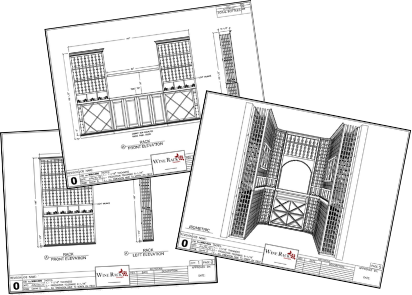
Utilizing a free design service is the most effective way to maximize every square inch of your available space. Professional CAD drawings eliminate "dead corners" that often lead to wasted storage and material. These drawings also serve a dual purpose by helping your contractors provide more accurate labor quotes. When a builder sees the exact dimensions and placement of every rack, they can bid the job with confidence rather than padding the price for unknowns. This allows you to incorporate standard-sized modules into layouts that feel entirely custom.
Phased Installation and Modular Growth
Many collectors utilize a "Phase Building" strategy to manage their cash flow while building a world-class cellar. You might design a room with a 1,000-bottle capacity but only install racks for 250 bottles initially. This modular growth often starts with the Wall Wine Rack series for immediate visual impact. You can then expand into floor-to-ceiling Vintner racks as your collection matures. For those looking to extend this level of craftsmanship to the rest of their home, NY Cabinets offers custom cabinetry solutions that perfectly complement high-end renovations. It is critical to plan the electrical and HVAC requirements for the final capacity during the first phase. Retrofitting a larger cooling unit later is significantly more expensive than installing the correct infrastructure from the start. While we emphasize quality, remember that not all components are made in America, though our specialized metal doors and modular wood series maintain high durability standards.
To keep your budget on track, you must distinguish between non-negotiables and optional upgrades. Always splurge on high-quality insulation, vapor barriers, and a reliable cooling unit. These elements protect your wine's chemistry and ensure long-term preservation. You can save on racking materials by choosing modular series in economical wood species or starting with basic cork-forward storage. Decor and specialized UV-filtered lighting can be added in later stages once the core environment is secure.
Beyond the technical build, understanding the culture of the bottles you store can enhance your enjoyment of the space; you can learn more about Wine Tours of Sedona to explore the vibrant wine scene in Northern Arizona and find inspiration for your own collection.
Building a world-class environment for your collection is achievable when you prioritize structural integrity over initial decorative flair. A strategic wine cellar cost breakdown emphasizes that investing in high-quality insulation and specialized cooling systems is the foundation of long-term preservation. By selecting modular racking series like the Vintner or Classic collections, you can scale your storage capacity alongside your growing inventory. This phased approach ensures that every dollar spent contributes directly to the protection and display of your bottles.
With over 15 years of design expertise and a commitment to American craftsmanship for our specialized doors and components, we understand how to balance technical needs with aesthetic goals. Our climate control experts are available to help you navigate the nuances of BTU requirements and vapor barriers. You don't have to manage these complex decisions alone.
We're here to bridge the gap between your initial inspiration and a finished, professional result. Take the first step toward a space that reflects your passion and rewards your curation.
Frequently Asked Questions
How much does a 500-bottle wine cellar cost on average?
A 500-bottle wine cellar typically falls into the entry-level closet or small room category. According to industry data, these projects often range between $25,000 and $60,000 depending on the complexity of the climate control and the choice of materials. High-density racking series like the Classic or Vintner options can help manage the cost-per-bottle. Your final investment will also depend on whether you choose a self-contained cooling unit or a more complex split system.
Can I build a wine cellar for under $5,000?
Building a wine sanctuary for under $5,000 is possible if you focus on small-scale DIY projects or passive storage. For this budget, you can typically accommodate 50 to 100 bottles using modular wooden wine racks or wall-mounted metal series. However, this price point usually excludes active climate control systems. If you require a conditioned environment, the costs for insulation, vapor barriers, and a dedicated cooling unit will likely push the total project budget higher.
What is the most expensive part of building a wine cellar?
The climate control system and the racking are generally the most significant financial components. A professional-grade cooling unit is a specialized mechanical investment that manages both temperature and humidity. Similarly, racking often accounts for 40% to 50% of a wine cellar cost breakdown. Other expensive variables include specialized glass walls, which require more powerful cooling units, and custom-made entries like high-durability metal wine cellar doors that ensure an airtight seal for your collection.
Do I really need a professional cooling system if my basement stays cool?
While a cool basement provides a helpful starting point, it rarely maintains the consistent 55-degree temperature and 60% humidity required for long-term aging. Passive cellars are susceptible to seasonal temperature swings that can cause wine to age prematurely. Professional wine cellar cooling systems are engineered specifically to handle these environments without stripping away essential moisture. Investing in active climate control is the only way to guarantee the protection of your inventory against fluctuating household conditions.
Is it cheaper to use wood or metal wine racks?
Wooden wine racks are generally the most cost-effective choice for high-density storage. Series like the Vintner or Classic modules offer a lower cost-per-bottle because they utilize space efficiently. Metal wine racks and wine peg series often have a higher price per bottle but provide a modern, minimalist aesthetic. If your goal is to maximize capacity within a specific budget, modular wood systems are the superior option. Metal is ideal for decorative showpieces or small wall displays.
What is the average labor cost for wine cellar installation?
Labor costs typically represent 20% to 30% of the total project budget. This includes specialized tasks such as installing vapor barriers, high-R-value insulation, and the racking itself. If you select a split cooling system, you must also factor in the cost of a licensed HVAC technician to install line sets and charge the system. Using a professional design service can help reduce labor expenses by providing contractors with precise CAD drawings that eliminate guesswork during a wine cellar cost breakdown.
Can I use a standard exterior door for my wine cellar?
You should avoid using standard exterior doors for a conditioned wine room. These doors are not designed to handle the 30-degree temperature differential between a cellar and the rest of the home. Specialized metal wine cellar doors feature thermal breaks and high-grade gaskets that prevent air leaks. A standard door will likely warp over time due to the high humidity inside the cellar. This leads to cooling unit burnout as the system struggles to maintain the set point.
How long does it take to build a custom wine cellar?
A professional wine cellar build generally takes between 8 and 16 weeks from the initial design phase to final completion. This timeline accounts for the manufacturing of custom or modular racking series and the necessary site preparation. Construction phases include installing the vapor barrier, insulation, and cooling infrastructure before the final racking installation. While modular series like the Vintner racks can sometimes be shipped faster, the structural requirements of a conditioned space require a steady, methodical pace.
Have an expert help today!
Free 2D wine cellar design