The Ultimate Guide to Wall Mounted Wine Racks: Design, Safety, and Style

If you view your wine collection as a living gallery, why settle for a storage solution that feels like an afterthought? A professional-grade wall mounted wine rack is a structural architectural element that demands as much engineering precision as it does aesthetic flair. You likely want a display that commands attention, yet the underlying worry about racks pulling away from the drywall or bottles being stored at the wrong angle can make the selection process feel overwhelming.
It's natural to feel torn between the timeless warmth of wood and the minimalist edge of metal, especially when the safety of your investment is on the line. We're here to help you bridge the gap between your initial vision and a finished, professional result. You'll discover how to maximize your storage capacity in a limited footprint while ensuring every bottle is positioned for optimal preservation and accessibility.
This guide provides a clear path through the technical requirements of secure installation and the latest trends in label-forward design. We'll examine how to choose materials that harmonize with your decor and why anchoring your system into wall studs or masonry is the only way to achieve true peace of mind. This overview will lead you from initial inspiration to a clear, actionable plan for your space.
Key Takeaways
- Learn how to select a wall mounted wine rack that functions as a structural architectural element while maximizing storage capacity in a limited footprint.
- Understand the aesthetic and functional differences between classic wood series and modern metal systems like minimalist wine pegs to best suit your home's decor.
- Master the physics of secure installation by calculating the cumulative weight of your collection and anchoring hardware directly into wall studs or masonry.
- Discover how to balance visual symmetry with essential environmental factors like UV protection and heat management to ensure long-term wine preservation.
- Recognize the value of quality craftsmanship and custom design services in transforming an initial vision into a professional-grade, secure wine display.
Beyond Storage: Why Wall Mounted Wine Racks are the Modern Standard
A wall mounted wine rack is a specialized hardware system designed to secure bottles directly to vertical surfaces. It represents a significant shift in how we approach both interior design and the hobby of collecting. For decades, wine was relegated to dark, hidden cellars or cramped kitchen cupboards. Today, the "Wine Wall" trend has successfully moved these collections into the social heart of the home, establishing them as a sophisticated centerpiece of modern living rooms and kitchens.
Proper storage is as much about science as it is about style. Wall systems ensure that bottles are kept at the correct orientation to maintain cork moisture. When the cork stays wet, it stays expanded, creating an airtight seal that protects the wine from premature oxidation. For those seeking a broader context on how these systems have developed over time, this encyclopedic overview of wine racks provides a helpful look at the materials and mechanical designs used across the industry to protect valuable vintages.
The Aesthetic Evolution of Wine Display
Wine storage has transitioned from a utilitarian necessity to a high-visibility architectural feature. Modern designers now treat a wine collection as a form of functional art, using the labels and glass textures to add depth and color to dining areas. This evolution isn't just about showing off; it's about the joy of curation. There is a powerful psychological appeal in seeing your collection daily. It serves as a visual record of past celebrations and future possibilities, making the act of selecting a bottle a more immersive and rewarding experience for the owner.
Maximizing Capacity in Small Footprints
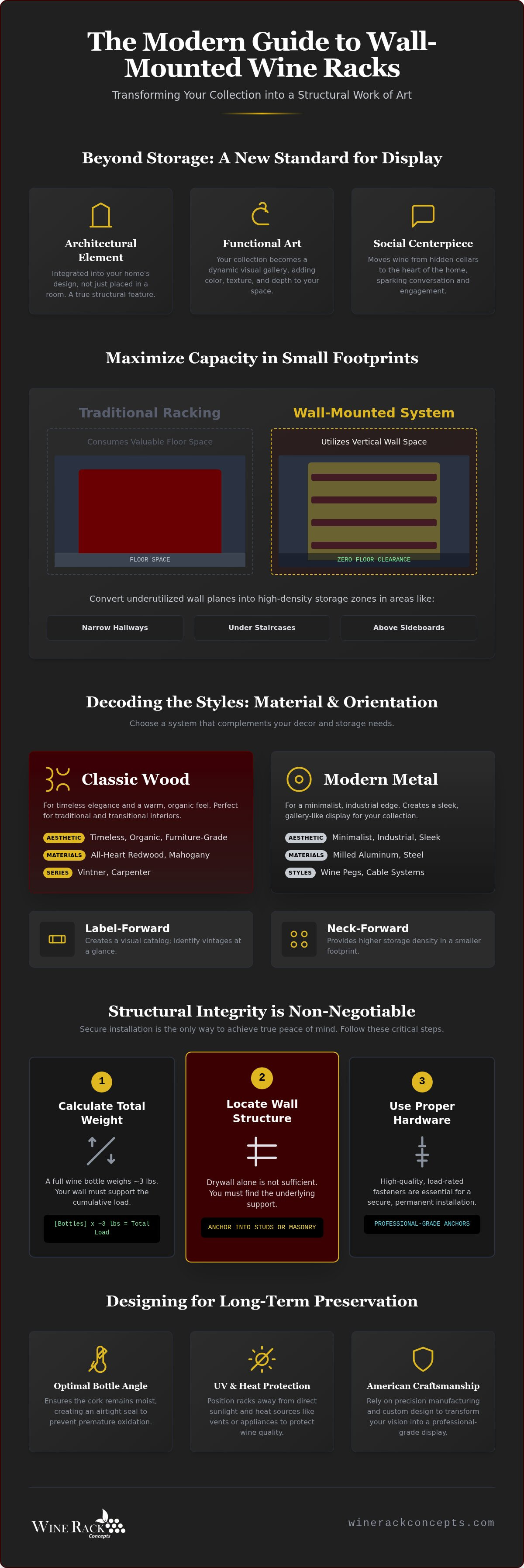
Footprint challenges are a reality for many urban dwellers, but vertical storage offers a sophisticated solution that traditional furniture cannot match. When you compare bottle density, a wall mounted wine rack often outperforms floor racking by utilizing height instead of depth. You can easily turn dead space into a functional cellar without obstructing walkways. Consider these common areas for a professional installation:
- Narrow hallways that cannot accommodate standing furniture.
- The triangular void frequently found under a staircase.
- The vertical space above a kitchen sideboard or wet bar.
Vertical racking maximizes volumetric efficiency by converting underutilized wall planes into high-density storage zones that require zero floor clearance. This approach allows you to scale your collection significantly without feeling crowded by bulky furniture or losing the open feel of your home.
Decoding the Styles: From Classic Wood to Minimalist Metal Pegs
Choosing the right materials for a wall mounted wine rack often feels like a choice between two worlds: the organic warmth of wood or the sharp, industrial edge of metal. While some designers argue these styles are mutually exclusive, a sophisticated display can actually bridge this gap by combining textures. If you prioritize a cozy, traditional atmosphere, wood remains the gold standard. If you lean toward a gallery-like, minimalist aesthetic, metal systems offer the sleek profiles you need. Wine Rack Concepts, LLC's Wall Wine Rack Series is specifically designed to provide these options without sacrificing the structural integrity required to support a growing collection.
Beyond material choice, you must consider bottle orientation. A label-forward design turns your collection into a visual catalog, allowing you to identify vintages at a glance. Conversely, neck-forward storage provides higher density, which is ideal if you have a larger inventory in a smaller footprint. Regardless of the style you select, durability is paramount. Quality components, such as those manufactured with precision in the USA, ensure that the hardware can withstand the constant weight of glass and liquid. When planning your layout, it's helpful to consult expert advice on proper installation and structural integrity to ensure your chosen style is backed by secure engineering.
Traditional Elegance with the Vintner and Carpenter Series
These series represent the timeless appeal of handcrafted wood racking. If you prefer the rich grains of All-Heart Redwood or the durability of Mahogany, these racks provide a furniture-grade finish that ages beautifully. You can customize your display with various stains to match your existing cabinetry. Because these systems are modular, you can start with a modest display and add new sections as your collection expands, ensuring your storage always feels intentional rather than cluttered.
Modern Innovation: Fusion Wine Walls and Metal Systems
The Fusion series offers a high-contrast look by mounting metal hardware onto wooden backer boards. This hybrid approach allows you to maintain the warmth of timber while enjoying the minimalist floating effect of sleek metal rails. These systems are particularly effective in high-traffic areas because the powder-coated finishes resist scratches and wear. If you're looking for a way to blend these different textures into a cohesive design, you might consider browsing Wine Rack Concepts, LLC's Wall Wine Rack Series to find a configuration that fits your specific architectural needs.
The Wine Peg Series: Ultimate Minimalism
For those who want total design freedom, the Wine Peg Series is the premier choice. You can install stainless steel or aluminum pegs in custom configurations, creating geometric patterns that reflect your personal style. These pegs allow you to adjust spacing for magnums or standard bottles effortlessly. By moving away from fixed grids, you can treat your wall as a blank canvas, resulting in a unique bottle configuration that feels more like a sculpture than a storage unit.
Structural Integrity: Safely Mounting Your Wine Collection
Every professional display begins with a basic understanding of physics. A standard 750ml bottle of wine weighs approximately 3 pounds. While a single bottle seems light, the cumulative weight of a 50-bottle or 100-bottle collection creates a massive static load. If you're planning a large-scale wall mounted wine rack installation, you're asking your vertical surface to support between 150 and 300 pounds of constant tension. This is why structural backing is the most critical element of your project; drywall alone lacks the shear strength to hold this weight and will eventually fail under the stress.
Securing your collection requires specialized hardware that goes beyond standard household screws. For the most secure fit, we recommend direct-to-stud screws that penetrate at least two inches into the wooden framing of your home. If a stud isn't perfectly positioned for your design, heavy-duty toggle bolts can provide additional support, but they should never be the primary load-bearing solution for high-capacity systems. Beyond the physical strength of the wall, you must also account for environmental factors like Layout, Lighting, and Climate to ensure the wine itself remains as stable as the hardware holding it.
Mounting Strategies for Different Wall Types
Successful installation depends on matching your hardware to your substrate. If you're working with standard drywall, use a stud finder to locate the 16-inch centers and plan your rack placement accordingly. In cases where the rack dimensions don't align with your studs, installing a wooden backer board or reinforcement plate allows you to distribute the weight across multiple studs safely. For masonry or brick walls, specialized sleeve anchors or Tapcon screws are necessary to create a permanent, vibration-free bond with the stone.
Professional Installation vs. DIY
A small, 12-bottle wall mounted wine rack is often a manageable weekend project for a confident DIYer. However, if your vision involves floor-to-ceiling displays or commercial-grade density, calling a professional installer is a wise investment in your home's safety. A professional will ensure the system is perfectly level; even a slight tilt can put uneven pressure on anchors, leading to hardware failure. Poorly anchored wall racks often suffer from "creep," which is the gradual, microscopic movement of mounting hardware as it pulls through the wall material under the relentless stress of gravity. A safety checklist should always include anchoring, leveling, and checking for nearby vibrations from appliances that could loosen hardware over time.
Designing Your Display: Layout, Lighting, and Climate
Designing a wine wall is about balancing visual impact with environmental stewardship. A well-placed wall mounted wine rack serves as a room's anchor, using symmetry and scale to draw the eye toward your collection. You should consider the flow of the room, ensuring that your most frequently accessed bottles are at eye level while long-term vintages are tucked into higher or lower tiers. This intentional layout simplifies inventory management and prevents unnecessary handling of delicate bottles. If you have a large collection, scaling the display to the full height of the ceiling can create a dramatic, library-like effect that feels integrated into the home's architecture.
Planning for accessibility means more than just reaching a bottle. It involves creating a system where you can rotate your stock without disturbing the sediment in aging wines. For example, placing your daily-drinking bottles within easy reach while reserving the top-most pegs for special occasion magnums creates a logical hierarchy. This methodical approach ensures that your display remains a functional tool for your lifestyle, rather than just a static piece of decor. If you are ready to explore how these layout factors fit into your specific floor plan, you can request a custom wine cellar design to ensure your collection is both beautiful and protected.
Lighting Your Collection Safely
Lighting is the most common area where aesthetics and preservation clash. While standard bulbs emit high levels of heat and UV radiation that can "light strike" a wine, LED systems are the only viable choice for a wine display because they emit negligible heat. If you want to create depth, backlighting the bottles creates a soft glow that emphasizes the glass's texture, while spotlighting highlights specific labels. We recommend using smart dimmers to limit light exposure. Even low-heat LEDs can affect wine quality if they're left on at full intensity for extended periods, so setting a timer or using motion sensors is a wise precaution for any high-end display.
Climate Control for Open Wall Displays
The challenge of passive storage lies in the inconsistency of residential HVAC systems. While your living room might feel comfortable at 72 degrees, this is often too warm for long-term aging. If you plan to store high-value bottles for several years, integrating a dedicated cooling system becomes a necessity. Self-contained refrigeration units are designed to manage the specific humidity and temperature requirements of a cellar without the complex ductwork of a central system. When these units are paired with glass enclosures, a proper vapor barrier is essential to prevent moisture from seeping into your home's framing and to maintain the precise 55-degree environment your wine requires.
The Wine Rack Concepts Advantage: Custom Quality Craftsmanship
Choosing a wall mounted wine rack is an investment in your home's character and the future of your collection. While the market is often saturated with mass-produced imports, Wine Rack Concepts, LLC maintains a standard of precision that only domestic manufacturing can provide. Our systems are engineered to endure; we build our racking to last as long as the vintages you curate. By focusing on structural integrity and premium materials, we ensure your display functions as a permanent architectural feature rather than a temporary fixture.
A professional-grade display often requires a holistic approach to succeed. Wine Rack Concepts, LLC offers comprehensive solutions that extend beyond racking, including metal wine cellar doors and self contained refrigeration units. This allows you to source a cohesive system from a single knowledgeable partner, eliminating the frustration of coordinating multiple vendors. If you require a complete environment, having every element designed to work in harmony is the most effective way to protect your investment.
Starting Your Project with Confidence
Moving from a preliminary vision to a finished result is a collaborative journey that requires expert guidance. Wine Rack Concepts, LLC acts as a helpful partner throughout this process, offering consultative design services to help you navigate the various series available. Whether you're selecting the high-contrast look of Fusion Wine Walls or the minimalist freedom of the Wine Peg Series, we help you choose the system that best fits your specific architecture. Our goal is to simplify complex decisions, providing you with a clear, actionable plan for your space.
Transforming Your Vision into a Structural Masterpiece
Designing a professional wine display is a process that balances engineering precision with artistic expression. You've discovered how a wall mounted wine rack can reclaim underutilized vertical space while serving as a sophisticated focal point in your home's social heart. Success depends on harmonizing these elements, from calculating the structural load requirements of your collection to implementing the lighting and climate controls that protect your investment. Whether you prefer the organic warmth of handcrafted wood or the minimalist edge of our specialized Wine Peg and Fusion series, your storage solution should be as enduring as the vintages it holds.
Our team in Cincinnati, Ohio, is dedicated to providing the high-quality components and expert design consultation needed to bring your project to life. We're here to act as your knowledgeable partner, bridging the gap between your initial inspiration and a finished, professional result. You can move forward with the confidence that your collection is supported by master craftsmanship and thoughtful design.
Browse our Professional Wall Mounted Wine Rack Collections and begin the rewarding process of curating a display that truly reflects your passion.
Frequently Asked Questions
How much weight can a wall-mounted wine rack actually hold?
A professional wall mounted wine rack is engineered to support the cumulative weight of your collection, which averages about three pounds per 750ml bottle. While individual series vary, a high-density system can safely hold hundreds of pounds if properly anchored. You should always check the specific load-bearing capacity of your chosen series, such as our Wine Peg Series, to ensure it matches your collection's volume and the structural limits of your wall substrate.
Do I need to hit a stud to install a wall-mounted wine rack?
Mounting directly into a wall stud is the only way to ensure the long-term safety and stability of a large wine display. While heavy-duty toggle bolts can support smaller, decorative racks, they lack the shear strength required for high-capacity systems. For any display exceeding a few bottles, you must anchor the hardware into wooden studs or solid masonry to prevent the rack from pulling away from the wall over time.
Is it better to store wine label-forward or neck-forward on a wall rack?
Selecting an orientation depends on whether you prioritize visual impact or storage density. A label-forward design turns your collection into a gallery, allowing you to browse vintages without handling the bottles. Neck-forward storage is the traditional choice for maximizing bottle counts in a narrow footprint. Many collectors use our Wall Wine Rack Series to combine both styles, placing rare bottles label-forward while stocking daily drinkers in high-density sections.
Can I install a wall-mounted wine rack in a kitchen or near a window?
You can install a rack in a kitchen, provided it's placed away from heat sources like ovens or dishwashers. However, you should never install a wine display near a window or in direct sunlight. Constant UV exposure and temperature fluctuations can light strike the wine and degrade its organic compounds. If your only available space is near a light source, consider using UV-filtering glass or blackout shades to protect your collection.
What is the difference between the Fusion series and standard metal racks?
The Fusion Wine Walls series differs from standard metal racks by integrating high-quality wooden backer boards with sleek metal hardware. This hybrid design provides a sophisticated, high-contrast look that bridges the gap between traditional and modern aesthetics. Unlike basic metal rails, the Fusion series offers enhanced structural support and a furniture-grade finish that feels like a custom architectural feature rather than a utilitarian storage tool.
How do I clean and maintain metal wine pegs and rails?
Maintenance for metal wine pegs and rails is simple and requires only a soft, lint-free cloth for regular dusting. If the metal requires a deeper clean, you can use a slightly damp cloth with mild soap; however, you must dry the hardware immediately to prevent water spots. Avoid using abrasive cleaners or harsh chemicals, as these can damage the powder-coated or anodized finishes that protect the metal from corrosion in humid cellar environments.
Should I choose wood or metal for my wall-mounted wine display?
Choosing between wood and metal is primarily a matter of your home's existing architecture and your personal design preference. Wood series like our Vintner or Classic collections offer a timeless, warm atmosphere that complements traditional decor and provides a furniture-grade feel. Metal systems, including our minimalist Wine Peg Series, are ideal for contemporary spaces where you want the bottles to appear as if they are floating against the wall.
Can wall-mounted racks be used in a temperature-controlled wine cellar?
Wall-mounted racks are perfectly suited for temperature-controlled wine cellars and are frequently used in professional, climate-managed environments. Our quality components are finished to withstand the higher humidity levels required for long-term wine preservation. If you're planning a refrigerated space, these racks can be paired with our self contained refrigeration units and metal wine cellar doors to create a fully optimized, professional-grade storage solution.
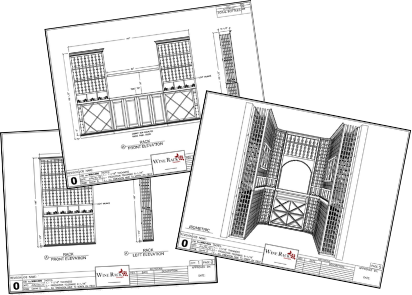
Have an expert help today!
Free 2D wine cellar design